
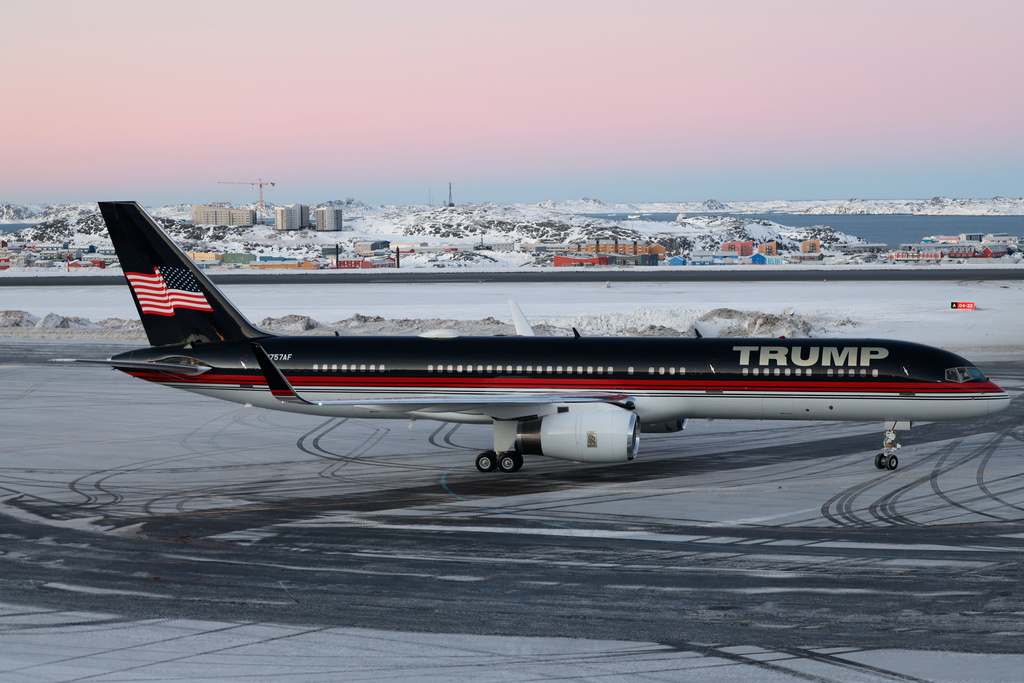
Questions are mounting over President Donald Trump�s claims that he has reached a new �framework� with European leaders regarding Greenland, as senior media analysts and European officials suggest the arrangement under discussion may largely reflect agreements and authorities that already exist.
Speaking at the World Economic Forum in Davos, Trump reiterated his push for expanded U.S. control over Greenland, citing national security concerns and publicly calling for �right, title, and ownership� of the territory. His comments followed weeks of pressure on Denmark to cede greater authority over the island.
Greenland is already covered by a 1951 defense treaty that permits the United States to expand its military presence on the island. The U.S. currently maintains a military base there, and the treaty framework has long governed American strategic access in the Arctic.
After his Davos remarks, Trump said he and European leaders had reached a �framework� and a �concept of a deal� concerning Greenland. While no details were released, some conservative commentators hailed the development as a historic diplomatic breakthrough.
However, CNN political analyst Maggie Haberman cast doubt on whether the reported agreement represents any substantive change.
Appearing on CNN�s AC360, Haberman said available information suggests the deal may simply formalize or restate existing arrangements among the United States, Denmark and Greenland.
�As of now, based on what they�re talking about, it looks as if they�re talking about something that is already in existence,� Haberman said.
CNN anchor Anderson Cooper pressed Haberman on whether the United States is gaining anything new from Denmark.
�So, Maggie, is it clear to you what, if anything, President Trump is getting from Denmark in Greenland that the U.S. doesn�t already have de facto control over?� Cooper asked.
�No,� Haberman replied. �And look, Anderson, we don�t know the answers to these questions. There�s a lot left unsaid. The president didn�t answer this.�
Haberman noted that the United States once maintained a larger military footprint in Greenland during the Cold War, and that current discussions may reflect a return to earlier levels of strategic engagement rather than a fundamentally new agreement.
�In fact, the U.S. used to have a greater military presence in Greenland,� she said. �It got scaled back after the Cold War.�
Haberman also pointed to Trump�s broader remarks at Davos, where he criticized NATO and questioned whether the alliance would come to the defense of the United States. She noted that NATO�s collective defense clause � Article 5 � has been formally invoked only once, following the Sept. 11 terror attacks.
�Article 5 was invoked once, and it was after 9/11,� Haberman said. �And someone who is from New York, it�s surprising that they don�t recall that.�
She characterized Trump�s approach as highly transactional and said European leaders remain deeply uneasy.
�He is speaking about this completely in transactional terms,� Haberman said. �And you can see that this is not over.�
Haberman added that while NATO Secretary-General Mark Rutte has been attempting to calm tensions, concerns in Europe � particularly in Denmark � have been building for weeks.
�I understand that Mark Rutte is trying to calm things down,� she said, �but European leaders are still very alarmed. And leaders in Denmark have been very alarmed for weeks and weeks now before this really became much more public.�
(YWN World Headquarters – NYC)
 Join the official YWN WhatsApp status




One Response
Why should Trump spend time making a “deal”, since the one from President Truman is exactly what he wants. It could be Trump is challenged when it comes to history. He really annoyed the Brits and Canadians (and Danes) be forgetting that they were in the thick of fighting in Afghanistan and has per capita casualties at the same level as the United States. He also confuses Iceland (an independent republic with an almost all European population descended from the Vikings) with Greenland (part of Denmark which is largely covered with ice and has an all indigenous population). How much longer until MAGA is saying what a good idea it would for Vance to become president in January 2027.