Iran has warned the US that it would respond forcefully to any major Israeli offensive against the Ali al-Taher ridge in southern Lebanon, where Iranian operatives are trapped alongside Hezbollah terrorists, Reuters reported on Thursday.
According to three regional officials who spoke on condition of anonymity, Tehran warned Washington that a full-scale Israeli assault on the ridge would trigger a large-scale Iranian attack.
Two officials said Iran’s warning was delivered through Oman, which has served as a mediator between Tehran and Washington. A third official said that the message was delivered around mid-August and that U.S. pressure prompted Israel to postpone plans to raid Ali al-Taher.
Those officials, who were briefed by Tehran, said more than a dozen members of Iran’s Islamic Revolutionary Guard Corps, including at least two senior officers, are inside the ridge alongside Hezbollah terrorists.
Hezbollah’s media office neither confirmed nor denied that Iran had delivered the warning, but said it was a “natural conclusion” that Tehran would have issued such a message.
“Iran considers any Israeli move on the ground in southern Lebanon, especially territorial expansion, a major violation of the Islamabad Agreement,” Hezbollah’s media office said, referring to the June U.S.-Iran memorandum of understanding that included a ceasefire in Lebanon.
The warning highlights Iran’s direct involvement in Hezbollah terror activities against Israel. Iran previously fired missiles toward Israel in early June in retaliation for Israeli attacks on Hezbollah near Beirut.
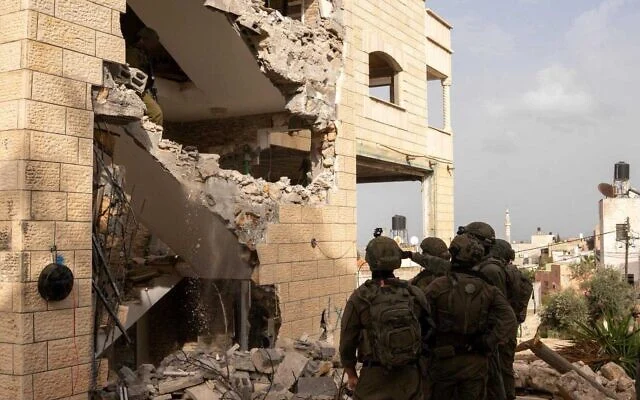
The battle over the strategic Ali al-Taher Ridge in Lebanon has emerged as one of the key flashpoints of the Third Lebanon War, with dozens of Hezbollah terrorists and Iranian advisers trapped inside a massive underground network as quiet diplomatic efforts continue to seek a way out of the standoff.
Most of the Iranian advisers are officers in the Islamic Revolutionary Guard Corps. They are trapped in the underground system in the “Bader” area, which overlooks the Nabatieh plateau and strategic transportation routes. The IDF currently controls large areas south of Ali al-Taher and has publicly described the ridge as one of its “primary operational focuses.”
Ynet reported last month that the presence of Iranian officers underground is forcing the IDF to proceed with caution. A bloody confrontation inside the tunnels could trigger a major escalation and reignite the front with Iran and the Gulf. The sides have maintained a low media profile while secret diplomatic contacts are being conducted with American mediation.
Lebanon is demanding that the Lebanese Armed Forces take control of the ridge and ‘demilitarize’ it, while Hezbollah is seeking an arrangement that would allow its terrorists to withdraw with their weapons while avoiding images of a humiliating retreat.
Despite the ceasefire announced in June, the IDF says Hezbollah continues to operate around Ali al-Taher and has twice launched explosive drones toward Israeli troops near the ridge over the past week.
One of the officials with direct knowledge of Iran’s warning said the IDF has been attempting to force both Hezbollah and IRGC personnel out by maintaining a siege and intercepting attempted drone deliveries of food and water.
“What we have seen over the past month is Israeli pressure to besiege Ali al-Taher in order to impose a reality within this facility that renders it uninhabitable,” Hezbollah’s media office said.
“This approach, and the absence of a large-scale attack, means that it is possible a message was conveyed through several countries—this is a natural conclusion.”
Hezbollah has warned that any large-scale Israeli assault on the ridge would mark a return to full-scale war and could result in missile attacks on communities in northern Israel.
(YWN Israel Desk—Jerusalem)