
Captivity survivors and now husband and wife, Sasha Trufanov and Sapir Cohen, spoke about the place that emunah came to occupy in their lives following October 7 and during their captivity in Gaza, in the first episode of “Thirsty Souls,” hosted by Eden Harel on Channel 14.
Trufanov, who was abducted from Kibbutz Nir Oz and held captive for 498 days, said that he entered October 7 as a secular person. When the life upon which he had built his future was taken from him in an instant, he discovered that he lacked the tools to cope with his new reality.
“When I found myself in the situation of October 7,” he said, “I didn’t have the tools to cope with that challenge. I arrived in Khan Younis with gunshot wounds in my legs, a stab wound in my shoulder, and a bleeding head. I was in terrible physical condition. But davka there, in the worst physical condition, is what led me to clarify my thinking—the understanding that I can’t control my fate—but only how I cope—that was the game changer.”
One of the difficult moments he described occurred after months in captivity. He said that after “the inferno in Khan Younis,” where he faced death on an almost daily basis, he was transferred to Rafah and placed inside a small wooden cage, surrounded by armed, masked terrorists who threatened him with knives and guns.
It was specifically there, he said, that something began to change within him. “I made a switch in my head, and the terrorists didn’t scare me as much anymore, and the thoughts of the future stopped plaguing me. “If Hashem gives me life, then I’ve been fortunate,” he recalled telling himself. “If not, that is your lot. You had 27 good years and a few bad months. All in all, it’s okay.”
Sapir said that before October 7, their relationship had been in a complicated place, and she had asked Hakadosh Baruch Hu for a sign as to whether Sasha was the man with whom she was meant to build her life.
Then Sasha returned from captivity.
She said that one of the first things he said to his mother was: “Ima, I know that there is a G-d.”
“It was literally among the first things he said,” Sapir recalled. “I said, ‘Wow.’ I sat there and… I just couldn’t believe it. I couldn’t believe it was happening.”
Sasha’s mother later told her son that she herself had become religious. Sapir feared how he would react, but she said Sasha replied to his mother: “Ima, I’m happy. I’m happy to hear that—you’re on the right path.”
Sasha’s mother, Yelena, previously said that while her son was being held in Gaza, she, her mother, and Sapir took upon themselves Shemiras Shabbos and additional mitzvos for the sake of his release. After his return, she said that Sasha had understood in captivity that his life was not in his own hands, but “only in the hands of Hakadosh Baruch Hu.”
Sapir, who was released after 55 days in captivity, also spoke on “Thirsty Souls” about the place that tefillah came to occupy in her life. She said that even before October 7, she had begun davening because of feelings of dread she began experiencing. During captivity, she continued davening daily and repeatedly recited a perek of Tehillim.
“I didn’t even ask to be released the next day,” she said. “I asked to be released at the time that was right for me.”
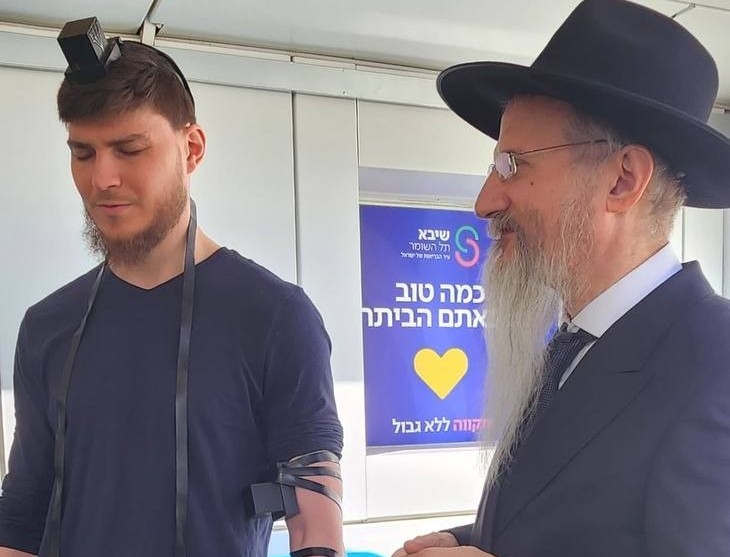
Sasha’s connection to emunah continued after his release, including visits with HaGaon HaRav Yitzchak Zilberstein and Russia’s chief rabbi, HaRav Berel Lazar, during which he donned tefillin for the first time in his life. He later visited the Kosel together with Sapir to thank Hashem for their release.
During the visit to the Kosel, Sasha said that after the period he had spent “in Gaza’s tunnels of darkness,” he felt the kedusha of the site and learned of the many tefillos that had been said on his behalf.
He now says that alongside his personal aspirations, he also wants to preserve what he learned during the period that changed his life.
“I have many dreams,” he said. “Some are practical, such as starting a family, developing myself, and becoming someone meaningful in this world. Others are more personal, such as developing myself and my soul and preserving what I learned.”
“I also genuinely have tremendous emunah that everything will be all right in the end,” he added. “As long as I do my part, everything will work out.”
(YWN Israel Desk—Jerusalem)





2 Responses
involvement of Russia’s chief rabbi seems highly inappropriate as Sasha probably encountered hamas members trained and supplied by russians.
Sasha still having his Russian name seems highly inappropriate as Sasha probably encountered Hamas members trained and supplied by Russians.