
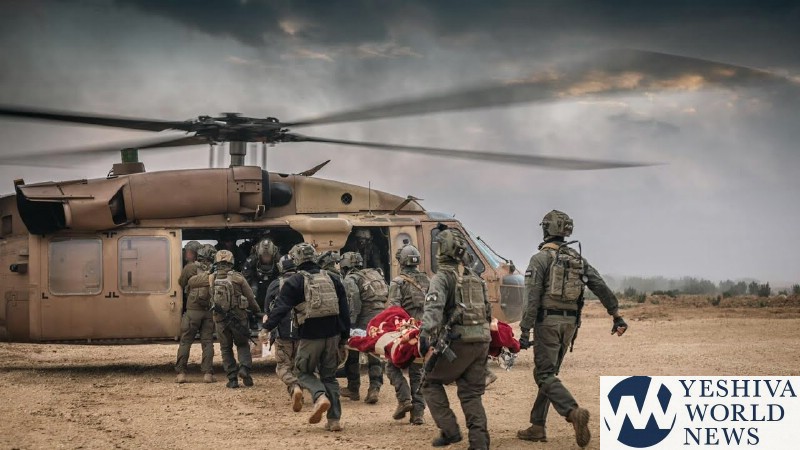
Advances in Israeli battlefield medicine are helping shape American military preparations, as the IDF reports that its casualty fatality rate fell from 15% during the 2006 Second Lebanon War to 7.1% in the war that began in October 2023.
Faster treatment, rapid helicopter evacuations, blood transfusions near the point of injury and improved sharing of patient information are among the developments credited with helping save soldiers’ lives.
A senior IDF battlefield medicine expert said advanced lifesaving treatment took approximately 15 to 20 minutes to reach a wounded soldier during the 2006 war against Hezbollah. Today, that treatment can begin immediately or within four minutes, he said.
Placing medical personnel close to combat forces, including a physician in each company, allows critical decisions to be made earlier in the treatment process. Rapid evacuation to hospitals in Israel provides another essential advantage.
The IDF said its Medical Corps adapted throughout the war, improving casualty evacuation, introducing medical technologies and treating wounded troops under fire in difficult terrain.
Another major focus has been controlling bleeding and providing blood products as early as possible. The expert said the IDF began emphasizing specialized bleeding-control products in 2013 and introduced plasma at the point of injury in place of saline.
Medical teams now carry blood units in coolers on their backs, allowing transfusions to begin closer to where soldiers are wounded. The expert credited the approach with saving a significant number of lives.
The military has also developed a system that allows medical personnel throughout the treatment chain to access patient information over technological networks. That helps successive caregivers see a wounded soldier’s condition and treatment history as care moves from the battlefield toward the hospital.
The expert identified the casualty fatality rate as a central measure of battlefield medical performance, citing the decline from 15% in 2006 to 7.1% in the current war.
He also noted that Israel’s approach drew on a 2012 American study examining battlefield deaths between 2001 and 2011, demonstrating the longstanding exchange of medical knowledge between the two militaries.
A 78-page U.S. Army report published in April 2026 examined Israeli military medical lessons from the war and urged American forces to prepare by applying those findings.
The report highlighted forward-deployed medical teams, biological surveillance and strict food-safety procedures among the measures Israel used to reduce health threats and maintain operational readiness.
It also warned that Israel had been required to make difficult adjustments while fighting—changes the United States could prepare for in advance.
“The time to prepare is now,” the report stated, stressing that clinical and tactical skills alone are insufficient.
Dr. Marc Siegel said Israeli advances in battlefield treatment, including surgical techniques and burn care, could benefit patients and medical practice worldwide.
An IDF spokesman described the American study as a mutual collaboration, saying U.S. officers had traveled to learn directly from Israeli military medical personnel.
(YWN World Headquarters – NYC)


