
Home › Forums › Decaffeinated Coffee › A Sukkah’la lyrics
- This topic has 42 replies, 11 voices, and was last updated 2 years, 11 months ago by Always_Ask_Questions.
-
AuthorPosts
-
September 25, 2017 12:54 am at 12:54 am #1368406mitzvahcardParticipant
I heard that there is a new poster out this year with the lyrics for the classic A Sukkah’la.
Does anyone know the authoritative words to the song?
September 25, 2017 7:10 am at 7:10 am #1368489? DaasYochid ?Participant? ????’?? ? ??????
??? ???????? ???????
??? ??? ??? ? ????’?? ??????
???????? ??? ???
??? ?? ?????? ???
??? ??? ??? ??? ????’?? ??????? ???? ? ??????
????? ???? ?? ??????
??? ?? ????????
??? ???? ??? ???
?? ??? ??? ? ?????
??? ??? ??? ??? ?????
??? ?? ???????? ??? ?????? ???? ??????? ????? ??????
??? ? ????? ??????
?????? ??? ???? ???????? ?????
?? ????? ??? ?????
??? ???? ??? ????
?????? ?? ???? ???? ???? ??????? ???? ???? ???
??? ???? ???? ???
??? ??? ?? ???? ??? ??? ????
?? ??? ???? ???
???? ????? ?????? ???
??? ?? ????’?? ?? ????? ??? ???? ????September 25, 2017 9:48 am at 9:48 am #1368562mitzvahcardParticipantWhat is the source of this version?
September 25, 2017 11:26 am at 11:26 am #1368618? DaasYochid ?ParticipantThe back of the Rabbis’ Sons record called Hallelu.
September 25, 2017 2:30 pm at 2:30 pm #1368819mitzvahcardParticipantWow! You typed out the whole thing?
September 25, 2017 4:37 pm at 4:37 pm #1369152Ex-CTLawyerParticipant@DY……….
now I know we are contemporaries. Down in my basement are all those Rabbi’s Sons albums bought when I was a very new teenagerSeptember 25, 2017 4:48 pm at 4:48 pm #1369222JosephParticipantNever woulda thunk DY is in the grandpa age parsha…
September 25, 2017 5:25 pm at 5:25 pm #1369403? DaasYochid ?ParticipantWow! You typed out the whole thing?
Yes, and fixed one typo. They actually sing it a bit differently than that.
September 25, 2017 5:27 pm at 5:27 pm #1369536? DaasYochid ?ParticipantNever woulda thunk DY is in the grandpa age parsha…
https://www.theyeshivaworld.com/coffeeroom/topic/how-to-deal-with-a-request-for-a-shidduch-picture
September 25, 2017 5:37 pm at 5:37 pm #1369652mitzvahcardParticipantSo now the question is – are the Rabbi’s Sons lyrics authoritative?
I have heard many versions.
Did you see the new poster?
Do the lyrics match?September 25, 2017 5:56 pm at 5:56 pm #1369667? DaasYochid ?ParticipantI saw it.
They’re close, but not precise (and the spelling is quite different).
The Rabbis’ Sons sing a couple of words as on the poster, differently than the lyrics on the record.
September 25, 2017 6:03 pm at 6:03 pm #1369671mitzvahcardParticipantDoes anyone know where I can find the REAL original song from Europe?
I don’t think it was composed by the Rabbis Sons…September 25, 2017 6:44 pm at 6:44 pm #1369682? DaasYochid ?ParticipantIt was originally a poem by Avrom Reisen. There have been several versions in song.
The ones I’ve heard are The Rabbis’ Sons, Yiddish Classics incomplete) and Eli Lipsker.
Here is a different version of the lyrics (apparently from a record of a lady singing it. I haven’t heard it, but found this).
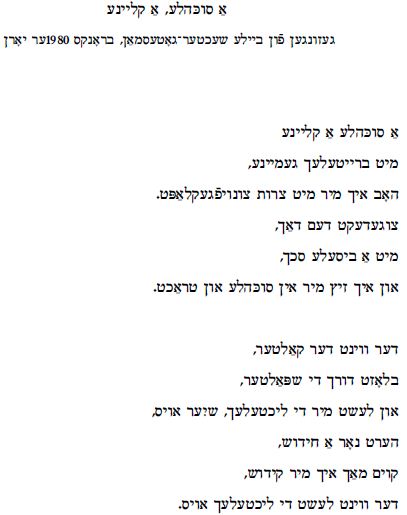
 September 25, 2017 7:01 pm at 7:01 pm #1369697? DaasYochid ?Participant
I found this. It might be the original poem:
? ???? ??? ????? ?????? {1876-1953}
????? ???????,
??? ?????? ???????
??? ??? ???? ??? ???? ??????:
?????? ??? ???
??? ? ?????? ???,
??? ?”??? ??? ??? ????? ??? ?????
??? ???????? ??????
??? ????? ??????
?? ????? ??? ???? ???? ???? ??????
?? ????? ??? ?????
??? ???? ??? ????:
??? ????? ?????? ?? ???????? ????
??? ????? ??? ?????,
???? ????? ???? ?? ??????,
???? ??????? ???? ??? ????,
??? ??? ??? ??? ?????
??? ??? ??? ??? ?????,
???? ????? ????? ???? ??? ????…
???? ??? ????? ????? ???? ??????,
????? ???? ???? ??? ????? ????.
?? ??? ????? ??????? ??????,
?”??????? ?? ????? ??:
??? ???? ??? ? ????
????? ???? ??? ? ???.
??? ???? ??? ?????? ????,
?????????????? ??? ?????,??? ??? ????? ??? ?????? ?????,
????? ?????? ????? ????September 25, 2017 7:55 pm at 7:55 pm #1369700Miriam377ParticipantCan someone post the english lyrics? All I remember was this:
My succaleh was small
not fancy at all
but it was special and dear to me.
some schach I threw over it hoping to cover it
and there I’d sit and think.September 26, 2017 1:02 am at 1:02 am #1369821mitzvahcardParticipantWhere did you find that original?
It seems very different!September 26, 2017 1:14 am at 1:14 am #1369825? DaasYochid ?ParticipantI googled the author’s name, and the word succah, in Hebrew, and it led me to an Israeli site.
September 26, 2017 1:14 am at 1:14 am #1369826? DaasYochid ?ParticipantMiriam377, that translation sound like it comes from this:
My Sukkahleh is small, not fancy at all
but is especially dear to me.
Schach I put on a bit, hoping to cover it,
there I’d sit and think. (2x)
The wind was a cold one,
the cracked walls were old ones,
the candles were flickering low.
At times as if dying, but suddenly rising,
as if they did not want to go. (2x)
My sweet little daughter
sensing the danger,
got scared and started to cry.
“Father,” she cried,
“Don’t stay there outside
the Sukkah is going to fall!” (2)
Fear not my child, its been quite a while
the Sukkahleh still stands strong.
The wind has been worse my dear,
but its almost two thousand years
yet the Sukkahleh still stands strong! (2x)(Mendel’s Messages)
The translation is not precise, which is inevitable since they made it rhyme.
September 26, 2017 8:47 am at 8:47 am #1369871kvetcherParticipantI also learned it from the RS album.
You’ll never find an “authentic” version. Besides, it’s not exactly Torah Moshe. It’s the message that counts.September 26, 2017 8:47 am at 8:47 am #1369870mitzvahcardParticipantI found this English adaption by Rabbi Avi Shafran:
A sukkaleh, quite small,
Wooden planks for each wall;
Lovingly I stood them upright.
I laid thatch as a ceiling
And now, filled with deep feeling,
I sit in my sukkaleh at night.A chill wind attacks,
Blowing through the cracks;
The candles, they flicker and yearn.
It’s so strange a thing
That as the Kiddush I sing,
The flames, calmed, now quietly burn.In comes my daughter,
Bearing hot food and water;
Worry on her face like a pall.
She just stands there shaking
And, her voice nearly breaking,
Says “Tattenyu, the sukkah’s going to fall!”Dear daughter, don’t fret;
It hasn’t fallen yet.
The sukkah will be fine, understand.
There have been many such fears,
For nigh two thousand years;
Yet the sukkahleh continues to stand.September 26, 2017 4:27 pm at 4:27 pm #1370612kvetcherParticipant?? ????’?? ?? ??????
?? ????’?? ?? ??????,
???? ???????? ???????,
???? ??? ??? ?? ????’?? ???????,
????????? ??? ????,
??? ?? ?????? ?????,
??? ??? ??? ??? ????’?? ????????.
????????? ??? ????,
??? ?? ?????? ?????,
??? ??? ??? ??? ????’?? ????????.?? ????? ?? ???????,
?????? ???? ?? ????????,
??? ?? ???????? ??? ????? ??? ?????,
?? ??? ??? ?? ???????,
??? ??? ???? ??? ???????,
??? ?? ???????? ??? ?????? ????? ????.
?? ??? ??? ?? ???????,
??? ??? ???? ??? ???????,
??? ?? ???????? ??? ?????? ????? ????.??? ?????? ??????[1],
??? ?? ?????’? ??????,
?????? ??? ???? ???????’? ??????,
?? ????? ??? ??????,
??? ????? ??? ??? ????:
“?????’?? ?? ???? ?????? ????? ?????!”
?? ????? ??? ??????,
???? ????? ??? ??? ????:
“?????’?? ?? ???? ?????? ????? ?????!”– ??? ???? ???? ?????,
???? ??? ???? ?????,
???? ??? ?? ???? ??? ???? ?????[2]!
?? ??? ???? ????,
????? ????? ??????? ?????,
??? ?? ????’?? ?? ????? ???? ????? ?????.
?? ??? ???? ????,
????? ????? ??????? ?????,
??? ?? ????’?? ?? ????? ???? ????? ?????.[1] Course, serving
[2] SorrowSeptember 27, 2017 12:26 am at 12:26 am #1371593mitzvahcardParticipantInteresting question:
In the last stanza, first line, the word “Na’ar” is spelled with an Alef in most versions.Is that the proper yiddish spelling of the word?
Because in Hebrew it is with an Ayin.September 27, 2017 12:39 am at 12:39 am #1371600? DaasYochid ?ParticipantIn Yiddish, it’s ???.
I misspelled it.
September 27, 2017 8:12 am at 8:12 am #1371637mitzvahcardParticipantDo the Yiddish and Hebrew words mean the same thing?
September 27, 2017 9:22 am at 9:22 am #1371639? DaasYochid ?ParticipantApproximately, but not precisely. You’re not going to learn Yiddish by studying and comparing the Yiddish and English song lyrics, but you will get the lyrics’ message.
September 27, 2017 11:59 am at 11:59 am #1371860mitzvahcardParticipantJust so I understand, naar in Hebrew is a noun, is naar in Yiddish an adjective?
September 27, 2017 12:35 pm at 12:35 pm #1371895AshParticipant@DY that’s not quite right. In yiddish an aleph is used for kamatz or pasach sound (almost like vowels in English), and an ayin for a segol sound when using a native Yiddish (or German or English) word. Hebrew words are usually written in their proper spelling especially if they’re clearly not Yiddish in origin.
(Exceptions include ????? for ??? but even that spelling is not usually used and even then only to show that it’s the “heimish” pronunciation.)
So ??? is “nohr” which means only, whereas ??? in the first version is clearly the Arameic word (for fool, the line means “on’t be fool”) and so would be written with an ayin.
All the IIRC.
September 27, 2017 1:03 pm at 1:03 pm #1371912ubiquitinParticipantAsh
You do not recall correctly DY is right. The spelling in yiddish for the word fool is ???.
The word ??? in Yiddish is pronounced Ner since as you correctly point out ayin makes a short e sound.
Words Like ??? and ?? (candle) are usualy spelled the same way since they dont have vowels (in yiddish as you know the letters Aleph, Ayin, Vav … are the vowels, there are no nekudos) so there is no confusion as to how ??? is pronounced you just memorize the vowels. In yiddish the word ??? is pronounced Ner it has a vowel. If you want to write Fool ie Nar the correct spelling in Yiddish is ??? it is ALSO the correct spelling for the word Nur as in only.Of course if you incorporate a Hebrw/Aramic word for fool ??? it isnt wrong, it just isnt yiddish (Then again the word ?? isnt Yiddish either a candle is ????)
September 27, 2017 5:27 pm at 5:27 pm #1372351mitzvahcardParticipantI am confused.
Are you saying that the Yiddish and Hebrew word mean the same thing but are spelled differently?On a different note, I noticed that there a variant spellings of the word “beinacht” or “banacht”.
Any explanation?
September 27, 2017 7:55 pm at 7:55 pm #1372439ubiquitinParticipant“Are you saying that the Yiddish and Hebrew word mean the same thing but are spelled differently?”
without question.
This comes up a lot with last names where the origin is yiddish. For example the name Goldberger. In Yiddish it is quite lengthy ?????????? with the ?…?..? serving as vowels, however in Hebrew the vowels are nekudos though often omitted/assumed thus an Israeli might spell his name ???????. Its the same name, pronounced the same one is spelled in yiddish the other in Hebrew.
Thus the word ??? pronounced Nar is not a yiddish word. There is a yiddish word that means the same thing and is pronounced the same way, and stems from that word. To get the word pronunced Nar in Yiddish it is spelled ???.
OTher than names I cant think of any other such example at the moment, though Im sure they are out there.As for your last question the correct spelling is ??????. different locales pronounce that differently as Baynacht Bynacht so the spelling may have shifted to ??????. You have to keep in mind most Yiddish speakers dont really care what YIVO has to say. so there isnt really a formal body governing the “correct” spelling of words. Im sure you will find the word fool spelled ??? in some places though it isnt technically the correct yidish spelling. Furthermore there is generally no formal yiddish grammar class that most current speakers study. I did have a basic spelling book/class in the second grade but after that we just learnt by rote and “what sounded right” based on what you heard
September 28, 2017 9:06 am at 9:06 am #1372612AshParticipantwithout question.
Very much with question. Do a google search for “??? ???? ???? ???” (with quotes, ideally) and then for “??? ???? ???? ???” and you’ll find they have a very similar number of results, and many from heimish websites/publications for both.
I don’t know about WIVO or academic yiddish but for an actual first-language Yiddish speaker it would be quite odd to spell it in a way that it too similar to “nohr/nur” (“only”) IMO and in colloquial Yiddish it is very common to write hebrew words as-is (like ???) not because of the lack of ambiguity because many words are simply written in Hebrew. This trend is compounded by the transliteration and appropriation of many English words into Ivrit.
In Yiddish it is quite lengthy ?????????? with the ?…?..? serving as vowels,
Almost. Hungarian Yiddish (e.g. perhaps Satmar) usually leave ?? at the end of words, but for the “er” suffix (and other similar suffix), Litvish or Polish Yiddish would leave out that final ?? so it would be written ?????????.
Name’s aren’t a good example though as they tend to be spelled the same way as they first were written long ago but any other word e.g. “???????” / “????????” might be a better example.
September 28, 2017 10:50 am at 10:50 am #1372712ubiquitinParticipantASH
” Very much with question…”
You arent realy Questioning nor even disagreeing with my point. My “without question” was in reference to this “Are you saying that the Yiddish and Hebrew word mean the same thing but are spelled different”
You agree that at the least the word ??? is yiddish as “they have a very similar number of results, and many from heimish websites/publications for both.”
Of course ??? isnt a Hebrew word thus this is, as I said, “without question” a “Yiddish and Hebrew word mean the same thing but are spelled different”
Unless you are arguing that the word ??? does NOT mean fool, which you very much imply isnt the case (as you say ” because many words are simply written in Hebrew.” Yes if you write the word “in Hebrew” the word is ???, no argument there.The only question is whether the Hebrew word ??? is ALSO a Yiddish word. This point is more semantics, since if we ignore YIVO (not WIVO) Yiddish evolves it is possible that now the Hebrew word ??? is considered Yiddish much like coup which is clearly French is now an English word. However you said “??? in the first version is clearly the Arameic word (for fool, the line means “on’t be fool”) and so would be written with an ayin” which is clearly not correct. IF you had written “so COULD be written with an ayin” I concede that it can.
for what it is worth if you Google translate Fool” into yiddish you get ???.
(your interesting tidbit abut Yiddish names is only tangentially related, we arent discussing differences among different dialects of Yiddish rather Yiddish vs. Hebrew)
September 28, 2017 10:50 am at 10:50 am #1372723ubiquitinParticipantI’m not sure if I did your experiment wrong “??? ???? ???? ???” yielded 214 results while “??? ???? ???? ???” yielded 154 results. that makes the former 40 % more common. Im not sure I would term that a ” similar number” let alone a “very similar number of results,”
Again though, even if they were equally used, DY’s spelling is still correct.
September 28, 2017 10:50 am at 10:50 am #1372728ubiquitinParticipant“but for an actual first-language Yiddish speaker it would be quite odd to spell it in a way that it too similar to “nohr/nur” (“only”) ”
Ive been trying to think of an example here is one: what does ??? mean?
Without context (or sticking in a nekuda) you dont know. Here are two contexts to help:??? ??? ????? (travel)
??? ??? ???? ????? ??? ?? ??? (before)(of course the word ??? is technically Hebrew but like the word ??? it doesnt contain any yiddish vowels so it is left alone)
October 2, 2017 12:20 pm at 12:20 pm #1376677AshParticipantWhen I did the search there were fewer than 20 results between them 180 vs 160 or something. Anyway, you can try other words and examples.
I don’t get your distinction and what are words that “contain yiddish vowels”? Every word can be written with “yiddish” vowels.
The suffix thing shown that sometimes the vowels are left out when it doesn’t add. There are better examples no doubt.
I am making up rules based on experience not formal knowledge of grammar, but I suspect that your “yiddish vowels” rule is similarly made up. True?
October 2, 2017 1:28 pm at 1:28 pm #1377204mitzvahcardParticipantIs it true that the difference between Banacht and Beinacht would be a litvish vs chassidish yiddish?
October 2, 2017 5:20 pm at 5:20 pm #1377514ubiquitinParticipantASH
“I don’t get your distinction and what are words that “contain yiddish vowels”?
Hebrew vowels (nekudos) are ??????????????? (ignore the
The corresponding yiddish vowels are ? ? ? ?? ? ?The word ??? doesnt contain a yiddish vowel nor does ???. Thus in yiddish they are written the same way,
The hebrew word ??? does contain a yiddish vowel, the ? which of course makes an ?? sound. thus in yidish the word ??? is prounced Ner.“The suffix thing shown that sometimes the vowels are left out when it doesn’t add. There are better examples no doubt.”
weve already provided examples like ??? ???. In the case of ??? a vowel isnt being left out, a “wrong” one is put in.“I am making up rules based on experience not formal knowledge of grammar, but I suspect that your “yiddish vowels” rule is similarly made up. True?”
Im not sure which rule you refer to. Strictly speaking the correct spelling is ???. I agree languages evolve and today perhaps ??? is correct as well.
However your first line “So ??? is “nohr” which means only, whereas ??? in the first version is clearly the Arameic word (for fool, the line means “on’t be fool”) and so would be written with an ayin.” wasnt quite rightOctober 2, 2017 5:45 pm at 5:45 pm #1377562ubiquitinParticipant“Is it true that the difference between Banacht and Beinacht would be a litvish vs chassidish yiddish?”
Im not sure at all. I am open to other suggestions.
March 9, 2018 5:31 pm at 5:31 pm #1485779ubiquitinParticipantAsh
I’m not sure if you are still around, over Purim I thought of another example. (Inyanei deyoma)
The Yiddish word for drunk is ????? this obviously stems from the Hebrew word ????? (In yiddish would be pronounced shichor)
???”?July 18, 2023 9:27 am at 9:27 am #2209188ubiquitinParticipantWow Just discovered something that blew my mind a little bit
the Yiddish word ??? may not stem from the Hebrew word ???. The German word “narr” means fool, the Yiddish is likely from the German
This is a better explanation than the one I offered as to why it is spelled with an alefJuly 18, 2023 12:27 pm at 12:27 pm #2209261DaMosheParticipantNice bump. I actually bought the poster a few years ago – I remember when I was young, I used to listen to my grandfather sing this in our sukkah. Now that I have the poster with the words in my sukkah, I sing it too. Sadly, my kids don’t appreciate the song, and when I start singing it, they start complaining.
I’m hopeful that one day they’ll appreciate the song.
I remember clearly that R’ Bender once told us in his weekly shmooze, “Sing the songs your zeides sang!”July 18, 2023 1:54 pm at 1:54 pm #2209307Menachem ShmeiParticipantubiquitin,
Very interesting point.
Quote from wiktionary:
From Middle High German narre, from Old High German narro (“fool, idiot, clown, stupid or crazy person”). Further origin unknown. Cognate with German Narr (“fool”), whence Dutch nar, Swedish narr, Estonian narr, etc.
The word may have been influenced in Yiddish by Hebrew ?????? (n�’ar, “a youth”), though there is no need for this assumption.If you search “???? ???” on otzar you get 229 quotes from seforim. For “???? ???” you get 50.
The issue with the German theory is:
In the German, the plural of “narr” is “narren.”
In Yiddish, it should be “???? ????” or “???? ????.”However, the plural term used in Yiddish ???????. Although this isn’t exactly Hebrew (which would be ?????) – this seems to be borrowing from the Hebrew style, which might show that ??? originates from Hebrew.
Similar to how one ???????? (or sometimes ?????’????) becomes two ??????? (although ??????? is pure Hebrew, while ??????? is a mix).
July 18, 2023 3:06 pm at 3:06 pm #2209311Menachem ShmeiParticipantInteresting to note how the communists banned Hebrew spellings in Yiddish, as they felt it brought too much religion into the “Yiddish culture.”
Like the Yiddish version of Pravda – “??? ????”
July 20, 2023 2:27 pm at 2:27 pm #2209922Menachem ShmeiParticipantSome other interesting examples to think about:
According to my otzar hachochma searches:
The Yiddish spelling of “balebos” is much LESS common that the Hebrew:
??? ??????? 289
??? ??? ???? 3,131
??? ???”? 863However, the Yiddish spelling of “sheigitz” is much MORE common:
??? ?????? 156
??? ??? 32
??? ??? 60July 20, 2023 10:25 pm at 10:25 pm #2210018Always_Ask_QuestionsParticipantMenachem > “??? ????”
the goal was to differentiate between Yiddish and Hebrew spelling so that those who learnt Yiddish would not be able to read Ivrit. I once talked to an elderly Yid from Odessa who just left USSR. He said that he – sadly – learned Yiddish as a kid but then communistim came and his cheder closed, and he wished to learn to read Ivrit all his life. I opened a chumash on the first page and ordered him: “read”. He read “bereshis bara …” and could not believe himself “I always was able to read Ivrit?!?”
This is like a moshal of a person who had a treasure buried in his yard his whole life but he was aware. Was he a rich man?
-
AuthorPosts
- You must be logged in to reply to this topic.