They have argued viciously in Congress over just about everything: Whether the Capitol insurrection should be investigated or brushed aside. If the president’s choice for the Supreme Court should be limited to the first Black woman. Even over whether or not to wear masks in the Capitol building.
But as lawmakers gather for President Joe Biden’s first State of the Union address amid the gravity of Russia’s invasion of Ukraine, they have mustered a rare and remarkable bipartisan resolve, determined to hold the U.S. and its allies together in the defense of a Western-oriented democracy.
When Biden stands in the House chamber Tuesday evening, trying to make good on what until now has been a faltering attempt to resolve the nation’s bitter divisions, he may find that the threat from Russian President Vladimir Putin abroad has become the unexpected force pulling the U.S. political parties toward common purpose.
“I think you will see in the State of the Union, a strong bipartisan support for our president,” predicts Sen. Chris Coons, D-Del., a Biden ally.
The turn of events is both stunning and fragile. Foreign policy has not been the kind of bipartisan draw it was during the past century, when Congress and the White House worked together as the U.S dominated the global stage. Factions on the right and left have broken off, most definitively over the long wars in Iraq and Afghanistan, creating oddball political alliances in the U.S. and chiseling away at a shared mission.
The revival of a robust majority that’s largely supportive of Biden’s strategy toward Russia is even more striking because it is shaping up as one of the most significant rejections of Donald Trump’s embrace of Putin and the former president’s praise of Putin’s tactics as Russia invaded Ukraine.
“We’re all together at this point and we need to be together about what should be done,” said Senate Republican leader Mitch McConnell.
Still, the State of the Union address may not be free of partisan antics, unfolding against the backdrop of a Congress deeply divided over many issues: a prime-time address to the nation, too tempting for lawmakers looking for attention.
This year is particularly fraught amid ongoing COVID restrictions and a Capitol still largely shuttered to the public. That’s due in part to safety concerns in the aftermath of the deadly Jan 6, 2021 assault by Trump supporters trying to stop Congress from certifying Biden’s election.
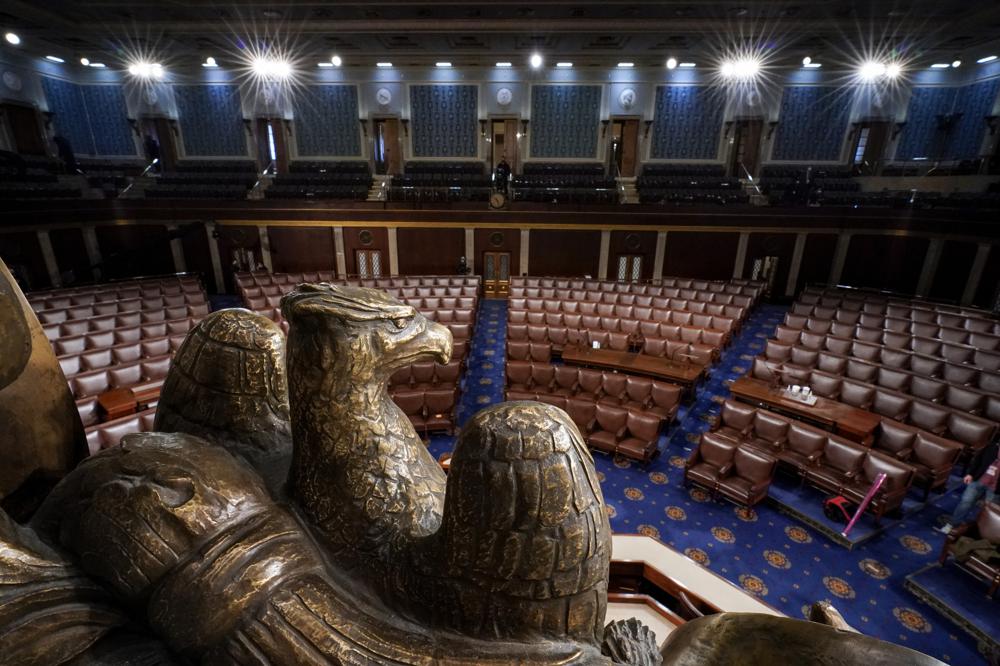
Tuesday’s gathering in the House chamber will be the first time since the pandemic outbreak in 2020 and last year’s attack on the Capitol that all members of the House and Senate are being invited to gather for what typically has been an annual event.
Masks will no longer be required, removing once source of friction for those lawmakers who had flouted the guidelines and risked being booted from the session for failing to comply — though COVID tests and social distancing measures will still be required
But the heavy metal security fence is back up around the Capitol complex. It’s not in response to specific warnings but more a bow to the “new normal,” a reminder of threats from within America’s own electorate.
Republican, Rep. Marjorie Taylor Greene of Georgia, was busy defending her appearance over the weekend at a conference hosted by a white nationalist — a view she said she didn’t endorse.
And it can’t be said that Republicans are fully pleased with Biden’s handling of the Ukraine war.
McConnell has been highly critical of the president’s runup to the crisis, calling the White House’s disastrous exit from Afghanistan last summer a sign of U.S. weakness that opened the door to Putin’s invasion.
Leading Republican lawmakers have derided what defense hawks view as Biden’s initial reluctance to impose sanctions to deter Putin’s advance on Ukraine. Others have criticized the White House climate change agenda as creating an energy policy that boosts Russian exports, including via the Nord Stream 2 pipeline to Germany, now scrapped over the war.
“We all know what Putin wants, and he said so publicly: He wants to reconstitute the USSR and pull back in his orbit all the countries that were in it before,” said Sen. Jim Risch of Idaho, the top Republican on the Foreign Relations Committee. “This is a seminal moment.”
But even some of the Trump’s staunch supporters are parting ways with the former president after he called Putin’s invasion tactics “genius.”
Republican Rep. Mo Brooks, who rallied with Trump supporters ahead of last year’s assault on the Capitol and has won Trump’s endorsement in the Alabama Senate primary, lambasted Putin’s invasion as “barbaric and evil.”
But in a nod to the non-interventionist strain that runs deep in both left and right flanks, Brooks added, “While Putin’s Ukrainian invasion and murders are heinous, this is first and foremost a problem for Western Europe to resolve.”
Congress will face tests ahead, starting with Biden’s request for at least $6.4 billion in supplemental funding to help Ukraine, which will require cooperation from both parties.
Said Sen. Chris Van Hollen, D-Md.: “You have the Trump voices in there, obviously, you know, a big part of the Republican Party nationally, but at least so far on Capitol Hill, especially in the Senate, I think you’ve got an overall bipartisan consensus. “I hope it stays that way.”
(AP)
 Join the official YWN WhatsApp status