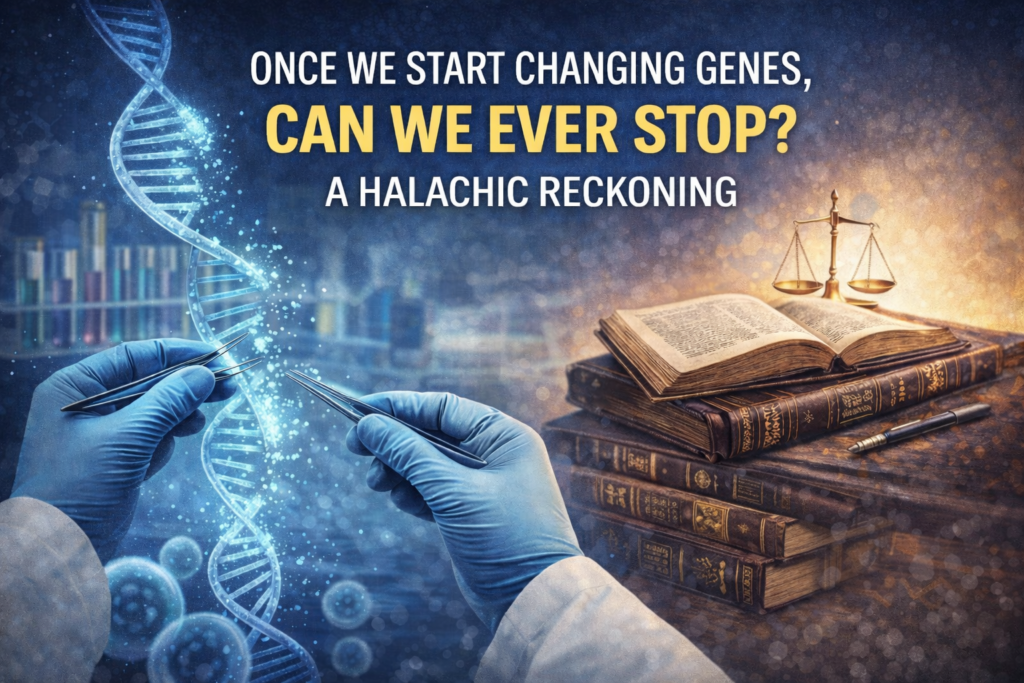
Genetic Engineering Through the Lens of Halacha: The Questions That Follow
Refuah B’Halacha is a halachic center that provides access to experienced Rabbanim who respond to medical-halacha questions of all kinds. Serving as a practical address for both everyday and complex inquiries, the Center assists individuals, families, physicians, and Rabbanim in navigating situations where modern medicine intersects with halacha. Rabbanim are available through the hotline and via the Refuah B’Halacha website.
In recent years, as medical technology has advanced at a rapid pace, the Rabbanim of Refuah B’Halacha have been receiving questions that until recently seemed purely theoretical. One of the most significant of these involves genetic engineering and the halachic boundaries of intervening in human creation.
Last week, Refuah B’Halacha published an article addressing the question: How far may genetic intervention go according to halacha? The article, published on Yeshiva World, generated widespread interest, responses, and thoughtful questions from readers, underscoring how relevant this issue has become in real life.
(Read the original article here)
The initial discussion focused primarily on genetic intervention as a tool for preventing serious and well-defined illness—such as hemophilia—an area in which there is relatively broad agreement among poskim. However, the many responses made it clear that the deeper question extends far beyond disease prevention. If halacha permits genetic intervention to prevent suffering, where does that permission end?
When the Question Is No Longer Only About Disease
If it is permissible to remove one genetic disease, why not remove all of them? If intervention before birth is already accepted in order to prevent suffering, is there a meaningful distinction between screening, selection, and genetic correction? And if genetic technology were one day able to reduce predispositions to severe mental illness, addiction, or destructive tendencies, would refraining from intervention truly be the more religious choice?
These questions are no longer theoretical. They are the natural continuation of a conversation that has already begun. Readers recognized that what once sounded like science fiction is rapidly becoming medical reality—and that halacha must address where the line is drawn.
A Form of Prevention That Already Exists
In truth, the Torah world has already embraced a form of genetic prevention. Dor Yeshorim screens for genetic compatibility and advises couples accordingly, preventing certain shidduchim in order to avoid the risk of severe inherited disease. While no genes are altered, the impact is profound: marriages are prevented in order to spare future children from suffering.
Some argue that genetic engineering could offer an alternative path. Instead of preventing shidduchim, perhaps the disease itself could be corrected—allowing more couples to marry and build families without fear. If so, could genetic engineering be viewed as a more advanced, and perhaps more compassionate, form of prevention?
And if intervention is already accepted—why stop there?
Between Human Effort and Altering Creation
Every parent wants the best for their children. We invest heavily in education, environment, emotional health, and spiritual growth. We daven for children who are healthy, balanced, and successful in Torah and in life. If technology were to allow the reduction of certain genetic predispositions, would that be fundamentally different from choosing the best schools, rebbeim, or surroundings?
Chazal teach that there are three partners in the creation of a child: the father, the mother, and Hashem. Partnership implies human effort and responsibility. And even as humanity advances technologically, Hashem remains infinitely ahead, guiding outcomes in ways no scientist can predict or control.
Yet this is precisely where the discussion becomes more complex—and more concerning.
A World of “Designed” Children?
Could genetic engineering open the door to a generation of “designer children”—not only healthier, but optimized for intelligence, temperament, or personality traits? What becomes of free will, individuality, and the Divine plan when every characteristic can be selected or eliminated?
Perhaps most troubling is the potential loss of humility in the face of creation itself.
Halachic Boundaries: A Clarifying Example
Contemporary poskim have raised examples that highlight the depth of this issue. If genetic engineering were used to alter a non-kosher animal so that it displayed the signs of a kosher species, would it become permitted? Chazal teach that the pig will one day “return” (chazor) to a permitted status in the times of Mashiach—but would halacha recognize such a change if brought about by science?
Rav Shlomo Zalman Auerbach zt”l wrote that the prohibition of kilayim applies only to physical mating between species, not to laboratory manipulation. He further explained that if a tomato were genetically engineered to grow on a tree, it would be considered a tree for halachic purposes, subject to orlah and the bracha of ha’eitz. However, animals present an additional challenge due to the principle of kol hayotzei min hatamei tamei—anything that originates from a non-kosher source remains non-kosher.
Beyond the technical halachic details lies a broader concern: the erosion of clear boundaries that define the Torah’s framework of permitted and forbidden.
Not Only What Can Be Done—But What Should Be Done
Genetic engineering holds enormous promise. It may prevent suffering, save lives, and solve problems once thought impossible. But it also forces us to ask not only what can be done, but what should be done.
The Rabbanim of Refuah B’Halacha address not only today’s medical-halacha questions, but those emerging on the horizon. As technology moves forward at an unprecedented pace, halacha must respond with wisdom, caution, and yiras Shamayim. These are not questions for laboratories alone, but for batei medrash, poskim, and individuals guided by their Rabbanim.
As always, complex medical-halacha questions must be addressed on a case-by-case basis, in consultation with competent rabbinic authority.
Refuah B’Halacha – A Resource for Our Generation
Refuah B’Halacha provides guidance for medical-halacha questions across a wide range of areas, including mental health, Shabbos, medical treatment decisions, hospital stays, fertility, and kashrus. The Center’s Rabbanim are available to listen, advise, and guide individuals through even the most sensitive and complex situations.
Refuah B’Halacha is available Sunday through Friday from 8:00 am to 10:00 pm, and on Erev Shabbos until ten minutes before candle lighting.
Hotline: 732-755-0851
Website: www.refuahbhalacha.org
 Join the official YWN WhatsApp status