On the Bronx streets where New York City�s new police commissioner started as a patrolman in the crime-ravaged early 1990s, gunfire and burned-out buildings were everywhere.
Sometimes the police radio would crackle with a different kind of call, not for a shooting or stabbing but for a sick child, a locked apartment door or a marriage on the rocks.
�I remember thinking, �Well, why do they call the police for this? It�s not an emergency,�� Commissioner Dermot Shea told The Associated Press in a recent interview. �And, you know, you kind of get a little wiser over time. The reason they call the police is because they really have nobody else to call.�
Shea, 50, is drawing on his early days as he pushes the nation�s largest police department to cultivate deeper bonds with the communities it serves � a key, he says, to building trust and cutting crime.
Shea, the son of Irish immigrants who grew up with four siblings in Queens, wants the NYPD�s 36,000 officers to remember their jobs are primarily about people � whether that means rushing to a crime scene, comforting a victim or merely lending a hand.
In many ways, he said, officers are �the glue that holds the city together.�
�Hopefully that�s the message we get to our cops and recruits, that everything you do is about helping people, working with people, serving people,� Shea said.
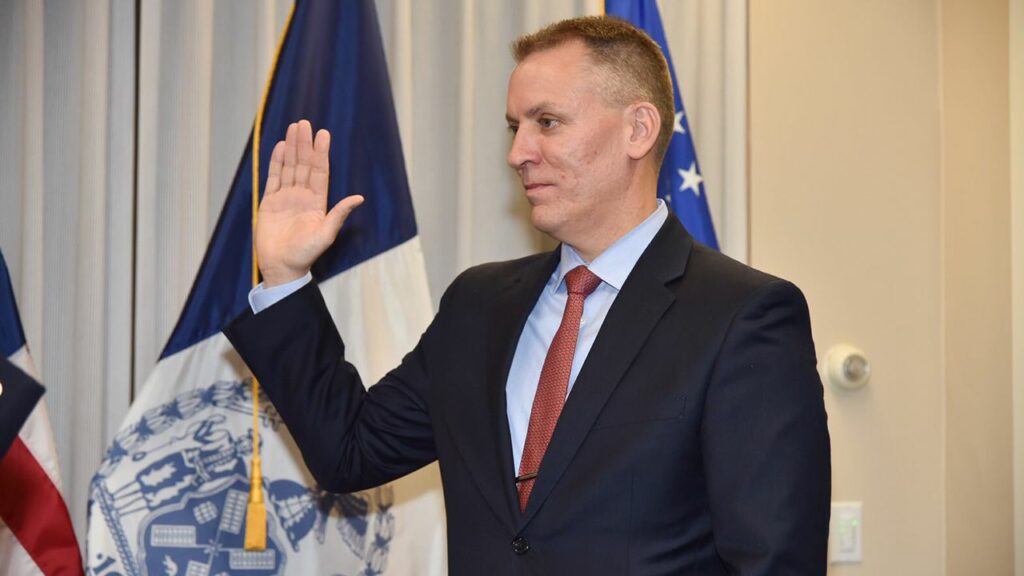
Shea was sworn in Dec. 2 as the city�s 44th police commissioner, succeeding James O�Neill, who left after three years on the job to become a security chief at Visa. Mayor Bill de Blasio said he was awed by Shea�s intellect and saw him as �the future of the NYPD.�
Critics chided de Blasio for picking another white man to lead the department, which has had only two black commissioners. Since then, Shea has appointed the NYPD�s first black chief of detectives and has made other changes to diversify the leadership.
It�s been an eventful first month for Commissioner Shea, between a rash of anti-Semitic attacks and the fatal stabbing of a Barnard College freshman � a case with the added sensitivity of youth suspects. Then there were the security implications after the U.S. last week killed a top Iranian general, and continued fallout from statewide reforms that eliminate bail for nonviolent felonies.
In previous leadership roles, Shea developed data-driven strategies for fighting and preventing crime, and helped move the NYPD to a community-oriented philosophy that encourages officers to interact with residents. Those changes followed a controversial era of stop-and-frisk and �broken windows� policing, which viewed low-level offenses as a gateway to bigger crimes. A judge found stop-and-frisk discriminatory.
Now, with crime in the city already very low, Shea wants to push further. He yearns for a day when the NYPD measures crimes prevented.
�We�re at a unique point, just as we were at a unique point in 2014 and we pivoted away from how we policed this city and maintained order and drove crime down and accomplished that softer touch,� Shea said.
�Because we�ve gone through that process already, where neighborhood policing started the last couple of years, where we�ve started to build a lot of these relationships, we�ve changed the mindset of officers on what policing looks like.�
Shea joined the department in 1991. He took the test as something of a fallback while majoring in economics at a state university in Oneonta, New York. Shea, working as a union doorman after college, wasn�t keen on spending his life sitting at a desk. As he entered the police academy, Shea said he was told being an officer is a �front row seat to the greatest show on earth.�
Shea�s older brother, James, entered the academy in the same class. He retired from the NYPD as a deputy chief and since 2013 has been public safety director in Jersey City, New Jersey, where he was a key figure in the response to last month�s deadly attack on a kosher grocery store.
Shea�s younger brother, Paul, joined the Army after the Sept. 11 attacks and is now a major. Their late father was also in the Army.
Commissioner Shea worked in narcotics and was a precinct commander in the Bronx in the 2000s before moving into the first of several top leadership positions.
In 2014, Commissioner William Bratton called with a new assignment running CompStat, an analytics system that Shea said is �probably the engine that drives the NYPD.�
Shea would sleep in his office at police headquarters the night before weekly CompStat meetings, at which leaders study statistics and strategies for targeting high-crime areas.
Sometimes he wouldn�t be done preparing until as late as 1 a.m.
Shea, who was chief of detectives before becoming commissioner, attributes his work ethic to his late father, a bartender and handyman whom he recalled missing work just once, after falling in snow and breaking his knee.
Shea�s parents emigrated to the U.S. in the 1950s but didn�t meet until living in New York.
His mother, Ellen, grew up in a Tobercurry home with a thatched roof and no indoor plumbing that was smaller than his office, Shea said, recalling a visit he made in the 1970s. His father was from County Laois.
Upon being appointed commissioner, Shea spoke of how proud his father and other relatives would have been, telling a City Hall crowd: �I can assure you there is a hell of a celebration going on in Heaven. You would have to know my father… There was probably some Irish whiskey being spilled.�
(AP)
 Join the official YWN WhatsApp status