
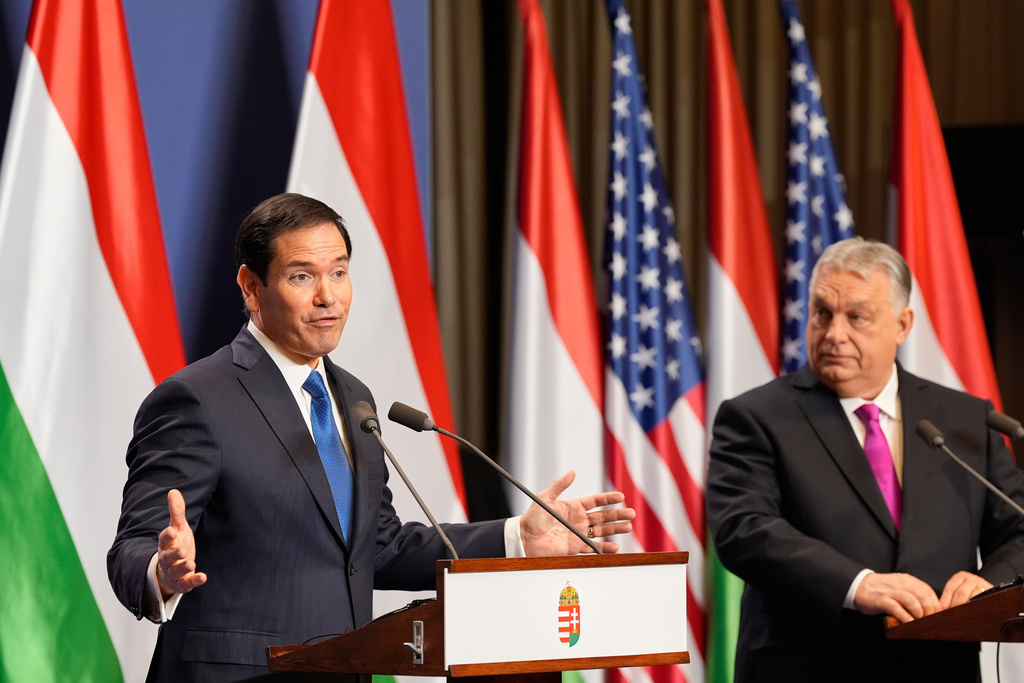
U.S. Secretary of State Marco Rubio on Monday enthusiastically endorsed Hungarian Prime Minister Viktor Orb�n ‘s bid to serve a fifth straight term after upcoming elections in April, emphasizing during a visit to Budapest the strong personal relationship between the nationalist leader and U.S. President Donald Trump.
Orb�n, who has led Hungary since 2010, is one of Trump’s most vocal supporters in the European Union, and has actively curried the U.S. president’s favor leading up to the April 12 vote in which he will face the toughest challenge of his last 16 years in power.
Rubio was in the Hungarian capital for meetings with Orb�n and his government where he signed an agreement on U.S.-Hungarian civilian nuclear cooperation that includes the possible purchase of compact nuclear reactors — known as small modular reactors or SMRs — as well as U.S.-supplied nuclear fuel and spent fuel storage technology.
At a news conference in Budapest, Rubio said U.S.-Hungary relations — which both he and Orb�n described as experiencing a “golden age” under Trump — go beyond mere diplomatic cooperation.
“I’m going to be very blunt with you,” Rubio said. “The prime minister and the president have a very, very close personal relationship and working relationship, and I think it has been beneficial to our two countries.”
“That person-to-person connection that you’ve established with the president has made all the difference in the world in building this relationship,” Rubio continued, addressing Orb�n. “President Trump is deeply committed to your success because your success is our success.”
Rubio on friendly territory in Central Europe
Rubio’s stop in Hungary followed a visit to Slovakia on Sunday after he previously attended the Munich Security Conference in Germany.
Led by euroskeptic populists who oppose support for Ukraine and vocally back Trump, Slovakia and Hungary are both friendly territory for Rubio in his push to shore up energy agreements with both Central European countries.
Widely considered Russian President Vladimir Putin’s most reliable advocate in the EU, Orb�n has maintained warm relations with the Kremlin despite its war against Ukraine while building ties with Trump and his MAGA — short for the 2016 Trump campaign slogan “Make America Great Again” — movement.
Orb�n has remained firmly committed to purchasing Russian energy despite efforts by the EU to wean off such supplies, and received an exemption from U.S. sanctions on Russian energy after a November meeting in the White House with Trump.
Rubio would not specify on Monday how long that exemption would last as the EU plans to phase out Russian fossil fuels entirely by the end of 2027.
Apparently trusting that his political and personal affinity with Trump could pay even greater dividends, Orb�n and his government have sought to woo the U.S. leader to Hungary before the pivotal April elections — hoping such a high-profile visit and endorsement would push Orb�n, who is trailing in most polls, over the finish line.
On Monday, Orb�n told Rubio that his government is ready to host any future trilateral peace summit between the United States, Russia and Ukraine, and that Trump has an “open invitation” to Budapest.
He also claimed that Ukraine and its president, Volodymyr Zelenskyy, were seeking to interfere in Hungary’s upcoming elections by criticizing Orb�n’s opposition to providing weapons or financial aid to Kyiv and threats to block Ukraine’s eventual membership in the EU.
Make Europe Great Again
Many in MAGA and the broader conservative world view Hungary as a shining example of successful conservative nationalism, despite the erosion of its democratic institutions and its status as one of the EU’s poorest countries.
Orb�n has riffed on Trump’s popular slogan and declared that he and his movement seek to “Make Europe Great Again.”
In turn, Trump has praised Orb�n’s firm opposition to immigration, exemplified by a fence his government erected on Hungary’s southern border in 2015 as hundreds of thousands of refugees fled Syria and other countries in the Middle East and Africa.
Budapest has hosted several annual iterations of the Conservative Political Action Conference, or CPAC, and another was hastily rescheduled this year to fall in March, just before Hungary’s elections.
(AP)
 Join the official YWN WhatsApp status


