United By Torah!
By: E. T. Rubin
There was an aura, a spiritual energy of kedusha and tahara, pulsing through the lobby.
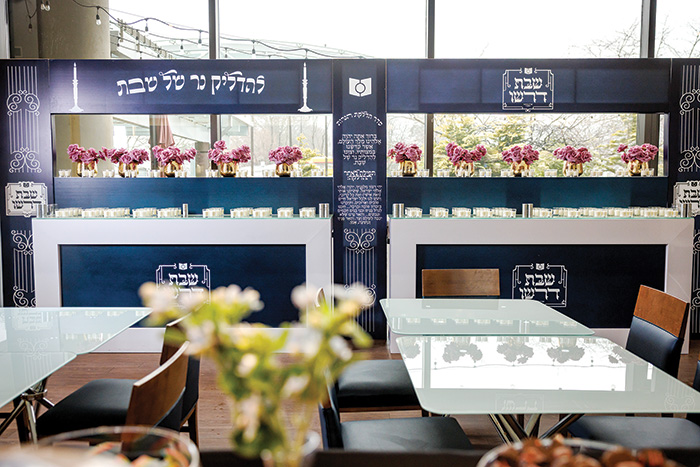
That pulsing energy was accompanied by a glow, a pure, lechtig glow emanating from the many hundreds of women whose hands were covering their faces as they welcomed the Shabbos Malka; the flames of their lecht dancing, reflecting the flames of Torah that they had all come to celebrate.
Kedusha? Tahara? In a hotel lobby?
It was a sight that left one amazed. The sight of so, so many Yiddishe Mammes whispering tefillos, gazing in wonder at the lecht that they had just kindled in the lobby of the Armon Hotel in Stamford, Connecticut. The sight of so many Yiddishe Mammes ranging from newlyweds to young mothers, to grandmothers and even great-grandmothers, all united by the light of Shabbos and the light of Torah, literally took my breath away!
And then I spotted her, one of my “Dirshu friends”, a woman whose husband, like mine, learns in Dirshu and who comes to the Dirshu Shabbos for a spiritual booster shot. This time, however, I noticed that she was wheeling a newborn baby, a very, very newborn baby.
“Mazal tov!” I lean over, offering to hold her precious bundle, soothing him with his pacifier. “Wow! This baby looks really new?”
“He is,” she agrees with a beatific smile. “He is three weeks old.”
“Three weeks old and you still came?!” I look at her wonderingly.
“Well,” the smile doesn’t leave her face, “we discussed it back and forth but really, I decided that there was no way I could miss this Shabbos! So here we are!”
And that said it all. Every woman in that hotel was there because, “There is no way we can miss this Shabbos!”
Greeting Shabbos Together
They came in droves, women from all walks of life and all corners of the country, women of all ages and from all different backgrounds, all came with one goal: to return home rejuvenated! To return home infused with chizuk to continue in their mission of doing everything possible to enable and empower their husbands to learn, review and learn more Torah! To gain an even deeper appreciation for their role as the eizer kinegdo.
One by one, the women finished their whispered tefillos, raised their heads, gazed lovingly into the hundreds of dancing flames and headed into the Crowne Ballroom to raise their voices together l’kras Shabbos with a medley of song and inspiration.
The evening was opened by the MC, Mrs. Miryam Swerdlov, whose simchas chaim injected an uplifting feeling of joy into the assemblage, eliciting smiles and laughter interspersed with her messages of chinuch tailored to the theme of the Shabbos, “Nashim b’may zochyon.”
A heartfelt, melodious Kabbalas Shabbos followed, led by the sweet and powerful voices of the Harmonies Choir led by Mrs. Hindy Ausch. The entire assemblage accompanied the young girls, singing the age-old words of the tefillos with Yiddishe niggunim.
It was a magnificent start to a Shabbos replete with food for the soul, opportunities for growth, passion and inspiration, complimented by a remarkable array of delectable seudos and oneg to please the palate as well.
Over the course of Shabbos, the women were treated to a panoply of speakers with messages that penetrated deep into their hearts and souls.
The Kochos of the Four Imahos Implanted… in US!
In one of her speeches, Rebbetzin Slovie Jungreis-Wolff passionately and emotionally described how each of the four imahos implanted unique kochos into the DNA of every single Jewish woman.
“Yes!” she exclaimed, “Each one of YOU has the koach of the imahos!”
She then poignantly described how Sara Imeinu gave us the koach to always look at everything as good, as fresh. The Torah tells us Sara Imeinu lived 100 years, 20 years and 7 years kulo shavin l’tov! “Really? Was Sara’s life good? She left everything to follow her husband. Where to? ‘You will see!’ What did she see? Famine! But it was good! Sara was barren for so many years and then poof! Hagar came and immediately bore Avrohom a child! That was good?! And finally, her husband took her son to the akeidah! Good?! Yes! Sara looked at everything in life as good and therefore each of us has that koach!”
“Rivka instilled in us the ability to go. When everyone tried to convince her to stay, she said, ‘eilech – I will go’. With those words, she gave us the ability to go and do, to never, ever give up on a child just because the world tells us to!”
She continued by explaining how Leah engrained in the psyche of Yidden to truly, sincerely thank Hashem for no reason other than to say thank You! Until Yehuda was born, people did thank, but with a selfish bend, such as when we thank our children for cleaning their plates off the table, in the hopes that it will encourage them to clean up again next time. And Leah said, “Hapaam odeh es Hashem – this time, I am just thanking Hashem!”
“And Rochel? She gave us the koach to cry! Rochel Mivaka al baneha! Each of us has inherited that ability, of a mother crying for her children!”
Our Support for Our Husband’s Torah = Their Ticket to Gan Eden!
Rebbetzin Aviva Feiner magnificently portrayed how it is a woman’s koach to spread Torah. Just by being there for our husbands, just by supporting our husbands and sons, encouraging them to committed learning, we become their ticket to Gan Eden.
She shared the story of Rav Elya Lopian’s wife. Rebbetzin Lopian had nine boys, and the family was poverty stricken. Another woman came to the Rebbetzin, “Rebbetzin Lopian,” she said, “You have nine boys! Can’t you send just one of them to work? Won’t that ease your poverty?”
“You know,” the Rebbetzin answered, “in this world, I don’t need my children, but when it comes to the next world, BOY will I need them!”
Rebbetzin Feiner then quoted the Gemara that says that “A man who doesn’t marry has no simcha, no life and… NO TORAH!”
“But,” Rebbetzin Feiner exclaimed, “It doesn’t say that about a woman! Every single woman can have Torah by encouraging and empowering her husband, her sons, her brothers to learn! Every woman’s koach spreads Torah far and wide, all over the world.”
In a panel discussion, Rebbetzin Feiner also encouraged every woman to do something for herself, that makes her b’simcha because if she gives to herself, she will be able to give to her family. “During a difficult period of my life, I was in a store and I picked up a purple Klik bar. I told that Klik bar, ‘I am buying you now because you are going to make me happy!’ To this day,” Rebbetzin Feiner concluded with a big smile and to the accompaniment of much laughter, “the thought of that Klik bar makes me happy!”
“Write it Down… and Burn it!”
Throughout the Shabbos, Mrs. Miryam Swerdlov interjected pithy wisdom and humor in her short introductions and speeches. One particular story held a deep chinuch lesson.
“One summer, a staff member came to give me the honors of dealing with a bunk that had misbehaved terribly. ‘Girls,’ I announced sternly. ‘I want you to meet me in back of the bunkhouse at midnight but first, I want each one of you to write down e…x…a…c…t…l…y… what happened and bring it to me.”
Mrs. Swerdlov went on to explain that she never intended to read the papers. Instead, as the girls gathered around, she had someone take a match and ignite an entire garbage can of papers. Then she had each girl put their letters in the burning fire. “Finished! Hashem forgives you also!”
“That is what everyone can do when you are feeling upset – write it down, burn it in the sink and poof! It is gone! Sad – write it down and burn it! Get all your feelings out on paper and then burn them! Then you won’t be weighed down by your feelings, and you will be able to be b’simcha!”
A Hug from Hashem!
The spiritually uplifting Shabbos was brought to a close by Mrs. Devoiry Ginsberg, who painted a picture of her most remarkable daughter, Hindy, a”h, a girl who was stricken with cancer at the age of sixteen and fought the sickness valiantly, with tremendous kochos hanefesh, simchas hachaim, emunah and bitachon. Anyone hearing about such a young girl losing her life at that age might think, “Tragic!” But Mrs. Ginsburg, with her engaging smile and soft-spoken voice, tells a story that is anything but tragic. In fact, the words said by Rebbetzin Jungreiss-Wolff from her father, encapsulate young Hindy’s story as well: “A long life is not good enough, but a good life is long enough!”
Mrs. Ginsburg brings us into Hindy’s journey through her journal. There is not a dry eye in the audience as she gives example after example of the nissim and hashgacha that she and Hindy so appreciated. One example happened when Mrs. Ginsberg washed all of Hindy’s blankets and then Hindy got cold. “I felt so bad! I could not understand what possessed me to wash all her blankets. Hashem, I thought to myself, what now? I headed back to the hospital, feeling down when suddenly, some women pushing carts passed by. ‘Um… Miss?” they called out, ‘Do you have a child in hospital?’ When I answered yes, they asked, ‘Would she enjoy one of our hand- crocheted blankets?’ It was the coziest, yummiest blanket! What a hug from Hashem!”
It was but one story among so many that showed a family’s love of Hashem… and Hashem’s love of Yidden who love Him!
Centuries of Learning Under This Roof!
And then came Motzoei Shabbos when the nashim of Dirshu were treated to a choice of fun, engaging activities such as picture drawing analysis by Mrs. Breindy Lipschutz and the opportunity to decorate personal drinking glasses, led by Mrs. Esty Berkowitz. This was followed by the penultimate climax of the Shabbos, the Melave Malka and what an experience it was!
In addition to the luscious, china-plated, three course meal, the Melave Malka featured a program replete with inspiration, musical interludes by Mindy Blatt and the Harmonies Choir along with practical, take-home messages, leaving the women with memories to keep them going long after the night wound to a close!
Once again, the inimitable Mrs. Miryam Swerdlov served as the Master of Ceremonies to introduce Mrs. Chany Feldbrand who spoke about what it means to be a Dirshu wife for over 25 years.
One of the many highlights of the night was when a granddaughter of Mrs. Hofstedter came up and emotionally described how when she dreams of a worldwide movement of Torah, she pictures one person standing behind it, “My Bubby!” Enthusiastic applause filled the room as Mrs. Hofstedter came up to receive a stunning gift presented by her very own granddaughters.
Torah: The Ultimate Simcha!
The main speaker of the evening, Rabbi Joey Haber, drew a magnificent picture of the confusion that clouds the vision in today’s world and how there is one and only one thing to bring simcha amid the confusion and that is Torah! He explained how there is a part of the curse of Adam that we don’t all know. It is the curse of “kotz v’dardar tatzmiach loch”. He then brought the Bnei Yissoschor who highlights the difference between the word echad in Shema and the word acher in the aseres hadibros about not having an el acher is just the last letter of each word: daled and reish. The confusion between echad, Hashem and the Torah and acher, all the avoda zarahs of the world is the biggest obstacle to happiness. Torah brings clarity! Someone who commits to learning Torah for real, with Dirshu, gains clarity!
“We are now in the month of Adar,” Rabbi Haber concluded, a month when the alepf of anochi Hashem Elokecha, is the first letter of the word, followed by the daled and reish. Anochi Hashem, Hashem and His Torah bring the ultimate simcha!” The night wound to a close, tying up the ‘mishloach manos’ of a wonderful, uplifting Shabbos that will serve to inspire and encourage all the remarkable Dirshu women for many weeks to come!


 Join the official YWN WhatsApp status