
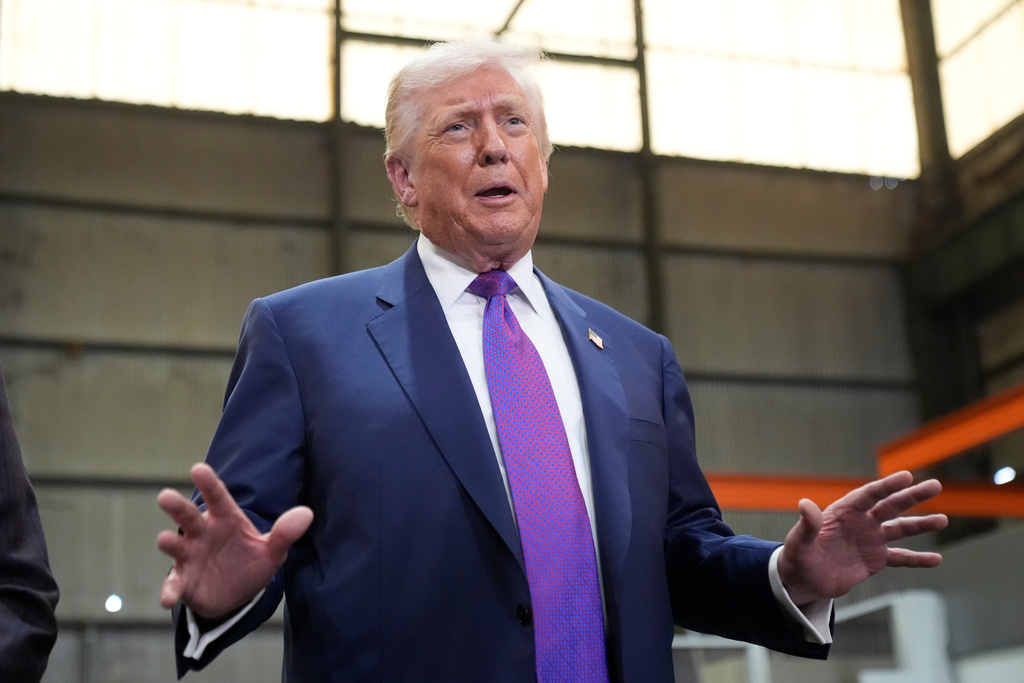
President Donald Trump said Sunday that a deal to end the war with Iran could come “soon,” expressing measured optimism about ongoing negotiations while warning that Tehran would cease to exist as a country if it rejects a U.S. proposal to end the fighting.
“I do see a deal in Iran. It could be soon,” Trump told reporters aboard Air Force One, adding moments later: “I think we’ll make a deal with them, but it’s possible that we won’t.”
Trump claimed, without offering evidence, that Iran has agreed to most of the 15 demands contained in Washington’s proposal for ending the war, including surrendering its nuclear weapons program and handing over stockpiles of highly enriched uranium. Iran has yet to formally respond to the offer, though U.S. negotiators had hoped for a reply by Friday.
“They’re going to give up nuclear weapons. They’re going to give us the nuclear dust,” Trump said. “They’re going to do everything that we want to do, and they’re going to go on and maybe have a great country again. But if they don’t do that, they’re not going to have a country.”
Trump also said Iran had agreed to allow 20 additional oil tankers to pass through the Strait of Hormuz beginning Monday, describing the gesture as a “sign of respect” and a signal of Iran’s willingness to negotiate. Pakistani Deputy Prime Minister Ishaq Dar, whose country is serving as one of the primary mediators between Washington and Tehran, first disclosed the development in a Saturday social media post.
Trump had previously claimed that Iran allowed eight Pakistani-flagged vessels and two others through the strait last week as a diplomatic “present.” Those figures have not been verified through public reporting or vessel-tracking data.
Iran has blockaded the strait since the outbreak of the war, choking off a critical artery for the global oil supply. When asked about reports that Iran has been imposing tolls on ships attempting to pass through, Trump said he needed to verify the claim, then added: “We could close it up in two minutes.”
In a separate interview with the Financial Times, Trump said his preferred outcome would be to seize Iran’s oil outright, and he declined to rule out a military operation to capture Kharg Island, the terminal through which roughly 90 percent of Iran’s oil exports flow.
“To be honest with you, my favorite thing is to take the oil in Iran,” he told the FT, before acknowledging the domestic political complications. He compared the situation to Venezuela, where the U.S. captured President Nicolás Maduro and has sought to assert control over the country’s petroleum industry. “Maybe we take Kharg Island, maybe we don’t. We have a lot of options,” Trump said. “It would also mean we had to be there for a while.”
Trump used his Air Force One remarks to also claim that U.S. strikes have effectively achieved regime change in Iran, a framing he first advanced when announcing negotiations to end the war.
“The one regime was decimated, destroyed, they’re all dead. The next regime is mostly dead, and the third regime – we’re dealing with different people than anybody’s dealt with before,” Trump said. “It truly is regime change.”
The broader Islamic Republic government has not, in fact, collapsed. U.S. officials have been seeking to work with parliament speaker Mohammad Bagher Ghalibaf, though most analysts describe him as no less hardline than the officials killed in the strikes, given his close ties to the Islamic Revolutionary Guard Corps.
Trump also reiterated that Mojtaba Khamenei – son of slain Supreme Leader Ali Khamenei, whom Iranian clerics selected to succeed his father – remains out of contact. “He may be alive, but he’s obviously very seriously wounded,” Trump said.
On the progress of military operations, Trump said the war is running “weeks” ahead of schedule, even as the White House on Thursday maintained its earlier projection of four to six weeks to conclude the conflict, which passed the four-week mark Saturday. He told the Financial Times the U.S. has struck approximately 13,000 targets and has around 3,000 remaining.
Trump offered a notably cautious assessment of the negotiating process, even amid his broader optimism. “We’re doing extremely well in that negotiation,” he said. “But you never know with Iran, because we negotiate with them and then we always have to blow them up.”
(YWN World Headquarters – NYC)
 Join the official YWN WhatsApp status


2 Responses
Why doesn’t Trump have the U.S. forces coming in from the east, the kurds from the north , and the Ugandans(heard they want to invade Iran) from the south. This way the Iranians can’t focus just on the Americans in one spot.
Trump has so little reserves of ammunition that America’s allies are afraid that if Russia or China (Iran’s allies) launch attack on Eastern Europe or East Asia, the US will be unable to respond effectively (other than by launching a full scale nuclear assault). The president doesn’t have the votes in Congress to get key legislation (e.g. funding the Border Patrol) through Congress. While the American energy companies profit greatly for higher oil and gas prices, American consumers pay much higher prices and it is the consumers that vote in elections, not the corporations. Iran perceives that they are winning, and the US will will be forced to settle on terms favorable to Iran; otherwise, Iran with help from its allies (Russia, China and North Korea), can trash the western economy which would result in a “regime change” in America with left-wing/Progressive/WOKE Democrats taking power .