
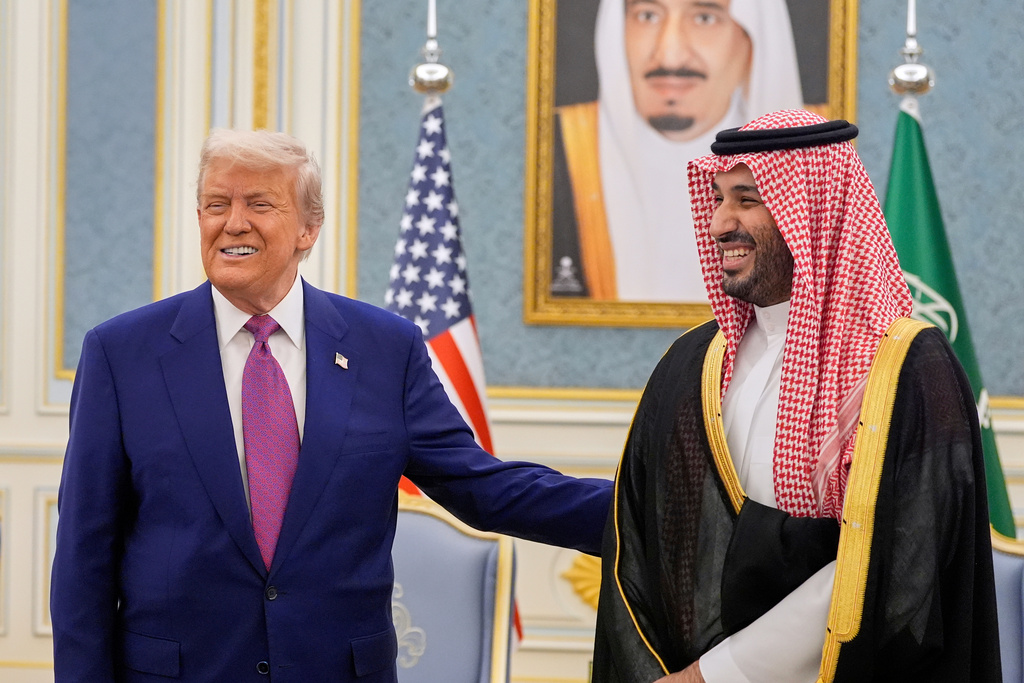
Gulf officials from the three countries President Trump publicly credited with persuading him to call off a U.S. military strike on Iran ostensibly planned for Tuesday say they were unaware of any imminent attack, according to a Wall Street Journal report that calls into question the central premise of the president’s announcement.
Trump said in a Truth Social post Monday afternoon that he had postponed a “scheduled attack of Iran” that had been set for Tuesday, citing direct appeals from Qatari Emir Sheikh Tamim bin Hamad Al Thani, Saudi Crown Prince Mohammed bin Salman and U.A.E. President Sheikh Mohamed bin Zayed Al Nahyan. The leaders, Trump said, had asked him to delay the operation by two to three days to allow serious negotiations with Tehran to bear fruit.
“I was asked by Saudi Arabia, Qatar, UAE, and some others if we could put it off for a short period of time,” Mr. Trump told reporters at the White House on Monday evening. “There seems to be a very good chance that they can work something out. If we can do that without bombing the hell out of them, I’d be very happy.”
But several officials from the three Gulf countries told the Journal they had not been briefed on any imminent American strike plan and therefore could not have asked Trump to pause it. The discrepancy raises questions about whether the operation was as advanced as the president described, whether the Gulf capitals were brought in only after the decision had been made, or whether the announcement itself was a piece of strategic messaging.
U.S. military officials quoted by The New York Times on Tuesday noted that Trump’s public announcement could itself function as a form of strategic deception. Trump acknowledged in his Truth Social post that the planned attack was something “nobody knew” about, an unusual framing given his simultaneous claim that three heads of state had urgently called him to stop it.
In his statement, the president said he had instructed Secretary of War Pete Hegseth, Joint Chiefs Chairman Gen. Daniel Caine and the U.S. military to stand down from the Tuesday strike but to “be prepared to go forward with a full, large scale assault of Iran, on a moment’s notice, in the event that an acceptable Deal is not reached.” He described the pause as a “very positive development” while acknowledging that previous moments of apparent breakthrough had collapsed. “But this is a little bit different,” he said.
The announcement came after a weekend in which Trump warned that the “clock is ticking” for Iran and that there “won’t be anything left of them” if Tehran did not move quickly on a deal. He had described the April 7 ceasefire as being on “life support” last week, days after U.S. and Iranian forces exchanged fire in the Strait of Hormuz. Iran has relayed an amended set of terms to the Trump administration through Pakistani mediators, though Trump previously dismissed an earlier Iranian proposal as “garbage.”
Markets reacted within minutes. Brent crude futures, which had been trading at $108.83 a barrel ahead of the announcement, fell more than $2 before climbing again to close at $107.25. The Strait of Hormuz remains effectively closed, and the United States is enforcing a naval blockade of Iranian ports that has redirected 85 commercial vessels from mid-April through Monday, according to U.S. military figures.
Iranian state television responded by characterizing the postponement as a “retreat” born of “fear” and reported that air defenses had been activated late Monday on Qeshm Island, the largest Iranian island in the Persian Gulf and home to about 150,000 people. Iranian authorities said the situation there was “under control.”
The Gulf monarchies have spent the war attempting to keep themselves out of the line of fire. Saudi, Emirati, Qatari and Kuwaiti officials privately complained earlier in the conflict that they were not given adequate notice of the Feb. 28 U.S.-Israeli strikes, even as they have absorbed repeated Iranian drone and missile attacks on their energy infrastructure, ports and refineries since the war began. The U.A.E. has accused Iran of carrying out drone and missile strikes during the ceasefire itself.
Trump has set and abandoned deadlines on Iran throughout the war. He has also, on at least one prior occasion, signaled a willingness to let diplomacy run its course only to order strikes shortly afterward, a pattern that played out at the war’s outset.
For the Gulf capitals named in Monday’s announcement, the political bind is acute. Confirming Trump’s account would suggest they had advance knowledge of an American military operation against Iran, a position with significant risk given Tehran’s prior warnings that any Gulf country whose territory or airspace is used against Iran becomes a legitimate target. Denying it, as their officials have now done to the Journal, undercuts the diplomatic narrative the White House offered the world.
(YWN World Headquarters – NYC)
 Join the official YWN WhatsApp status


2 Responses
This is what happens when America elects a serial adulterer and liar as president. Virtually every word out of his mouth is a lie. Iran couldn’t care less about the threats of Mr. Election Denier. Trump is out of his league and quite obviously has no idea what he is doing. His “Department of War” has fired every capable general and the new boss is a joke of a FOX news host he boasts of military escapades on an insecure signal chat. The lacking of planning by Trump is costing us all and he has no way out of it. Bibi deserves blame as well. In any case Trump has no money for health issues but all the tax payer money for his ballroom – which he lied would be paid with private funding – and slush fund cash cow for his J6 rioter buddies.
Liar just trying to cover his incompetence and stupidity.