As Russia escalates its war in Ukraine and stories of civilian casualties and destruction in cities reach the United States, support has risen for a major American role — and so has fear of the threat Russia poses to the U.S.
The new poll from The Associated Press-NORC Center for Public Affairs Research also finds a majority of Americans say they’re willing to accept damage to the economy if it helps to stop Russian President Vladimir Putin’s invasion. Forty percent now say the U.S. should have a “major role,” up from 26% in an AP-NORC poll conducted just before the invasion began.
Another 46% say the U.S. should have a “minor role.” The percentage who think the U.S. shouldn’t be involved at all ticked down from 20% to 13%.
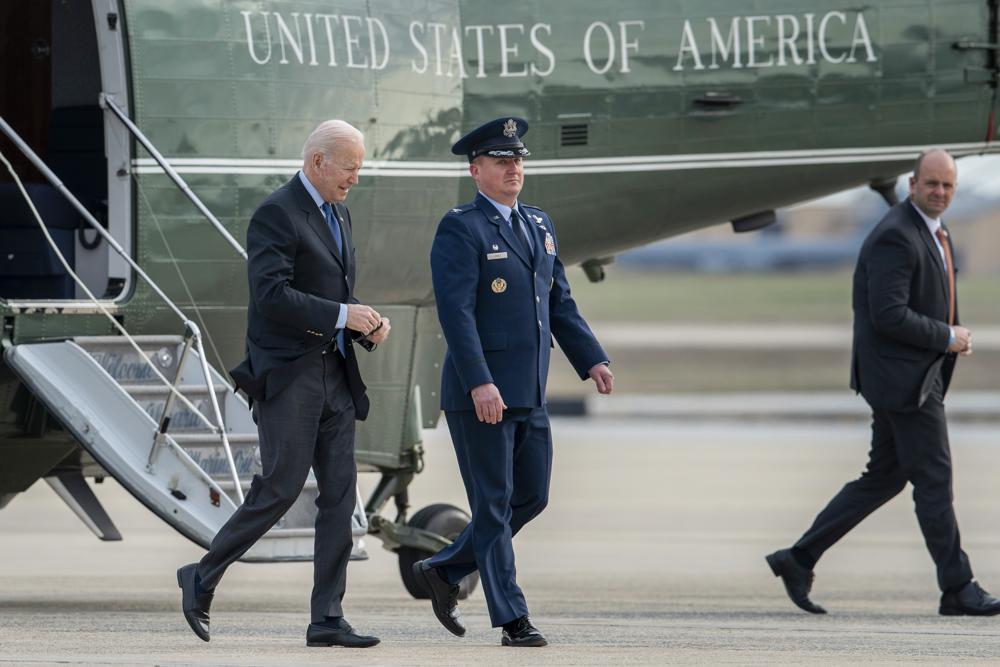
The poll suggests many Americans want President Joe Biden to do more to counter Russia without suggesting he should reverse his pledge not to send U.S. troops to Ukraine.
Additional U.S. forces have deployed to neighboring countries that are part of NATO. The U.S. and West, meanwhile, have imposed sanctions that have crushed Russia’s economy. They are providing anti-tank and anti-missile weapons to Ukraine, which has mounted a robust resistance, killed thousands of Russian troops, and stopped Russia from taking Kyiv or other major cities so far. But the White House has also held back some weapons and intelligence as it seeks to avoid a direct conflict between the U.S. and Russia, which have the world’s two largest nuclear arsenals.
A majority of Americans — 56% — think Biden hasn’t been tough enough on Russia, according to the poll. Another 36% said his approach has been “about right.”
Speaking after the release of the earlier AP-NORC poll, White House press secretary Jen Psaki noted that Americans may have different meanings of what is a “major role” or “minor role” in the conflict. “We make national security decisions based on what’s best for our country’s national security, not on the latest polling,” Psaki said.
Russia’s continued bombardment of Ukraine and Putin’s raising the alert level on his country’s nuclear weapons has sparked fears around the world. The poll shows the vast majority of Americans are at least somewhat concerned that the U.S. will be drawn into a war with Russia, including nearly half who are very or extremely concerned. Several respondents interviewed after the poll raised the possibility of a third world war.
There’s also increasing worry about Russia’s influence in the world — with 64% saying they were very or extremely concerned, up from 53% a month ago — and strong support for the U.S. sanctioning Russia and supporting Ukrainian refugees. Two-thirds said they favor accepting people from Ukraine into the U.S., compared to only about 1 in 10 opposed.
Putin’s decision to invade reminded Leo Martin, an 85-year-old from Council Bluffs, Iowa, of Nazi Germany entering Poland in 1939, which started World War II in Europe.
“I’m not sure if Putin is bluffing but it seems like we’re going to have to push back,” he said. “I didn’t think he was quite as ruthless as he is. That kind of surprised me.”
Americans ages 60 and older were most likely to say the U.S. should play a major role, at 58% compared with 39% of those ages 45 to 59 and 29% of those under age 45. The percentages in all three age groups rose this month from February.
The poll also found a small majority of Americans — 55% — saying the bigger priority for the U.S. in response to Russia’s invasion of Ukraine is “sanctioning Russia as effectively as possible, even if it damages the U.S. economy.” Still, a sizeable minority — 42% — said the bigger priority is “limiting damage to the U.S. economy, even if it means sanctions on Russia are less effective.”
About 7 in 10 Americans approve of economic sanctions imposed by the U.S. on Russia in general and the ban on Russian oil in particular.
“When you look at what the people of Ukraine are going through and all the upheaval over there, it’s like, ‘Well, we can pay a little more for gas,'” said Anne-Marie Klein, 38, from Longview, Washington.
Klein said she considered Putin a “madman” and said the U.S. had to strike the balance between pushing back against the Russian president without instigating the kind of global conflict that her two sons, ages 8 and 10, may one day have to fight. She said she believed the U.S. should play a “minor role.”
“‘Minor role’ to me means our troops aren’t fighting,” she said. “It can stop there and not become nuclear.”
Drake Brandon, a 23-year-old from Sacramento, California, said he was trying to find work and said many people were worried about rising gas prices and economic issues. But while Brandon also said he wanted the U.S. to have a “minor role” focusing on sanctions, he rated his level of concern about the conflict, on a 1 to 10 scale, as an 8 or 9.
“I think about it every day,” he said. “Part of me thinks Putin has nothing to really lose at this point.”
(AP)
 Join the official YWN WhatsApp status