
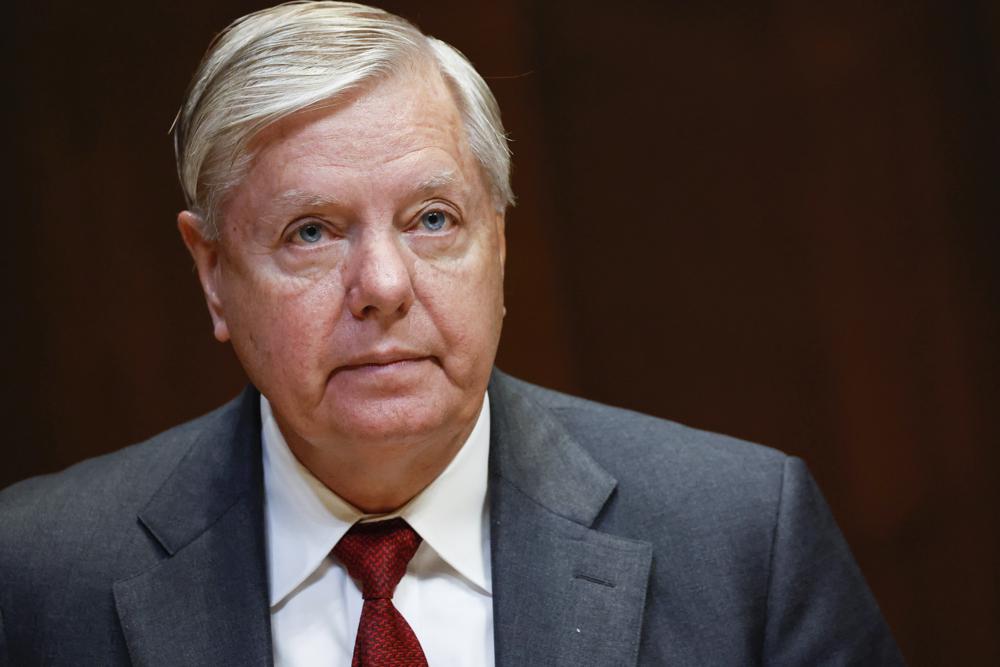
U.S. Sen. Lindsey Graham wasn�t seeking to interfere in Georgia�s 2020 election when he called state officials to ask them to reexamine certain absentee ballots after President Donald Trump�s narrow loss to Democrat Joe Biden, his lawyers said in a federal court filing.
Graham�s lawyers made the argument as part of efforts to fight a subpoena compelling the South Carolina Republican to testify before a special grand jury in Georgia that�s investigating Trump and his allies� actions after his 2020 election defeat.
�Senator Graham has never inserted himself into the electoral process in Georgia, and has never attempted to alter the outcome of any election,� Graham�s attorneys wrote Tuesday in court papers filed in South Carolina. �The talk was about absentee ballots and Georgia�s procedures.�
Graham was one of a handful of Trump confidants and lawyers named in petitions filed last week by Fulton County District Attorney Fani Willis as part of her investigation into what she alleges was �a multi-state, coordinated plan by the Trump Campaign to influence the results of the November 2020 election in Georgia and elsewhere.�
In her subpoena petition, Willis wrote that Graham, a longtime Trump ally, made at least two telephone calls to Georgia Secretary of State Brad Raffensperger and members of his staff in the weeks after Trump�s loss to Biden, asking about reexamining certain absentee ballots �to explore the possibility of a more favorable outcome for former President Donald Trump.�
After their call, Raffensperger told The Washington Post that Graham had asked him whether he had the power to reject certain absentee ballots, a question the official said he interpreted as Graham�s suggestion to toss out legally cast votes, an allegation Graham at the time called �ridiculous.�
Willis also filed petitions to compel cooperation from former New York Mayor Rudy Giuliani � who was one of Trump�s primary lawyers during the failed efforts to overturn the result of the election � as well as lawyers Kenneth Chesebro, Cleta Mitchell, Jenna Ellis, John Eastman and Jacki Pick Deason.
Graham�s lawyers argued in the legal filing that he has �sovereign immunity� from state court procedures pertaining to his job as a senator, as well as constitutional protection because �the testimony sought relates to matters within the legislative sphere.� They asked the federal judge in the case to quash Graham�s subpoena.
�What I�m trying to do is do my day job,� Graham said in a statement provided to The Associated Press on Wednesday. �If we open up county prosecutors being able to call every member of the Senate based on some investigation they think is good for the country, we�re opening Pandora�s Box.�
Willis� office didn�t immediately respond to a request for comment Wednesday.
Because she is trying to compel testimony from people who live outside of Georgia, Willis had to submit petitions for a judge�s approval. The judge overseeing the special grand jury signed off on her petitions.
A judge in Graham�s home state will determine whether he is a �material and necessary witness,� whether the trip to Atlanta to testify would be an undue burden and whether the subpoena should be issued.
The case was initially assigned to U.S. District Judge Timothy M. Cain, who was Graham�s law partner back in the late 1980s and early 1990s. The case was reassigned Wednesday to U.S. District Judge Henry Herlong Jr., who ruled that the subpoena can�t be executed for the time being and scheduled a hearing for next Wednesday.
(AP)
 Join the official YWN WhatsApp status




One Response
The whole premise of this so-called “investigation” is ridiculous and illegal. The first amendment explicitly protects Trump’s and others’ right to call Raffensperger and urge him to do as they asked. They weren’t asking for anything illegal; they simply wanted him to look at the absentee votes and identify just a small fraction of the many tens of thousands of illegally cast ones that they asserted were to be found among them. (Whether that assertion was correct is irrelevant; all that matters is that they clearly believed it.)