
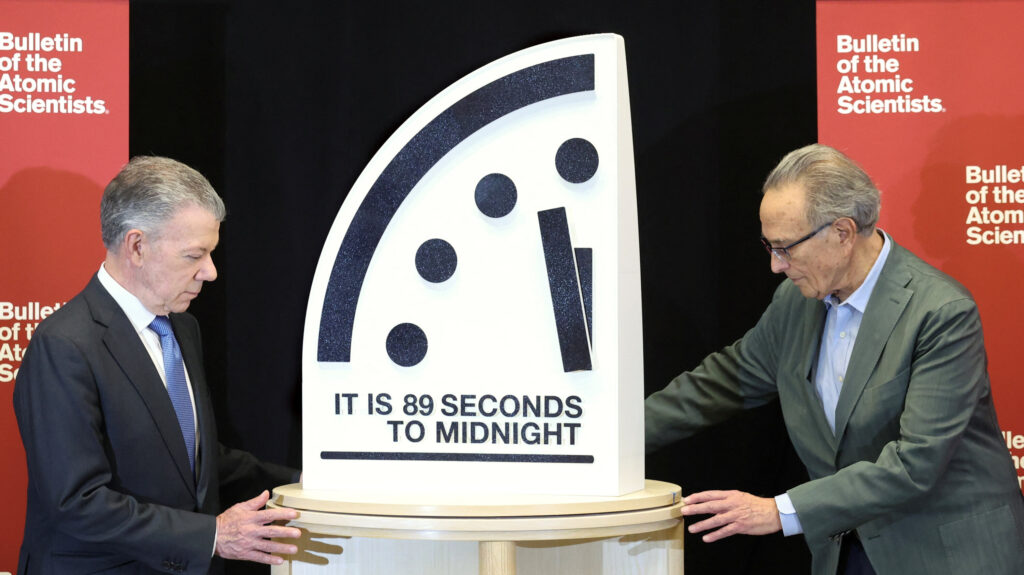
The Bulletin of the Atomic Scientists moved its Doomsday Clock closer to catastrophe on Tuesday, setting it at 85 seconds to midnight — the closest point to global disaster in the symbolic clock’s 79-year history.
The shift, which advances the clock four seconds from last year, reflects what the group described as a worsening convergence of nuclear tensions, geopolitical instability and emerging technological threats, particularly artificial intelligence.
“It is the determination of the bulletin’s science and security board that humanity has not made sufficient progress on the existential risks that endanger us all,” said Alexandra Bell, the organization’s CEO. “We thus move the clock forward.”
The Doomsday Clock, created in 1947 by scientists involved in the Manhattan Project, is designed as a metaphor for how close humanity is to self-inflicted catastrophe. The Bulletin was founded by figures including Albert Einstein and J. Robert Oppenheimer, with the clock serving as a public warning system tied to nuclear, biological, technological and climate-related threats.
Last year, the clock stood at 89 seconds to midnight. This year’s move to 85 seconds marks the most dire assessment in the organization’s history.
Steve Fetter, a member of the Bulletin’s Science and Security Board, said the decision reflects “increased risk of catastrophe resulting from current trends,” including the possibility of nuclear conflict, global disease threats and the rapid expansion of artificial intelligence.
At a press conference announcing the change, Bulletin leaders cited a worldwide “failure of leadership” as a central driver of rising risk.
“Major countries became even more aggressive, adversarial and nationalistic,” said Daniel Holz, a Bulletin board member and physics professor at the University of Chicago. “Conflicts intensified in 2025 with multiple military operations involving nuclear-armed states.”
Those concerns were fueled by a series of flashpoints over the past year, including escalating tensions between India and Pakistan and renewed nuclear signaling by Russia amid its war in Ukraine. Earlier this month, Moscow fired a nuclear-capable hypersonic missile at Ukraine, a move that drew alarm among Western officials and arms-control experts.
Compounding the nuclear risk is the looming expiration of the New START treaty, the last remaining major arms control agreement limiting U.S. and Russian strategic nuclear arsenals. The treaty is set to expire Feb. 5.
“For the first time in over half a century, there will be nothing preventing a runaway nuclear arms race,” Holz warned.
The Bulletin also highlighted artificial intelligence as a rapidly growing threat multiplier.
Journalist and Nobel Peace Prize laureate Maria Ressa warned that generative AI is accelerating “global chaos” by enabling the spread of disinformation at unprecedented speed and scale, while also enabling new forms of fraud and manipulation.
“One clear risk is the use of AI to design novel pathogens — particularly pathogens that don’t exist in nature and for which no countermeasures exist,” Fetter said. He also warned about the growing use of AI in military systems, especially if autonomous technologies are incorporated into lethal decision-making.
Bulletin leaders stressed that the Doomsday Clock is not intended as a prediction of imminent apocalypse, but as a policy and political warning designed to spur action.
“It is ticking, but it can be turned back,” Ressa said. “Now is the time to act.”
The organization called for renewed arms control efforts, stronger global cooperation, and governance frameworks for emerging technologies that prioritize safety and transparency over speed and commercial competition.
(YWN World Headquarters – NYC)
 Join the official YWN WhatsApp status







2 Responses
Bunch of ??????
It’s a political clock that depends on the political leanings of its owners.