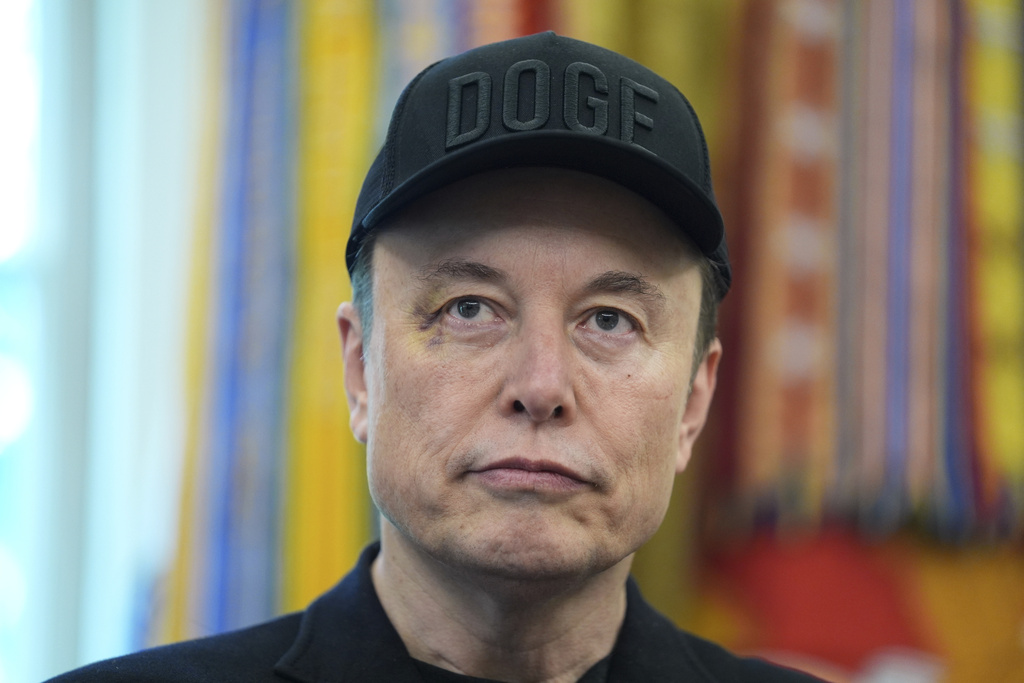
Elon Musk says his rocket company SpaceX is shifting its primary focus from colonizing Mars to building what he calls a “self-growing city” on the Moon, arguing that the lunar goal is more achievable in the near term.
Speaking recently at the World Economic Forum, and in a post Sunday on X, Musk said the company believes a permanent human settlement on the Moon could be established within a decade — far sooner than a comparable effort on Mars.
“For those unaware, SpaceX has already shifted focus to building a self-growing city on the Moon,” Musk wrote. “It is only possible to travel to Mars when the planets align every 26 months … whereas we can launch to the Moon every 10 days. This means we can iterate much faster.”
Musk said missions to Mars would continue in parallel and could begin within five or six years, but emphasized that lunar development would take priority. “The overriding priority is securing the future of civilization,” he wrote, adding that the Moon offers a faster path toward that goal.
The announcement marks a notable shift for Musk, who for more than a decade has promoted Mars colonization as central to human survival. He has frequently criticized lunar-focused missions and last year dismissed the Moon as “a distraction.”
Last year, Musk said SpaceX hoped to land its first uncrewed spacecraft on Mars by 2026. That timeline, like several of his past projections, has since slipped.
The company’s new emphasis comes as the U.S. government pushes to return astronauts to the Moon through NASA’s Artemis program. Under the agency’s Artemis III mission, astronauts are expected to land on the Moon by 2028 — the first such landing since the Apollo era.
SpaceX holds a nearly $3 billion contract to build the lunar lander for the mission, using its massive Starship rocket system. The vehicle has experienced multiple test failures and has yet to reach orbit successfully, raising concerns among federal officials about schedule delays.
Former NASA acting administrator and current Transportation Secretary Sean Duffy has warned that the agency could turn to rivals if SpaceX falls further behind.
One potential alternative is Blue Origin, founded by Jeff Bezos, which has been developing its own lunar landing systems after pausing its space tourism operations.
Musk’s announcement also follows recent corporate developments. Earlier this month, SpaceX agreed to acquire his artificial intelligence firm xAI, creating a combined private company valued at roughly $1.25 trillion, according to Bloomberg. The merger ties together Musk’s aerospace, artificial intelligence and social media ventures, including X and its Grok chatbot. Analysts say the consolidation could complicate potential plans for a SpaceX initial public offering, which has been reported by the Financial Times as under consideration.
Industry analysts say Musk’s pivot reflects both technical realities and strategic positioning. Regular lunar launches would allow SpaceX to test life-support systems, construction techniques and logistics networks more frequently than deep-space Mars missions.
(YWN World Headquarters – NYC)
 Join the official YWN WhatsApp status