
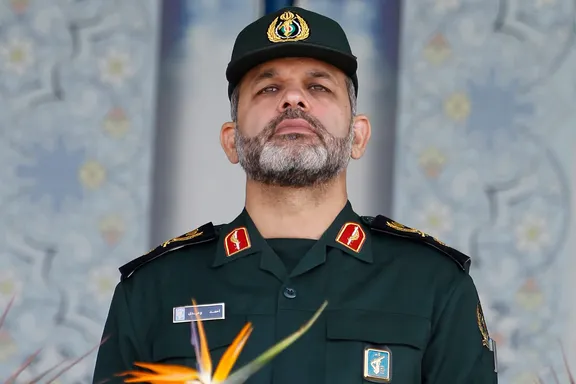
Iranian state media announced on Sunday that Ahmad Vahidi, a former defense and interior minister, has been appointed commander of the Islamic Revolutionary Guard Corps.
The appointment came just hours after Iran confirmed the deaths of several top officials in Saturday’s strikes, including IRGC commander-in-chief Mohammad Pakpour. Also killed were Chief of Staff of the Armed Forces Abdolrahim Mousavi, Defense Minister Aziz Nasirzadeh, and Ali Shamkhani, a senior adviser to Supreme Leader Ali Khamenei.
The loss represents one of the most severe blows to Iran’s military hierarchy in decades. Within a single strike, the country’s senior command structure was effectively decapitated.
Vahidi is not an obscure military technocrat. He is a figure whose name has appeared for years in international arrest warrants and sanctions lists. Since 2007, he has been subject to an Interpol Red Notice at the request of Argentine prosecutors, who accuse him of helping plan the 1994 bombing of the AMIA Jewish community center in Buenos Aires. That attack killed 85 people and injured hundreds more when a van packed with explosives detonated outside the building. It remains one of the deadliest attacks against Jewish targets outside Israel since the Holocaust.
At the time of the bombing, Vahidi was serving as commander of a special Quds Force unit within the Revolutionary Guard. Argentine authorities allege he played a central role in overseeing the operation. Iran has consistently denied involvement in the attack and has refused to extradite the officials charged. The case has strained relations between Buenos Aires and Tehran for more than three decades and remains unresolved.
Vahidi’s record is not limited to foreign allegations. As Iran’s interior minister during the 2022 nationwide protests, he oversaw security forces accused by Western governments and human rights organizations of violently suppressing demonstrations. The protests, which followed the death of Mahsa Amini, were met with mass arrests and the reported use of lethal force. The United States sanctioned Vahidi over what his role in serious human rights abuses and the suppression of dissent.
Now, Tehran has chosen him to lead the most powerful and influential institutions in the country. The Islamic Revolutionary Guard Corps is not merely a military branch; it operates as a parallel power center with control over key security operations, intelligence networks, and significant economic holdings. Its Quds Force arm directs Iran’s external operations and maintains ties with allied militias across the Middle East.
The choice of Vahidi appears to send a deliberate signal. Rather than seeking a figure who might want to soften tensions or suggest a pivot toward diplomacy, Iran has elevated a commander deeply associated with hardline policies, external operations, and internal crackdowns.
President Donald Trump has said the joint US-Israeli campaign will continue “uninterrupted” until broader security objectives are achieved.
(YWN World Headquarters – NYC)
 Join the official YWN WhatsApp status





3 Responses
Dead man walking
walking dead man.
the next dead vildeh chaya on the list