
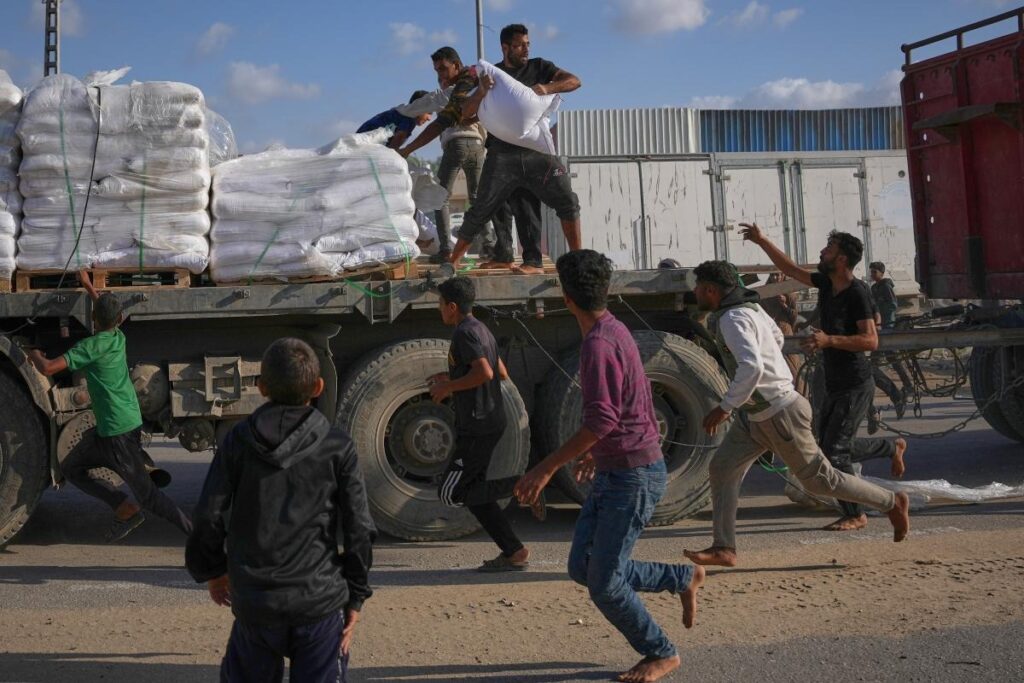
Hamas has rebuilt its fighting force to an estimated 20,000 armed terrorists, reestablishing military and political control over large portions of the Gaza Strip during the cease-fire, according to a new report from the New York Times. The terror group is manning checkpoints, enforcing street-level authority, and replenishing its finances through new taxes on commercial imports, even as Israel and the Trump administration insist Hamas must disarm as part of the emerging peace framework.
Two years of war devastated Gaza and killed more than 22,000 Hamas terrorists, according to Israeli figures. But intelligence officials now warn the group has effectively replaced the bulk of its losses.
“Hamas was hit hard, but it wasn’t defeated,” said Shalom Ben Hanan, a former senior Shin Bet official. “It’s still standing.”
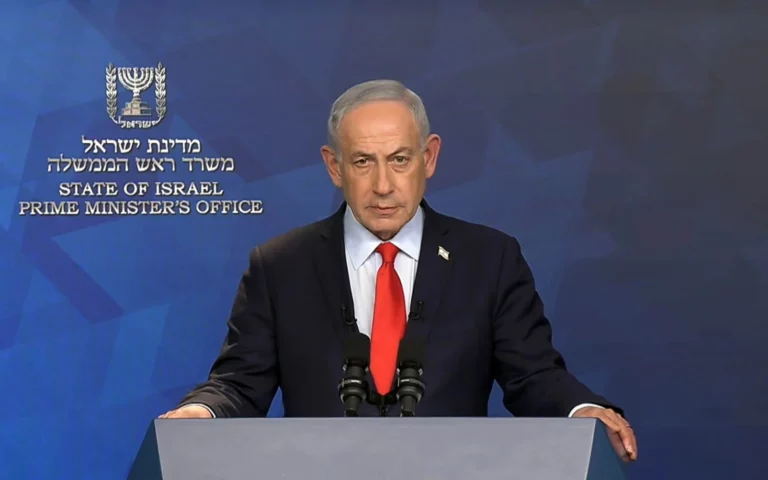
Israeli PM Netanyahu expressed skepticism that the proposed international stabilization force–set to deploy in Gaza under the second phase of President Trump’s regional peace plan–will be able to compel Hamas to disarm.
“We can do it the easy way, or the hard way,” Netanyahu warned. “But in the end it will be done.”
Netanyahu reiterated that Israel will not permit the creation of a Palestinian state, arguing it would pose a permanent existential threat.
Israeli and Western reports indicate Hamas now controls roughly 43% of Gaza, maintaining access to its extensive underground tunnel network and stockpiles of rockets capable of striking deep inside Israel.
In its territory, Hamas has resumed full internal policing. Residents report violent crackdowns on crime, including public executions of alleged offenders–actions that have paradoxically boosted the terror group’s popularity among desperate Gazans.
The group’s resurgence was punctuated by a recent victory: the death of Yasser Abu Shabab, a leader of an Israeli-backed anti-Hamas militia, during clashes among clans in Rafah.
Following Israel’s decision to allow commercial goods into Gaza during the cease-fire, Hamas has reportedly imposed tariffs on items such as solar panels and computers, businessmen told the Times. Hamas officials deny this, but merchants insist the taxes are real–and lucrative.
The influx of cash has enabled Hamas to recruit new fighters, attracting impoverished Gazans with promises of food stipends and salaries.
Husam Badran, a senior Hamas figure, said the group is willing to transfer authority to Palestinian technocrats–as the Trump plan requires–only if Israel withdraws from the remaining 57% of Gaza and allows a process toward Palestinian statehood.
“Without that, talking about these matters would be nonsensical,” Badran said.
But Netanyahu has made clear that Israel will never accept a Palestinian state, and that if Hamas refuses to voluntarily demilitarize, Israel will resume fighting.
US officials say a transition to Phase Two of Trump’s 20-point peace plan is imminent. It will outline the structure of the temporary Board of Peace, as well as the International Stabilization Force expected to govern Gaza and oversee demilitarization.
Whether Hamas will cooperate–or whether Israel will again be forced to intervene–remains the central question as the terror organization regains strength on the ground.
(YWN World Headquarters – NYC)
 Join the official YWN WhatsApp status





2 Responses
If the New York Times story is correct (and even occasionally some of them are truthful, at least in part), it means Bibi lost the war, and that usually means the end of a politician’s career.
Am I missing something? We�re doing a �peace plan� and everyone is ok with Hamas rearming its terror control of Gaza? Which point in the 20 point plan does that fall under? Is it not obvious that there is no peaceful future, 20 point or 2 million point plan notwithstanding? Is it not clear that Hamas has no plans to let anyone run a peaceful Gaza? If Turkey or the Palestinians or any country or group of countries become the �neutral� managers of Gaza, don�t we know exactly how neutral that will be? Why are we kidding ourselves? Who doesn�t get it? Are we waiting for Hamas to have full control of Gaza (or will we even care if they do)? How asinine�