
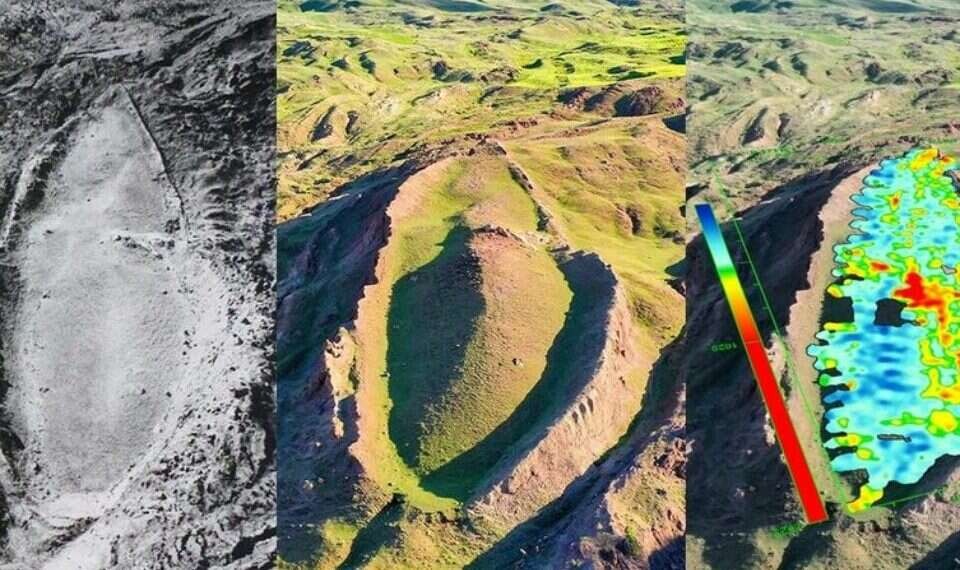
For generations, the question of where Noach’s Teiva came to rest after the Mabul has captured the imagination. Now, newly discovered archaeological findings near Turkey’s Mount Ararat are renewing discussion around a site long associated with the Teiva.
Researchers in eastern Turkey report that pottery fragments dating back thousands of years have been uncovered near the Durupinar Formation, a boat-shaped geological structure that has been at the center of Teiva-related speculation for decades. The discoveries were made during road construction near the site, located close to the town of Dogubayazit in Agri province.
Prof. Dr. Faruk Kaya of Agri Ibrahim Cecen University said the ceramic fragments were found close to the outline of the formation and indicate human activity in the region in a timeframe that broadly aligns with traditional estimates for the period of Noach and the aftermath of the Mabul.
“These findings show that this area was inhabited in ancient times,” Kaya said, adding that the dating of the pottery is consistent with the era associated with the events described in Sefer Bereishis.
The Durupinar Formation has drawn attention since it was first identified in 1959 by Turkish Army Captain Ilhan Durupinar. Subsequent erosion caused by heavy rains and seismic activity exposed more of the structure, revealing an outline that many observers have noted resembles the shape of a large vessel.
In Bereishis, the Torah states that the Teiva came to rest on the “mountains of Ararat” after the waters of the Mabul prevailed over the earth for 150 days. The Torah also provides precise measurements of the Teiva — 300 amos long, 50 amos wide, and 30 amos high — dimensions that researchers say roughly correspond to the scale of the Durupinar site.
In recent years, scientific study of the area has intensified. In 2022, the Mount Ararat and Noah’s Ark Research Team was formally established through a partnership between Agri Ibrahim Cecen University and Istanbul Technical University. The team includes experts in fields such as geophysics, chemistry, and geo-archaeology.
Rock and soil samples collected from the formation were analyzed in specialized laboratories at Istanbul Technical University. According to researchers, the results suggest that sustained human life in the region was possible, lending further support to claims that the area could correspond to the site described in the Torah.
While definitive proof of the Teiva’s location remains elusive, the pottery discoveries have added a new layer of evidence to an age-old question, and have once again drawn global attention to a site many believe may be connected to one of the most foundational events recorded in the Torah.
(YWN World Headquarters – NYC)
 Join the official YWN WhatsApp status







3 Responses
Every tragedy has a wake up call message DIRECTLY FROM HASHEM that you’re not going to find in any sefer in the world or read in any newspaper from a Gadol Hador or speaker saying about the tragedy. And neither is it from me a Internet businessman writer.)
THE MESSAGE
In October of 2011, on the week of Parshas Noach. The country of Turkey was hit by a major-7.2-Earthquake that resulted in hundreds of deaths, thousands injured & hundreds of buildings destroyed. It happened in the region of Turkey known as the Ararat Province, which research says, is where the taiva of Noach came to rest as the mabul (flood) subsided. In this part through many generations thousands of jews thrived in Turkey, with shuls, of which almost nothing remains today. Some shuls remain empty, standing isolated in the city of the Van region, which is the city of Charan, where Terach lived with Avraham until he moved to Eretz Yisroel. What is the message from Hashem? Todays judaism in Turkey is totally isolated, if we don’t do ????? as soon as possible, other countries will be destroyed of jews C�V & become isolated.
LOL
??? ????