
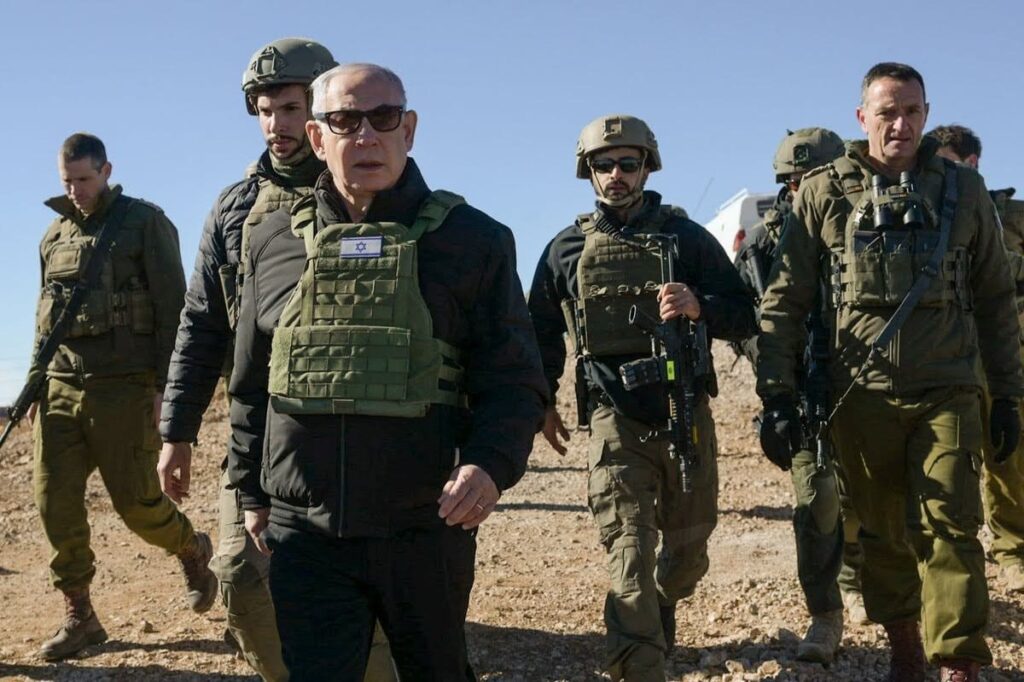
Less than a week before Hamas’s October 7, 2023, massacre, Israeli PM Netanyahu instructed his senior advisers and security chiefs to preserve a policy of economic incentives and relative restraint toward the terror group, according to a report aired Sunday by Channel 12.
The disclosure complicates Netanyahu’s recent effort to portray himself as a consistent advocate of tougher action against Hamas, following the release last week of a 55-page document containing selected excerpts from cabinet discussions in the years preceding the attack.
Those excerpts, published as part of Netanyahu’s response to a state comptroller inquiry, depicted the prime minister as favoring aggressive measures while casting political rivals and security officials as obstacles to decisive action. However, the Channel 12 report says Netanyahu omitted a key meeting held on October 1, 2023 — just six days before the Hamas-led onslaught.
According to a leaked summary of that meeting’s protocol, Netanyahu praised Israel’s security services for maintaining calm and emphasized the need for moderation ahead of Sukkos in order to avoid escalation.
“The prime minister expressed great appreciation to all the security services on their activities to maintain the quiet on all fronts,” the summary states, “and stresses that we must act with moderation in order to cool down the fronts and avoid escalation.”
At the meeting, security chiefs reportedly urged moving toward targeted assassinations of Hamas leaders. Netanyahu, however, conditioned any such operations on the outbreak of open conflict and directed the defense establishment to prioritize potential actions in the West Bank rather than in Gaza, according to the report.
The prime minister also defined Israel’s central strategic goals at the time as advancing normalization with Saudi Arabia and preventing wider regional confrontation.
The October 1 meeting was attended by senior figures from Israel’s political and security leadership, including Mossad chief David Barnea, then-defense minister Yoav Gallant, then-Shin Bet director Ronen Bar, then-IDF Chief of Staff Herzi Halevi, National Security Adviser Tzachi Hanegbi, and Strategic Affairs Minister Ron Dermer. The session took place at the Prime Minister’s Office in Jerusalem.
Senior defense officials told Channel 12 that Netanyahu’s publication of selective quotations distorted internal discussions and caused what they described as “irreparable damage” to relations between political leaders and the security establishment.
The controversy has quickly spilled into Israel’s electoral arena, where accountability for the October 7 failures has become a central issue.
Former prime minister Naftali Bennett, Netanyahu’s leading challenger in the upcoming elections, issued a video statement Sunday night blasting the prime minister’s account.
Bennett mocked Netanyahu’s portrayal of events by comparing him to the fictional character in the 1994 film Forrest Gump, describing him as a passive figure swept along by history rather than an active leader.
“He is not a leader, but someone who is led. He is not a commander, but a subordinate,” Bennett said, adding that Netanyahu’s document undermined his own claims of authority.
Bennett acknowledged that he, too, has criticized Israel’s security establishment, but argued that ultimate responsibility rested with Netanyahu, who served more than a decade as prime minister in the years leading up to the attack.
“He was the prime minister of Israel and the supreme commander of the State of Israel for 12.5 out of the 14 years preceding the greatest disaster in Israel’s history,” Bennett said.
He further accused Netanyahu of portraying himself as incapable of controlling the military and intelligence agencies — a stance Bennett said amounted to self-indictment.
“What emerges from it is that Netanyahu did not lead, did not manage, and did not govern,” Bennett said. “Instead of absolving himself, he has drafted the most severe indictment imaginable against a prime minister in Israel.”
Bennett also faulted Netanyahu for allowing terrorist threats to expand on multiple fronts, arguing that Hamas in Gaza and Hezbollah in Lebanon grew unchecked under his watch.
(YWN World Headquarters – NYC)
 Join the official YWN WhatsApp status





1 Response
Israel didn’t have an army willing to fight before October 7th. Everyone was deserting the army. Including high ranking generals, because of the Judicial fight.