
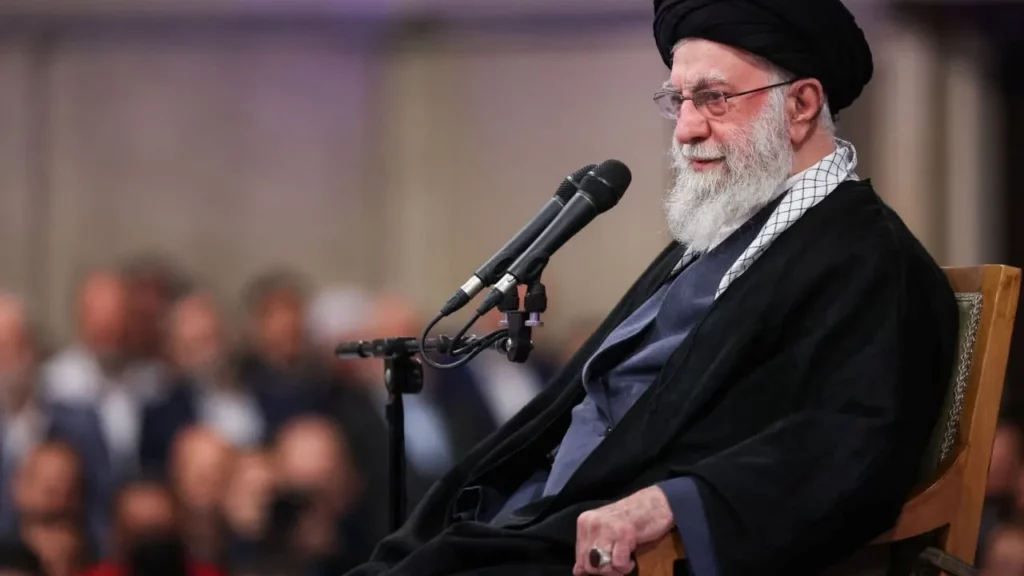
The U.S. and Israel launched a major joint attack on Iran early Shabbos morning, carrying out hundreds of strikes on high-level targets, including the leadership of the Iranian regime.
The IDF spokesperson announced that about 200 fighter jets took part in what it described as its largest-ever attack, targeting Iranian ballistic missile launchers and air defense systems. Hundreds of munitions were dropped on about 500 military targets across western and central Iran in near-simultaneous strikes during the morning hours. The attack on Iran has been named Operation Roaring Lion.
�This is the largest strike operation in the history of the Israeli Air Force, carried out after meticulous planning and based on high-quality intelligence, while synchronizing hundreds of fighter jets simultaneously,� the IDF spokesperson said. �The strikes on Iran�s air defense systems facilitated the expansion of the IAF�s air superiority over Iranian skies and severely degraded the regime�s offensive capabilities�the launch sites in western Iran.�
At about 9:40 p.m. local time, a senior Israeli official confirmed that Iranian Supreme Leader Ali Khamenei was eliminated in the opening strikes. Prime Minister Binyamin Netanyahu was even shown photo evidence of his body being pulled from the compound.
President Donald Trump also confirmed that Khamenei was dead, killed in the opening salvo.
�Khamenei, one of the most evil people in History, is dead,� Trump wrote on Truth Social, announcing the death of the Islamic Republic�s longtime leader. The president said strikes would continue �uninterrupted� throughout the week or as long as necessary until regime change is secured.
The announcement came as U.S. officials described one of the most intense openings to a military campaign in history.
According to an unnamed U.S. official who spoke to Fox News, American forces launched nearly 900 strikes in the first half-day of operations, attacking targets from land, air and sea, including with drones.
Iran fired roughly 300 ballistic missiles during the first 12 hours of combat – at least half of them aimed at Israel – according to the U.S. official. American forces simultaneously conducted offensive strikes while defending against incoming projectiles.
Israelis spent Shabbos day running in and out of bomb shelters, though only 1 casualty was reported, coming from a missile strike in Tel Aviv.
Additionally, a three-story apartment building in Ramat Gan sustained serious damage after being hit by shrapnel, but b�Chasdei Hashem, no one was injured. Rescue teams evacuated the building�s residents due to safety concerns.
In another missile attack, a private house was damaged by shrapnel in Petach Tikvah, but Baruch Hashem, the family members were in the shelter and weren�t injured.
There were reports of shrapnel falling in many other locations, mainly in central Israel, causing property damage.
The volleys were far smaller than those fired during the June 2025 war, when Iran frequently launched dozens of missiles at once to try to overwhelm Israel�s defenses. It was unclear whether the reduced scale stemmed from damage to Iran�s capabilities in that war, the impact of the day�s initial Israeli-American strike, confusion within Iranian forces, or a combination of these factors.
Iran maintains an estimated arsenal of 2,000 long-range missiles and another 2,000 shorter-range missiles, the official said, noting that those stockpiles had been replenished following U.S. and Israeli strikes last summer.
Iran also launched missiles at US allies in the Middle East, including Qatar, Saudi Arabia, Jordan, the UAE, Kuwait, and Bahrain. One person was killed, and several were injured in an attack in Dubai, and three soldiers were lightly injured in an attack on the Ali al-Salem Air Base in Kuwait.
While Israel was reportedly behind the strike that killed Khamenei, Trump indicated that the United States played a central role in the operation.
Khamenei �was unable to avoid our intelligence and highly sophisticated tracking systems and, working closely with Israel, there was not a thing he, or the other leaders [who] have been killed along with him, could do,� Trump wrote.
�This is the single greatest chance for the Iranian people to take back their country,� Trump said, claiming that members of Iran�s Islamic Revolutionary Guard Corps and other security forces �no longer want to fight� and are seeking immunity.
Trump called on Iranian security personnel to surrender in exchange for immunity or �face imminent death.�
�Hopefully, the IRGC and police will peacefully merge with the Iranian patriots and work together as a unit to bring back the country to the greatness it deserves,� Trump wrote.
He also claimed that Iran had been �very much destroyed and, even, obliterated� in just one day of fighting.
Despite the reported killing of Iran�s supreme leader, U.S. officials signaled the military campaign is ongoing.
The unnamed official told Fox News that Operation Epic Fury is expected to last �a couple of weeks,� though Trump retains the authority to conclude it sooner.
�The heavy and pinpoint bombing, however, will continue, uninterrupted throughout the week or, as long as necessary to achieve our objective of PEACE THROUGHOUT THE MIDDLE EAST AND, INDEED, THE WORLD!� Trump wrote.
U.S. and Israeli forces are still working to suppress remaining Iranian air defenses before operating more freely in Iranian airspace, the official said.
Washington also knows where Iran is stockpiling highly enriched uranium, according to the official, though those sites are difficult to reach.
(YWN World Headquarters – NYC)
 Join the official YWN WhatsApp status




6 Responses
timche es zeicher (zecher) amalek
Important update!
There were zero casualties in Eretz Yisroel, some we’re lightly injured running to shelters.
We had a beautiful Shabbos here in Yerushalayim, My In-laws are here, they walked over to us, and we spent time by them. Baruch Hashem.
Did the U.N. condemn Israel yet?
G-d Bless President Donald Trump ????”?
G-d Bless Prime-Minister Bibi Netanyahu
Khamenei shall be enjoying Purim-Fest with his 72 Virgins.
Thank you president Trump
War is an act of Congress, not the executive branch. Where were the Congressional votes?