
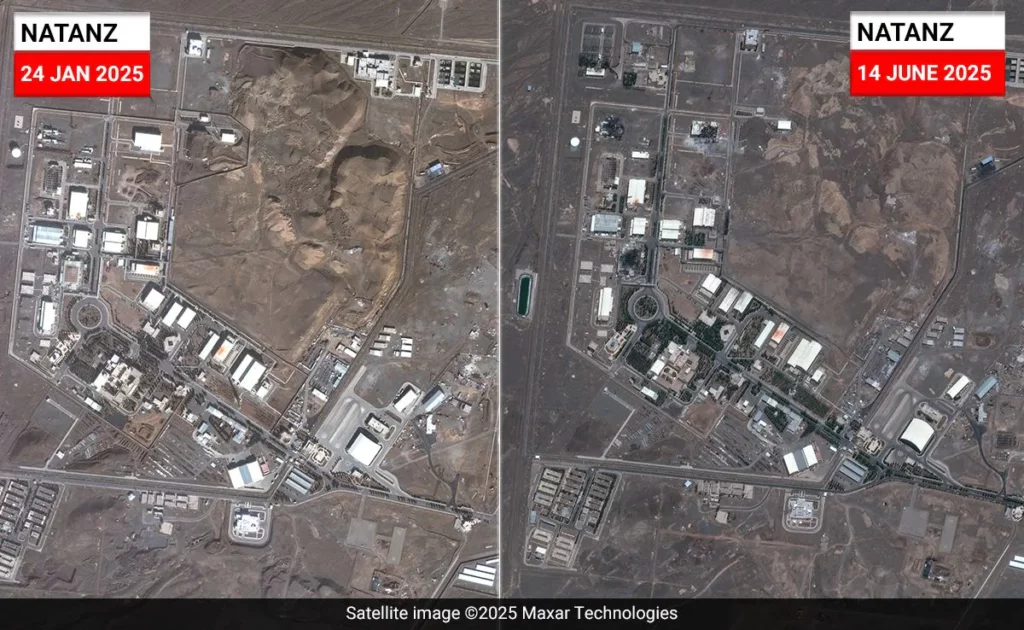
Recent satellite images reveal renewed activity at key Iranian nuclear sites, including Natanz, Isfahan and Parchin-Taleghan 2, as Tehran appears to take steps to conceal the status of facilities previously targeted in U.S. and Israeli strikes, according to imagery and expert analysis released this week.
The developments come as Donald Trump weighs the possibility of a major military strike against Iran �on a day-to-day basis,� according to reporting on the situation.
Concealment efforts at Natanz and Isfahan
Satellite data from Planet Labs PBC, first published by the Associated Press, show that Iran has constructed new roofing over damaged buildings at the Natanz and Isfahan sites � facilities that were struck in coordinated attacks by Israeli and U.S. forces in 2025.
Experts say the coverings may be intended to block satellite observation of salvage or reconstruction operations, complicating international monitoring. Tehran has barred access by the International Atomic Energy Agency, leaving remote imagery as the primary oversight method.
Natanz, roughly 220 kilometers southeast of Tehran, was Iran�s principal uranium enrichment complex before it was hit by airstrikes that severely damaged above-ground infrastructure and likely degraded underground centrifuge halls, according to analyses of previous strikes.
Isfahan � located approximately 350 kilometers south of the capital and home to uranium conversion and related facilities � was also hit in both Israeli and U.S. operations.
Imagery also highlights construction at Parchin-Taleghan 2, a site linked in past assessments to Iran�s former Amad weapons program, including explosives testing. Although Iran�s intentions remain unclear, ongoing construction and concealment measures have drawn scrutiny from Western analysts.
It is not yet known what activities Tehran is undertaking beneath the new roofs or at other fortified sites. Some analysts suggest Iran may be relocating assets within these locations or preserving sensitive material, rather than moving them elsewhere.
Strategic context and U.S. concerns
Iranian officials have not publicly addressed the recent imagery, and it remains unclear whether the activity signals a resumption of any nuclear operational capacity. However, the images come amid heightened regional tensions and speculation that Iran could seek to salvage or reconstitute elements of its nuclear infrastructure.
The possible concealment and salvage work at Natanz and Isfahan is occurring against the backdrop of wider geopolitical strain. The United States has increased its naval presence in the region and President Trump has repeatedly warned that military action remains an option if diplomacy fails to address Tehran�s nuclear trajectory.
International authorities, including the IAEA, have been restricted from inspecting many sites, which analysts say further complicates efforts to assess Tehran�s nuclear intentions.
The Iranian program�s core facilities � including Natanz and conversion operations at Isfahan � have long been central to uranium enrichment; criticism and concern over their activities have been at the heart of international negotiations and confrontations.
(YWN World Headquarters – NYC)
 Join the official YWN WhatsApp status


