
Israel�s Chief Rabbinate has issued a public warning over multiple imported food products found to carry misleading or unauthorized kosher certifications, raising concerns about kashrus and consumer transparency.
In a special update, the Kashrut Fraud Division of the Chief Rabbinate of Israel detailed deficiencies involving dairy, fish, and meat products sold in major food chains.
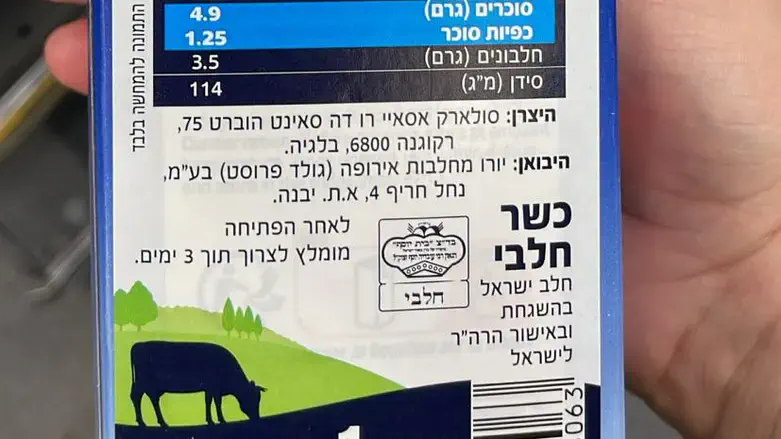
One case involves long-life whole milk produced in Belgium by Solarec and imported by Euro Dairies Europe (Gold Frost) Ltd. of Yavne. The cartons claimed supervision by Badatz Beit Yosef and approval from the Chief Rabbinate, presenting the product as chalav Yisrael.
However, inspectors from the Rabbinate�s Import Department found that the milk was never authorized. As a result, officials ordered the product to be removed from shelves and returned to the importer.
The Rabbinate also cited serious problems with �100% smoked cod liver in fish oil,� imported by G. Willifood International Ltd.. Although the packaging displayed kosher approval and supervision by the Orthodox Union, the Import Department had rejected approval requests for production batches beginning in January 2025.
According to the Rabbinate, the rejection stemmed from missing documentation regarding parasite treatment and uncertainty over compliance with bishul Yisrael requirements.
In the meat sector, inspectors identified misleading labeling on frozen beef shank imported from Argentina and marketed by Tnuva. An on-site inspection found that outer packaging described the meat as kosher-chalak, while the stamp on the meat itself indicated only standard kosher certification.
The Rabbinate said the discrepancy could mislead consumers who rely on stricter kashrut standards.
�In light of this discrepancy, which constitutes misleading a consumer,� the agency said, the products were ordered returned to the distributor to prevent further violations.
The Kosharot organization urged shoppers and supervisors to closely examine certification notices.
�We call upon the general public and kashrus supervisors to pay attention to the details of the kashrus update,� the group said, warning against purchasing products that do not meet official standards.
(YWN World Headquarters – NYC)
 Join the official YWN WhatsApp status


2 Responses
this is hard to understand. how is the consumer supposed to know that the product inside is not what it�s supposed to be? we can only rely on the hekhsher that we can see.
It sounds like the three incidents described have three different issues:
1. A totally false hechsher – the milk did NOT have a hechsher, but the packaging said it did. Flat-out fraud.
2. There was an OU hechsher, but the Rabbanut had not accepted it. This is something I’ve seen previously, where the OU accepts a product but the Rabbanut does not – most specifically with respect to Chalav Yisrael, where the OU follows Rav Moshe’s hetter with respect to liquid milk but the Rabbanut does not. This is not necessarily a situation of fraud, but of maintenance of specific standards.
3. Misleading labeling – it sounds like it was unclear if the meat in question was, in fact, Chalak (Glatt), but it was, in any case, Kosher. This needs to be investigated to make sure that labeling is clear and consistent, but did not necessarily involve deliberate fraud.
Kashrus is serious stuff, and in any case – it’s good to see the Rabbanut taking it seriously.
an Israeli Yid