
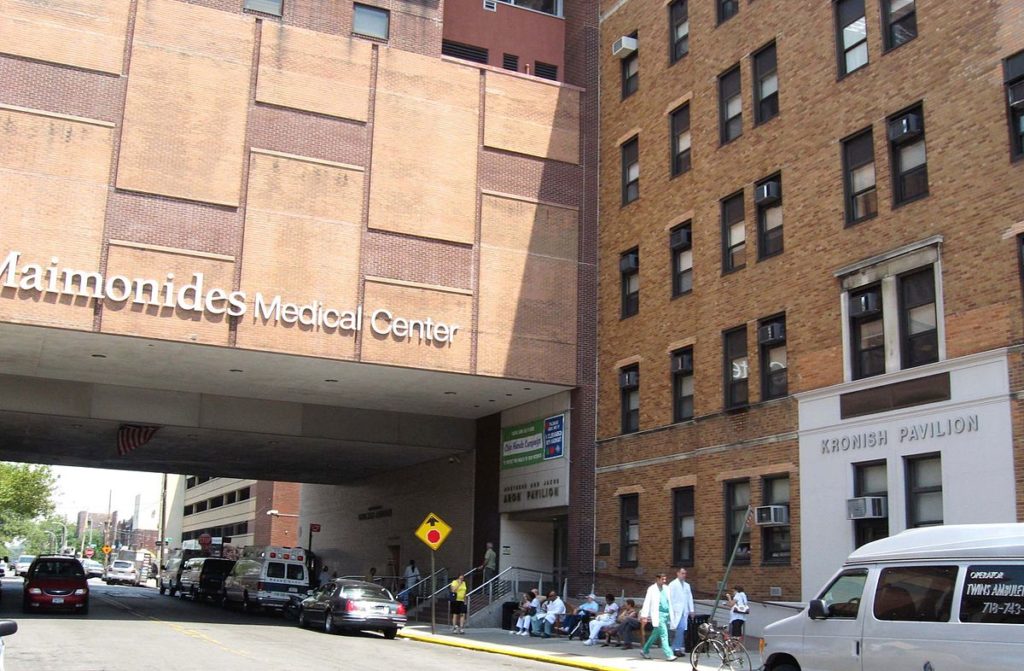
The proposed sale of Maimonides Medical Center to NYC Health + Hospitals, announced with great fanfare last December and scheduled to close by April 1, is now widely regarded as unlikely to close on that date, and may not close at all, YWN has learned.
The unprecedented transaction essentially involves the giveaway of a multi-billion dollar community hospital to the City of New York, and must pass a slew of regulatory and court hurdles before it can proceed. Yet YWN has learned that the current Maimonides administration has not even submitted the necessary applications for those approvals, though even the simplest hospital transactions can take a year to process.
“There is zero chance this transaction can be completed by the April 1 target date, and a very substantial likelihood it will never actually be completed,” said Martin Bienstock, an attorney for the Trustees. “All the stakeholders need to start thinking about how to preserve Maimonides as a community hospital, and to help it become the world-class hospital.
Under New York Law, when a not-for-profit hospital like Maimonides tries to transfer its assets, it requires approval from the Attorney General or the courts. The Maimonides transaction, which involves an unprecedented giveaway of a private not-forprofit hospital to a municipal entity, is exactly the kind of deal the statute was designed to scrutinize.
In New York, even simple, uncontested transactions typically take a year or more to complete. Yet as of this writing, five weeks from the closing date, the Maimonides administration has not even submitted an application to the Attorney General’s office.
Based on the lengthy review necessary to properly supervise a multi-billion transaction like this one, the Attorney General cannot approve the transaction in so short a timeframe.
In addition, “approval by the Attorney General would appear to conflict with the Attorney General’s rules governing disputed sales” Bienstock said. “It’s pretty unlikely that the Attorney General will approve the transaction at all.”
The sale was actively opposed by seven Trustees, who have gone to court to stop the Board’s giveaway of the community hospital, and by community organizations like Hatzalah.
Under the Attorney General’s published procedures, a contested deal involving active litigation, dissenting Trustees, and community objections must be referred to the courts rather than approved directly. Court review of a transaction of this magnitude would take many additional months to proceed.
Once the matter heads to the court, active opposition by the Attorney General and rejection by the Courts remain a serious consideration.
The transaction faces a fundamental legal problem: the giveaway of a community hospital to the City would violate the Not-for-Profit Corporation law and Maimonides’ own charter. Maimonides’s Certificate of Incorporation authorizes dispositions only to other not-for-profit organizations not to government entities. And in any event, the transfer of privately held not-for-profit assets to a government entity is inconsistent with the protections New York law affords to charitable assets, which are held in trust for the community; they may not simply be handed over to the government.
There is another reason the sale appears unlikely to go through. Every major hospital transaction in New York is reviewed by the Public Health and Health Planning Council, a state body that evaluates whether changes in hospital ownership will harm access to care, quality of care, and the health of the surrounding community. This process exists for exactly this kind of deal. But as with Attorney General approval, the Maimonides administration has yet to even submit an application to the PHHPC.
Any such application would face significant scrutiny. Putting H+H in charge of Maimonides raises serious public health concerns. H+H is funded by New York City, which has well- documented funding challenges. H+H itself runs some of the lowest-ranked hospitals in the state. Research by leading health economists demonstrates that this type of transaction, in which a community hospital is absorbed into large, centralized government systems, is literally deadly; community control gives way to government bloat and inefficiency, leading to increased morbidity and mortality.
In the short term, it is impossible to imagine the Mamdani administration, which is facing a devastating budget crunch, devoting significant resources to Maimonides. But the problem is not specific to any particular administration; the City of New York is simply not the best choice for operating a quality community hospital.
The failure to seek PHHPC approval is also viewed as a likely concern of the Attorney General, since the Attorney General’s is not designed to review the public health impact of a hospital sale like this one.
The sale faces another obstacle that may be impossible to overcome. Today, Maimonides’ community-based physicians have a great deal of autonomy and play a major role in the operations of the hospital. But by law, H+H and its operations must be under the direct control of the Mayor and his administration. If the hospital is turned over to H+H, the physicians will lose their autonomy and authority, there does not appear to be any reasonable way of accommodating community physicians while at the same time turning operations of the hospital over to New York City.
Insiders report that H+H and the physicians remain far apart in negotiating the terms for their future relationship.
In December, seven frum members of the Maimonides Board of Trustees voted against the sale and filed a derivative lawsuit in New York Supreme Court, Kings County, to block the transaction. That lawsuit focused on the Board’s own failure to do its due diligence and pursue options to affiliate with private healthcare systems instead of the City. Since the filing, many of the arguments advanced by CEO Ken Gibbs as requiring immediate action have been exposed as false.
A discovery motion is scheduled for March 17, at which the Plaintiffs hope to obtain copies of key exhibits to the Sales Agreement, including an exhibit showing how insiders stand to profit from the transaction. A preliminary injunction hearing is scheduled for April 14.
“This transaction would permanently strip an independent community hospital of its identity and hand it to a municipal bureaucracy with a well-documented track record of operational deficiencies,” said Akiva Shapiro of Gibson Dunn. “The Trustees we represent are fighting to ensure that Maimonides remains an institution that serves the community that built it.”
The April 1 closing date now appears unattainable. Even if Maimonides were to file an application with the Attorney General tomorrow, the AG’s office would in all likelihood refer it to the courts a process that would take many additional months. The Public Health and Health Planning Council has not reviewed the transaction. The physicians have not agreed to it. And a lawsuit challenging the legality of the deal is advancing.
The seven Trustees who voted no appear to have fundamentally changed the trajectory of this transaction. Much work remains to be done but their vision of an improved Maimonides with greater resources and committed to the health of its constituent communities is coming closer to realization every day.
(YWN World Headquarters – NYC)
 Join the official YWN WhatsApp status





6 Responses
BH!
Imagine if Mamdani would own Maimonides
He would probably rename it to mamdanides
If you know anything about the takeover of Maimonides, you would know this article is 99 percent nonsense. Just some people trying to spin it their way.
It was a terrible idea, but that doesn’t mean the hospital is in the clear yet.
There were severe issues with the hospital operations prior to this deal being proposed, and community organizers have spent the last few months opposing the transaction rather than empowering the Hospital administration to do better.
I just received an email from Maimonides (on Purim!) saying that the transfer of ownership could happen as early as March 31st.
The amount of redundant sentences in this article is amazing.
bubbe mayses, their plan is working
minimal pushback
a hospital losing a million a day aint ” worth billions”
mamdani wont fund the hole so things will collapse by themselves and then it will pass and flip hands to the city
the trustees know good and well why the hospital is losing its “HOISEN”