
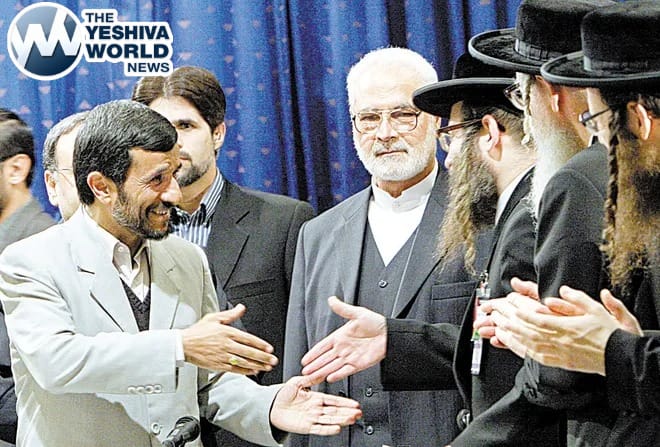
A joint U.S.-Israeli strike at the opening of the war with Iran that was widely believed to have killed former Iranian president Mahmoud Ahmadinejad may have had the opposite effect–allowing him to escape from tight regime control and disappear underground, according to reports citing people close to the former leader.
Associates of Ahmadinejad told reporters that he is still alive, contradicting early claims that he had been killed during the opening barrage of Operation Roaring Lion and Operation Epic Fury.
According to those accounts, the strike hit near Ahmadinejad’s residence in the Narmak neighborhood of northeast Tehran. The explosion killed several members of his security detail and created the chaos that enabled Ahmadinejad and his family to flee the area and go into hiding.
The unusual turn of events has been described by his associates as a kind of accidental “jailbreak” that freed the controversial former president from the surveillance and restrictions imposed on him by Iran’s ruling establishment.
For months before the war, Ahmadinejad’s movements had been tightly monitored by the regime. Following massive anti-government protests in January–during which tens of thousands of demonstrators were reportedly killed–authorities tightened control over the former president.
His phones were confiscated, and the number of bodyguards stationed around him was increased dramatically, reportedly rising to around 50 personnel tasked with monitoring his movements.
The February strike shattered that security cordon. In the aftermath of the blast, Ahmadinejad vanished. According to reports, Iranian authorities no longer know his whereabouts.
Since his disappearance, he has surfaced only briefly in public communications, including a message congratulating Mojtaba Khamenei on his rise to the position of Iran’s supreme leader.
Ahmadinejad, who served as Iran’s president from 2005 to 2013, has long had a turbulent relationship with the country’s ruling clerical establishment. Despite once being a prominent figure within the regime, he has repeatedly been barred from running for president again by Iran’s powerful Guardian Council–in 2017, 2021 and again in 2024.
Following his disqualification in 2017, Ahmadinejad increasingly positioned himself as a critic of Supreme Leader Ali Khamenei and elements of the Islamic Republic’s power structure.
Analysts say that uneasy relationship has made him a uniquely sensitive figure inside Iranian politics.
“Arresting Ahmadinejad could unsettle the regime,” Iran analyst Meir Javedanfar, who co-authored a biography of the former president, told The Atlantic. “He knows a hell of a lot about it.”
(YWN World Headquarters – NYC)
 Join the official YWN WhatsApp status




8 Responses
Maybe Yisroel Dovid Weiss and his cohorts can give him sanctuary?
Maybe he was an American spy.
This story sounds like it was generated by AI.
@Yaapchik:
This constant ridicule of NK is simply anti-Torah and therefore obviously wrong.
NK’s goal is obviously to protect Jews, and they are absolutely right in their message to the world that the Jews are not responsible for anything the Zionists do or don’t do.
While NK may be misguided in some of their methods in promulgating that message, that is a reason to pity them and possibly attempt to reason with them about that, not to mock them.
He’s probably in the Monsey vicinity.
Maybe “within the mile”.
He’s hiding in my basement in new jersey
Dear Hakatan,
NK is not reasonable. That is the first fault. (It is possible to be correct while being unreasonable. But being able to reason is a necessary skill.) Second, they do not empathize with Jews that think differently. Third, the current rank and file of NK refuse to debate sugyos that relate to the existence of the State, because they don’t know any sugyos. Fourth, the origins of NK was to prevent modernity from taking over Yerushalyim. Nothing, absolutely nothing to do with protecting Jews (physically or spiritually).
NK protects our city. Exactly as their name sounds.