
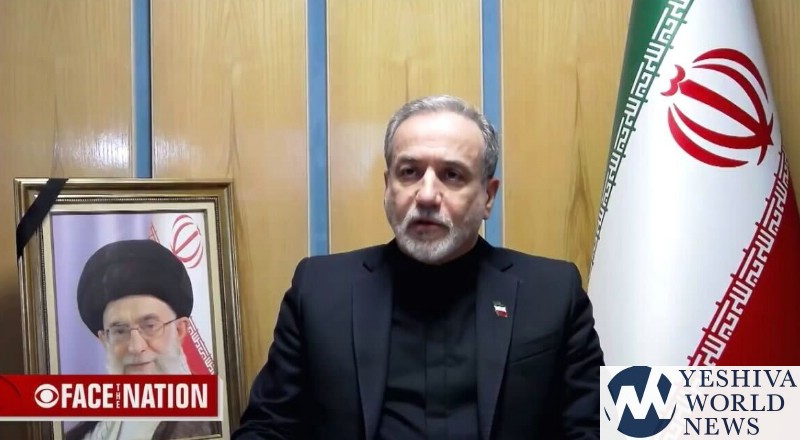
Iran’s foreign minister on Sunday insisted that the regime’s stockpile of highly enriched uranium remains buried beneath the rubble of nuclear facilities bombed during the ongoing war, while also rejecting any ceasefire or negotiations with the United States or Israel.
In an with CBS’s Face the Nation, Iranian Foreign Minister Abbas Araghchi said the estimated 440 kilograms of uranium enriched to up to 60 percent purity — material that can be relatively quickly refined to weapons-grade levels — remains trapped beneath the ruins of sites struck during the joint U.S.-Israeli bombing campaign against Iran’s nuclear facilities last June.
“Our nuclear facilities were attacked, and everything is under the rubble,” Araghchi said. “Of course, you know there is the possibility to retrieve them, but under the supervision of the [International Atomic Energy Agency]. If one day we come to the conclusion to do that, it would be under the supervision of the agency. But for the time being, we have no program. We have no plan to recover them from under the rubble.”
Western intelligence assessments have long warned that such material could be converted to weapons-grade uranium in a relatively short timeframe if Iran chose to do so.
The uranium is widely believed to have been stored deep underground at the Isfahan nuclear complex, a key component of Iran’s nuclear infrastructure. The site was among those targeted during the wave of strikes carried out by Israel and the United States in June, part of a broader military campaign aimed at crippling Iran’s nuclear program and deterring further escalation in the region.
The fate of the buried uranium has become a central concern for policymakers in Washington. President Donald Trump said last week that the United States could consider sending ground forces into Iran at some point in the future to secure the material, a move that would mark a dramatic escalation in the ongoing conflict.
Diplomatically, the issue had been at the center of nuclear talks between Washington and Tehran before those negotiations collapsed amid the military campaign. U.S. officials had demanded that Iran relinquish its stockpile of highly enriched uranium as part of any agreement designed to prevent the country from obtaining nuclear weapons.
Araghchi suggested that Tehran could theoretically place the material on the negotiating table in the future, but insisted that no such discussions are currently underway.
“Everything depends on the future,” he said. “If any time in the future we decide to enter into negotiation with the U.S. or other interlocutors, we may decide what to put on the table. For the time being, nothing is on the table.”
The Iranian diplomat also flatly rejected claims from Washington that Tehran has been seeking a ceasefire or new negotiations following weeks of intense military pressure.
“No, we never asked for a ceasefire, and we have never asked even for negotiation,” Araghchi said. “We are ready to defend ourselves as long as it takes.”
He also pushed back on the notion that the current conflict threatens the survival of Iran’s ruling system.
“This is not a war of survival,” he said. “Iran is stable and strong enough. We are only defending our people from this act of aggression.”
Beyond the nuclear issue, Araghchi acknowledged that multiple countries have quietly approached Tehran seeking assurances that their commercial vessels will be allowed to safely transit the Strait of Hormuz, the strategically vital maritime chokepoint through which roughly one-fifth of the world’s oil supply normally passes.
Iran has threatened to restrict traffic through the strait as part of its response to the U.S.-Israeli strikes, raising fears of severe disruptions to global energy markets.
“We are open to countries who want to talk to us about the safe passage of their vessels,” Araghchi said, adding that several governments had already reached out to Tehran for discussions.
While he declined to identify the countries involved, a report by the Financial Times said France and Italy had contacted Iran to explore arrangements that would allow their shipping to pass through the strait safely.
According to Araghchi, Iran’s military has already allowed certain vessels from unspecified countries to pass through the waterway, though others have avoided the route altogether due to security concerns.
“This is up to our military to decide,” he said, adding that some countries are choosing not to send ships through the strait “because of the insecurity which is there, because of the aggression by the U.S.”
(YWN World Headquarters – NYC)
 Join the official YWN WhatsApp status


3 Responses
It’s cool how he demands Amiraakins must to keep International Law and Amiraakins egreshin and President Tromp is break International Law.
Hey there Mr. Funny Name foreign minister, International law is only extended to people who respect it! That excludes you from the get-go
It’s cool how he demands Amiraakins must to keep International Law and Amiraakins egreshin and President Tromp is break International Law.
Hey there Mr. Funny Name foreign minister, International law is only extended to people who respect it! That excludes you from the get-go. You killed 100,000 of your own citizens: that’s upholding International Law, Right?
if he says it, it�s probably not true.