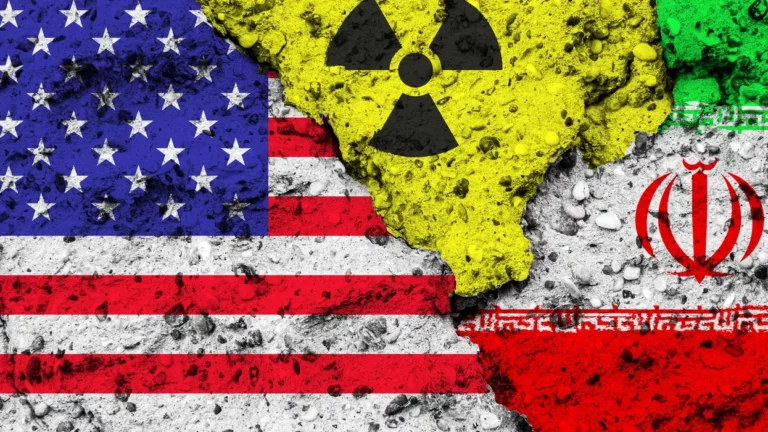
President Trump is weighing a military operation to extract nearly 1,000 pounds of enriched uranium from Iran, according to the Wall Street Journal, a mission that would likely require American forces to operate inside the country for days or longer and ranks among the most complex operations of the ongoing war.
Trump has not yet given the order, officials told the WSJ, and is weighing the risks to U.S. troops. But he has made clear in private conversations with political allies that Iran cannot retain the material, and has discussed seizing it by force if Tehran refuses to surrender it at the negotiating table.
“They’re going to give us the nuclear dust,” Trump told reporters Sunday night, warning that Iran must comply with U.S. demands or “they’re not going to have a country.”
White House press secretary Karoline Leavitt said in a statement that Pentagon planning does not constitute a presidential decision. “It’s the job of the Pentagon to make preparations in order to give the commander-in-chief maximum optionality,” she said.
Before the U.S. and Israel conducted a series of airstrikes on Iran last June, the country was believed to hold more than 400 kilograms of 60% highly enriched uranium and nearly 200 kilograms of 20% fissile material, which is readily convertible to weapons-grade. International Atomic Energy Agency Director General Rafael Grossi has said he believes most of the stockpile remains at two of the three sites struck in June: an underground tunnel at the nuclear complex in Isfahan and a cache at Natanz.
Any mission to retrieve it would be extraordinarily difficult, former military officers and experts warned. U.S. forces would need to fly to the sites under potential fire from Iranian surface-to-air missiles and drones, secure perimeters, clear mines and booby traps, and then extract the material — likely contained in 40 to 50 specialized cylinders resembling scuba tanks — using teams trained to handle radioactive material in a conflict zone.
The cylinders would need to be loaded into protective transportation casks, potentially filling several trucks. Unless a nearby airfield were available, a makeshift one would need to be constructed. Experts said the full operation would take days, if not a week.
Trump has told associates he wants to avoid a protracted conflict, and some senior aides are pressing him to move on, in part because polls suggest Republicans could face significant losses in the coming midterm elections. Trump and some allies have said privately that a targeted seizure operation could be completed without materially extending the war, and that a resolution by mid-April remains possible.
But military and national security experts cautioned that a forced uranium seizure could trigger Iranian retaliation that extends the conflict well beyond the four-to-six week timeframe Trump’s team has publicly outlined.
Iran is not currently enriching uranium, U.S. officials said, and would still need to refine the material to weapons grade and construct a warhead to become a nuclear-armed state. The country also lacks an intercontinental ballistic missile capable of reaching the American homeland, though the Defense Intelligence Agency projected last year that Iran could have dozens by 2035 if it adapts its space launch vehicle program.
Trump has also encouraged his advisers to press Iran to surrender the uranium as a condition of any peace settlement. Pakistan, Turkey, and Egypt have been acting as intermediaries between Washington and Tehran, though direct negotiations have not yet begun.
The Pentagon already has many of the assets in the region needed to conduct a uranium extraction, officials said. It is also considering deploying an additional 10,000 ground troops to expand the president’s options, and has been positioning quick-reaction Marine units and paratroopers from the Army’s 82nd Airborne Division to potentially seize strategic locations.
Defense Secretary Pete Hegseth, asked at a Pentagon briefing this month about the fate of Iran’s enriched uranium, signaled that the U.S. military had options beyond diplomacy.
“We have a range of options, up to and including Iran deciding that they will give those up, which of course we would welcome,” Hegseth said on March 13. “I would not, never tell this group or the world what we’re willing to do or how far we’re willing to go, but we have options, for sure.”
(YWN World Headquarters – NYC)
 Join the official YWN WhatsApp status