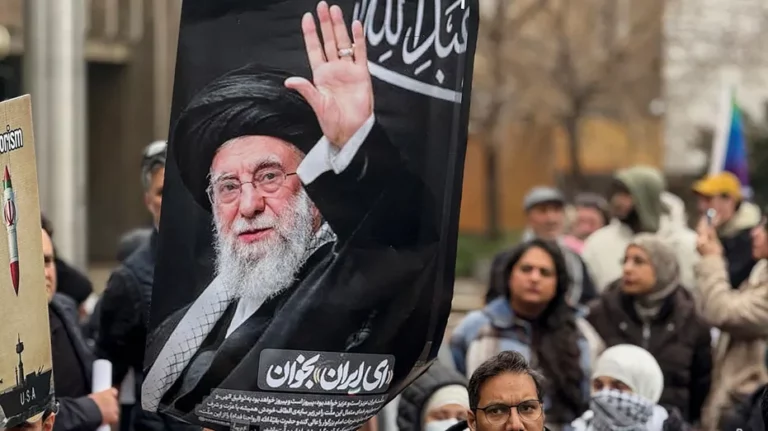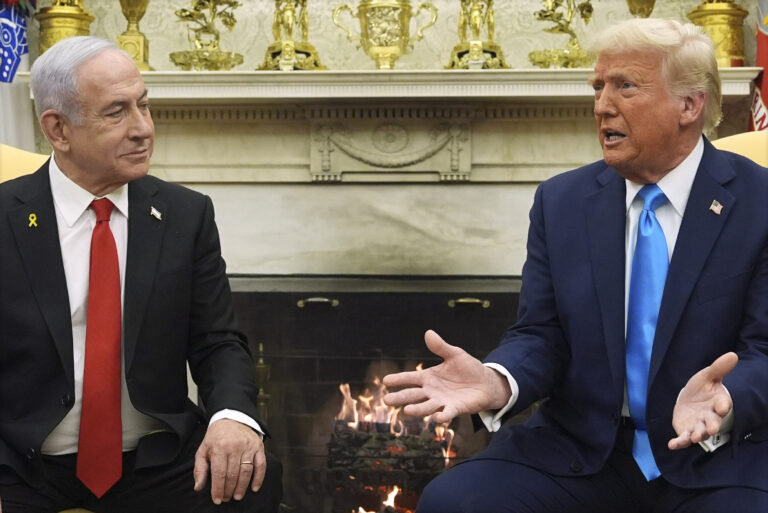
President Trump insisted Sunday that toppling Iran’s government was never something he cared about, a claim that directly contradicts a long record of his own public statements over the past year in which he urged Iranians to seize control of their government, declared that the United States had already achieved “regime change,” and openly asked why there shouldn’t be one.
“As far as regime change, I never cared about regime change,” Trump told The Wall Street Journal on Sunday. “This is the third group we’ve dealt with, and this is the most rational group yet.” The remark came as the United States and Iran confirmed a war-ending memorandum of understanding, with a signing ceremony set for June 19 in Switzerland.
The disavowal stands in stark contrast to what Trump and his administration said when the war began and in the months that followed.
When the US and Israel launched their campaign on February 28, Trump addressed the Iranian people directly and called on them to overthrow their leaders. “I say tonight that the hour of your freedom is at hand,” Trump said in a video posted to social media. “When we are finished, take over your government. It will be yours to take. This will be probably your only chance for generations.” He added: “America is backing you with overwhelming strength and devastating force.”
Hours after the first strikes, Trump told the Washington Post: “All I want is freedom for the people.”
Both Trump and Israeli Prime Minister Benjamin Netanyahu indicated at the outset that the goal of the strikes was regime change, calling on civilians to seize control of the government once its military and institutions were crippled.
A month into the war, Trump went further, claiming the objective had already been met. “I think we’ll make a deal with them, pretty sure, but we’ve had regime change,” Trump told reporters aboard Air Force One in late March, citing the number of Iranian leaders killed in the conflict. “We’re dealing with different people than anybody’s dealt with before. It’s a whole different group of people. So I would consider that regime change.”
That assessment matches what Trump said Sunday in a different register. In claiming Sunday that he is now dealing with “the third group” and “the most rational group yet,” Trump again referenced the turnover in Iranian leadership produced by the war, the same turnover he previously characterized as regime change he had achieved.
The pattern of openly embracing regime change extends back to the 2025 conflict. After US strikes on three Iranian nuclear sites in June 2025, and just hours after Vice President JD Vance and Secretary of State Marco Rubio said on Sunday talk shows that the US did not want regime change, Trump wrote on Truth Social: “It’s not politically correct to use the term, ‘Regime Change,’ but if the current Iranian Regime is unable to MAKE IRAN GREAT AGAIN, why wouldn’t there be a Regime change??? MIGA!!!”
Throughout the war, Trump’s own subordinates repeatedly contradicted him in the other direction, insisting regime change was not the aim even as the president embraced it. “This mission was not and has not been about regime change,” Defense Secretary Pete Hegseth said. Vance told NBC’s “Meet the Press” during the 2025 strikes: “We don’t want a regime change. We want to end the nuclear program, and then we want to talk to the Iranians about a long-term settlement here.”
The mixed messaging reflects what critics have called the central contradiction of Trump’s Iran policy. Trump had explicitly positioned himself against regime-change wars in the Middle East, declaring in a policy address: “Our policy of never-ending war, regime change, and nation-building is being replaced by the clear-eyed pursuit of American interests. It is the job of our military to protect our security, not to be the policeman of the” region.
Trump’s Sunday disavowal also lands at an awkward moment for the administration’s broader claims about the war. The deal reportedly fails to achieve any of the goals of the war set out by the US and Israel, including eliminating Iran’s nuclear weapons program, depleting its ballistic missile stockpile, ending its support for terror proxies, and creating the conditions for the fall of the regime. Iran’s military said it “humiliated” the United States and Israel in a statement issued after the agreement was announced.
The new Iranian leadership that emerged from the war may also be less accommodating than what came before. The killing of the country’s top leaders by the US and Israel appears to have strengthened and emboldened the Islamic Revolutionary Guard Corps, and Iran’s new supreme leader, Mojtaba Khamenei, is considered more radical than his late father, Ayatollah Ali Khamenei.
(YWN World Headquarters – NYC)
 Join the official YWN WhatsApp status