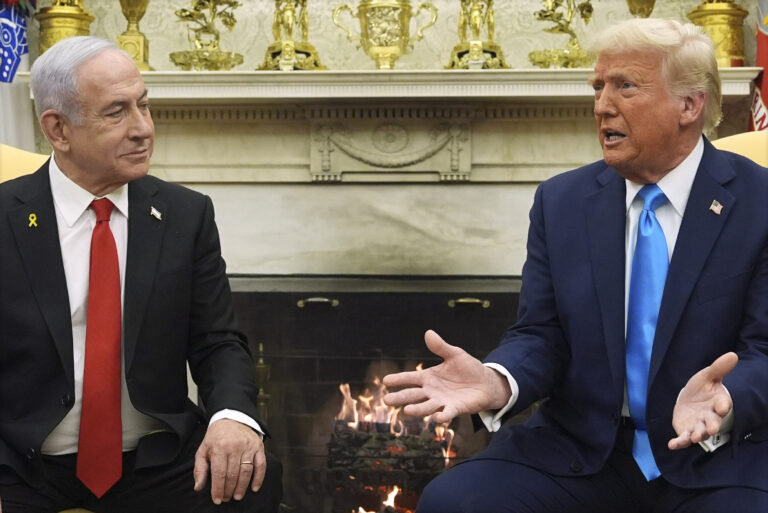
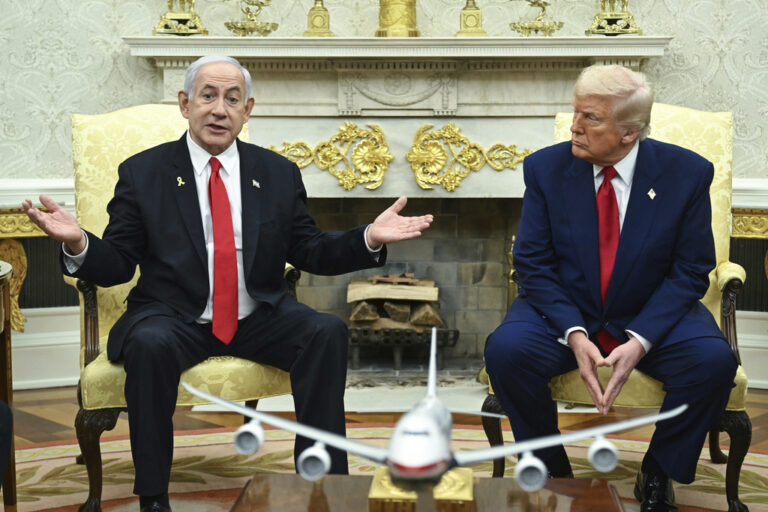
There is a familiar pattern running through American foreign policy over the past few years: start with a roar, pull back at the critical moment, and hand the other side a prize they never could have won on their own. Joe Biden did it with Ukraine. Biden did it with Gaza. Now Donald Trump has done it with Iran. Different presidents, different wars, same disease.
The disease is the half-war. And half-wars do not produce half-victories. They produce full defeats with a great deal of noise along the way.
The Pattern Before Trump
To understand what just happened with Iran, it helps to see it as the latest chapter in a longer story.
When Russia invaded Ukraine in 2022, the Biden administration committed to helping Kyiv fight back. But help always came with strings. The U.S. would supply artillery, but not long-range missiles. Then missiles, but not ones that could reach inside Russian territory. Then limited permission to strike inside Russia, but only for certain targets, only in certain areas. Every escalation was delayed, hedged, and delivered a month too late to matter. Ukraine was given just enough to keep bleeding but never enough to actually win.
Biden did the same thing with Israel in Gaza. After the Hamas massacre of October 7, 2023, America declared full support for Israel’s right to defend itself. Then came the conditions. Biden told CNN directly: “If they go into Rafah, I’m not supplying the weapons that have been used historically to deal with cities.” Rafah was the last remaining Hamas stronghold, the place where Hamas leadership was hiding, where the tunnel networks ran deepest, where hostages were believed to be held. The United States told Israel it could not enter with full American backing. For months Biden voiced his opposition to a Rafah invasion but never articulated exactly what price Israel would pay if it went ahead anyway. The red lines kept moving. The threats kept dissolving. Help was always offered. Full commitment was never given.
Trump mocked this pattern relentlessly. He was right to. What he did not mention was that he was about to reproduce it on a much larger stage, at a much higher cost, with far more dangerous consequences.
Round One: The Twelve-Day War, June 2025
The first direct military clash between Israel and Iran came in June 2025, when Israel launched Operation Rising Lion. In the early hours of June 13, 2025, 200 Israeli aircraft targeted military sites throughout Iran and the regime’s major nuclear facilities at Natanz, Fordow, and Isfahan. The United States joined the campaign directly, striking the nuclear sites with B-2 stealth bombers. Iran retaliated with an unprecedented barrage of nearly 900 ballistic missiles and 1,000 armed drones. A ceasefire took effect on June 24 after intense mediation, ending what became known as the Twelve-Day War.
The damage to Iran was real but incomplete. The IAEA confirmed damage at multiple nuclear sites including Natanz, Isfahan, and several other facilities. However, a preliminary U.S. intelligence assessment indicated the strikes may have set the nuclear program back by months rather than fully destroying it. Iran’s air defenses were badly degraded. Senior military commanders were killed. But the regime stood. The nuclear program was wounded, not dead. And Iran’s leadership drew their own conclusions about what Israel and America were actually willing to do.
The Collapse Within: Winter 2025-2026
The Twelve-Day War did not just damage Iran’s military. It accelerated the collapse of an already fragile economy. The rial, Iran’s currency, lost more than 40 percent of its value in the months following the June 2025 conflict, on top of a longer-term collapse that had erased nearly 90 percent of its value since the United States exited the nuclear deal in 2018. By the end of 2025, annual inflation exceeded 60 percent, food prices had risen more than 70 percent year-on-year, and nearly one in five young Iranians was unemployed.
Starting in late December 2025, market instability prompted demonstrations among Tehran’s bazaar merchants, the shopkeepers who had long been a pillar of the Islamic Republic’s support, and the protests quickly spread outside the capital. The unrest reached 675 locations across 210 cities in all 31 provinces of Iran. It was the most serious internal challenge the regime had faced since 1979.
On January 8, security forces launched a crackdown so brutal that some observers described it as “Iran’s Babi Yar.” It marked the deadliest incident of repression since the Islamic Republic took power.
Trump saw an opening. He told protesters “help is on its way,” urging them to take over government institutions and warning that their killers would “pay a big price.” He posted: “Iranian Patriots, KEEP PROTESTING. Take OVER YOUR INSTITUTIONS!!!” He canceled diplomatic meetings with Iranian officials in solidarity. He sent an aircraft carrier group to the region.
Those protesters believed him. They stayed in the streets. They risked their lives on the strength of an American president’s word.
Round Two: February 28, 2026
On February 28, 2026, a fundamentally different and far more ambitious military campaign began. This was not a repeat of the Twelve-Day War. The opening salvo on February 28 assassinated Supreme Leader Ayatollah Ali Khamenei and several family members in Tehran. U.S. and Israeli forces launched nearly 900 strikes in 12 hours targeting Iranian missiles, air defenses, military infrastructure, and leadership. Netanyahu said the goal was to “remove the existential threat posed by the terrorist regime in Iran” and to “create the conditions for the brave Iranian people to take their destiny” into their own hands.
Khamenei’s son, Mojtaba, was installed as the new Supreme Leader by the same clerical establishment that had run Iran for 45 years. The government did not collapse. Iran retaliated with missiles and drones against U.S. bases and American allies across the region. And then Iran closed the Strait of Hormuz.
Why the Strait Changes Everything
The Strait of Hormuz is a narrow waterway between Iran and the Arabian Peninsula, barely 21 miles across at its tightest point. It does not look impressive on a map. What passes through it every single day is roughly one in every five barrels of oil on earth, plus enormous volumes of liquefied natural gas that heats homes and runs factories across Europe and Asia.
When Iran shut it down, the global economy convulsed. Brent crude surged past $120 per barrel, and the International Energy Agency called it the largest supply disruption in the history of the global oil market, echoing the 1970s oil crisis through acute supply shortages, currency volatility, and the heightened risk of stagflation and recession. Gas prices at American pumps jumped past $4 a gallon. Raw material costs climbed sharply. Ocean freight rates more than doubled, meaning nearly everything Americans buy got more expensive.
Pain at home has a way of concentrating a president’s mind. Trump, who had been threatening to obliterate Iran’s infrastructure if no deal was reached, suddenly needed the deal more than Iran did. The leverage had flipped.
The Threats That Evaporated
What followed was one of the most embarrassing public displays of brinkmanship in modern American diplomatic history.
Trump set a deadline of March 21 for a deal. Then he moved it to March 23. Then April 7. Three deadlines. Each one that passed without consequence taught Iran the same lesson: the deadlines were not real.
When Trump threatened to destroy the oil infrastructure on Kharg Island, the hub through which 90 percent of Iran’s crude oil is exported, U.S. strikes hit military targets on the island but deliberately avoided the oil facilities. Iran’s foreign minister had warned that hitting the oil infrastructure would trigger severe retaliation, and the U.S. blinked. Trump told PBS News: “I left the pipes. I didn’t want to hit the pipes because, you know, years of work to put them together.” He had just struck Iran’s crown jewel and left the most valuable part intact.
Trump then warned in a Truth Social post that “a whole civilization will die tonight” unless Iran reopened the Strait of Hormuz. He threatened to destroy every bridge in Iran and knock out every power plant, sending the country “back to the Stone Ages.” Hours later, he pulled back from the threats less than two hours before his own deadline, as the U.S. and Iran agreed to a two-week ceasefire.
On June 11, Trump threatened new strikes on Iran, then canceled them the same day, citing progress in negotiations. On Thursday morning he posted about plans to hit Iran “very hard.” Hours later he announced he was canceling the strikes because talks were progressing
Every time Trump made a threat and pulled back, Iran got the same message: the president of the United States does not follow through. Wait him out, and the deal gets better.
What the Deal Actually Says
So what does the United States come away with after two separate military campaigns spanning a year, an oil shock that economists compared to the 1970s, months of empty threats, and weeks of negotiations mediated by Pakistan and Qatar?
Iran commits, on paper, to never developing a nuclear weapon. Enrichment limits and technical verification details are still to be worked out in follow-up talks. Iran agrees to reopen the Strait of Hormuz.
Here is what Iran gets in return: sanctions relief on oil sales that Iran estimates could generate nearly $10 billion in revenue within 60 days alone. According to Iranian officials, $24 billion in previously frozen Iranian funds will be released under the deal.
Now consider this carefully. Before either of these wars began, there were no oil sanctions waivers on the table. Iran’s oil revenues were being strangled as part of America’s maximum-pressure campaign. Iran fought two rounds of military confrontation, closed the world’s most critical oil chokepoint, and is walking away with oil revenues it never had before the first bomb dropped in June 2025. That is not losing. That is America losing.
Three Goals, Zero Achieved
The stated justifications for the February 2026 campaign were three: dismantle Iran’s nuclear program, destroy its ballistic missile capability, and end its support for proxy forces, specifically Hezbollah in Lebanon, the Houthis in Yemen, and Hamas in Gaza.
On missiles and proxies, the deal does not deliver. Two of three war aims have simply vanished from the text.
On nuclear, the result is a freeze, not a dismantlement. Iran will be kept some distance from a nuclear weapon, roughly the same constraint the 2015 Obama deal imposed. Except Iran now enters this arrangement having demonstrated something critical: it can survive two rounds of American and Israeli military strikes, absorb the aftermath, close a global waterway, and come out with a stronger economic hand than when the shooting started. It gets to keep its missiles. Its proxy terrorist network survived. Any discussion of leadership change in Tehran appears to be entirely off the table.
The Obama deal had real problems. The sunset clauses would eventually expire. It did not address missiles or proxies. Netanyahu called it catastrophic, perhaps overstating the case, but not without some basis. What it did do was impose genuine inspections, keep Iran at least two months from nuclear breakout, and come with Iran’s oil exports severely restricted and no precedent for weaponizing the Strait of Hormuz.
The deal being signed now produces similar nuclear limits, but in a completely different strategic environment. Iran has established the Hormuz shutdown as a usable weapon. It retains its missiles. Its proxies survived. It collects oil revenues that were not on the table before any of this began. We are heading toward something that looks like a weaker version of the deal Trump spent a decade calling catastrophic, with Iran holding more cards than it held in 2015.
The half-war doctrine is now complete. Iran learned it can outlast American threats, close the Strait, and win. The Iranian protesters who believed Trump meant he said have been left to die. And both the US and Israel are now worse off.
Well done, Donald!
(YWN World Headquarters – NYC)
 Join the official YWN WhatsApp status