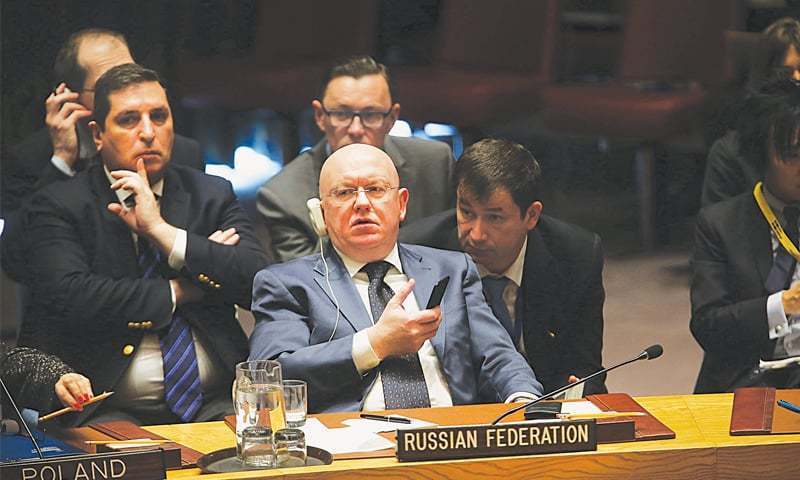
Russia’s U.N. ambassador says relations between Moscow and Washington are “practically non-existent,” which he says is bad not only for both countries but for the world — and he sees little prospect for improvement anytime soon.
Vassily Nebenzia said in a recent wide-ranging interview with a small group of journalists that the Trump administration should offer some incentives to North Korea to move forward toward denuclearization, saying the situation “is stalemated at the moment.”
Russia and China have backed an easing of sanctions to spur momentum, but the U.S. insists that North Korea must first make major steps toward eliminating its nuclear program.
“I’m concerned that it doesn’t roll back” to the 2017 era of increasing nuclear and missile tests and escalating rhetoric, Nebenzia said. “I think that the U.S. hopefully is starting to understand that the situation may go (back).”
As for Iran, Nebenzia said he worries about U.S. strategy if its sanctions don’t bring about the changes in behavior the Trump administration wants. He sees “a danger if they go to the limits.”
“I’m worried if anybody wants to go to war with Iran, and that is the enigma and the question — what is the strategy about Iran?” Nebenzia asked.
He said the U.S. and Russia need to talk about global issues including strategic stability, terrorism, narcotics and regional conflicts, and he thinks President Donald Trump “understands pretty well that it’s better to cooperate.”
But he said because Russia has become a major issue in U.S. domestic policies — accused of hacking and interfering in the 2016 U.S. elections which is being investigated by special counsel Robert Mueller — “and given the vulnerabilities that drift around this administration, I don’t see too bright prospects for improving (relations) any time soon.”
Looking more broadly at the U.S. position in the world under President Donald Trump, whose overarching policy is “America First,” Nebenzia said he doesn’t see the United States retreating.
It’s that the balance of power in the world is changing, he said, “and we definitely witness the rise in a multipolar world” where other centers of power not only Russia and China but India, Brazil and Africa “all want to be a part of the world governance and they want their voice to be heard and their interests taken into account.”
Nebenzia echoed Russian President Vladimir Putin’s view that Trump’s decision to pull U.S. troops out of Syria was a good move, though he expressed some skepticism about whether the announcement will become a reality.
He said in the interview at Russia’s U.N. Mission late Friday that a pullout “will be helpful and conducive to the eventual Syrian settlement” of the seven-year conflict.
If and when the U.S. leaves Syria, Nebenzia said, America’s Kurdish allies in the northeast should reintegrate into Syrian society, and “their rights and interests should be taken into account in the final settlement.”
Alluding to fears that Turkish forces could cross the border and go after the U.S.-allied Kurdish fighters, Nebenzia added, “I think that’s the best antidote for them against any possible bad developments that might take place.”
Nebenzia said former U.S. Secretary of State Condoleeza Rice voiced his answer to the question of why Russia is in Syria: “The only reason Russia is present in Syria is to prevent another Libya, and that is true.”
He said “Syria was a hotbed of the terrorist caliphate” established by Islamic State extremists, and “our aim was not to let them flourish there” and to restore Syria’s territorial integrity and sovereignty.
Nebenzia said the greatest threat in today’s world is not Russia, China, North Korea and Iran as the U.S. national security strategy claims but terrorism — and what’s needed most is “a true coalition to fight international terrorism.”
Responding to questions about Trump’s decision to cut the U.S. force in Afghanistan in half, Nebenzia said: “Afghanistan is one country that demonstrated to the whole world that it’s impossible to defeat.”
“That was demonstrated by the British.That was demonstrated by the Soviets and now it’s the turn of the Americans,” he said.
Nebenzia said it “looks like there’s no military solution, and the understanding of that is gaining momentum.”
The government and the Taliban will have to talk to each other, he said, stressing that “the Taliban is part of Afghan society — you can’t write them off.”
(AP)
 Join the official YWN WhatsApp status