
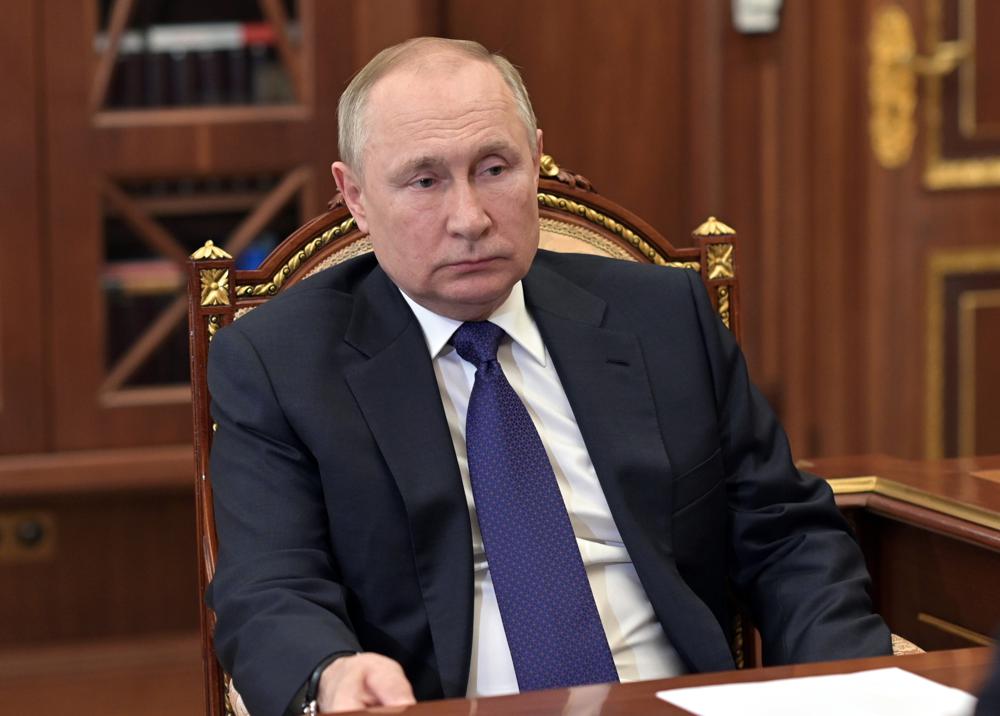
Russian nuclear submarines sailed off for drills in the Barents Sea and mobile missile launchers roamed snow forests Tuesday in Siberia after President Vladimir Putin ordered his nation�s nuclear forces put on high alert over tensions with the West over the invasion of Ukraine.
Russia�s Northern Fleet said in a statement that several of its nuclear submarines were involved in exercises designed to �train maneuvering in stormy conditions.� It said several warships tasked with protecting northwest Russia�s Kola Peninsula, where several naval bases are located, would join the maneuvers.
In the Irkutsk region of eastern Siberia, units of the Strategic Missile Forces dispersed Yars intercontinental ballistic missile launchers in forests to practice secret deployment, the Defense Ministry said in a statement.
The military didn�t say whether the drills were linked to Putin�s order on Sunday to put the country�s nuclear forces on high alert amid Russia�s war in Ukraine. It also was unclear whether the exercises represented a change in the country�s normal nuclear training activities or posture.
Putin�s decree applied to all parts of the Russian nuclear triad, which like in the U.S., consists of nuclear submarines armed with intercontinental ballistic missiles, nuclear-tipped land-based ICBMs and nuclear-capable strategic bombers. The United States and Russia have the two largest nuclear arsenals in the world, by far.
The U.S. said Putin�s move unnecessarily escalated an already dangerous conflict, but so far has announced no changes in its nuclear weapons alert level, perhaps in part because it was unclear what the Russian president�s order meant in practical terms.
Russia and the U.S. have the land- and submarine-based segments of their strategic nuclear forces on alert and prepared for combat at all times, but nuclear-capable bombers and other aircraft are not. One party raising the nuclear-combat readiness of bombers or ordering more ICBM-carrying submarines to sea would ring alarm bells for another.
Compared to the U.S., Russia relies more heavily on nuclear-tipped intercontinental ballistic missiles, which are located in silos or mounted on mobile launchers. A change in their readiness status could be more difficult to spot and assess.
Putin�s order heightened already soaring tensions, drawing comparisons to the 1962 Cuban Missile Crisis that saw Moscow and Washington teetering on the brink of a nuclear conflict.
In announcing his decision, Putin cited �aggressive statements� from NATO powers and new, crippling Western sanctions that froze Russia�s hard currency reserves, an unprecedented move that threatened to have devastating consequences for the its economy and finances.
The latest statements from Putin and other Russian officials indicated the Kremlin view of Western sanctions as a threat on par with military aggression.
Dmitry Medvedev, a deputy head of Russia�s Security Council, responded Tuesday to French Finance Minister Bruno Le Maire commenting that the European Union would unleash an all-out economic and financial �war� against Russia.
�Today, some French minister has said that they declared an economic war on Russia,� Medvedev, who served as Russia�s placeholder president in 2008-2012 when Putin had to shift into the prime minister�s post because of term limits. �Watch your tongue, gentlemen! And don�t forget that in human history, economic wars quite often turned into real ones.�
(AP)
 Join the official YWN WhatsApp status


2 Responses
The US should call his bluff by announcing our own nuclear forces are on alert, and by announcing a radical increase in spending on updating nuclear weapons and upgrading anti-missile defenses, something that will also send a strong message to China, North Korea and Iran that US won’t put up with their trying to bully us.
I agree with akuperma.