
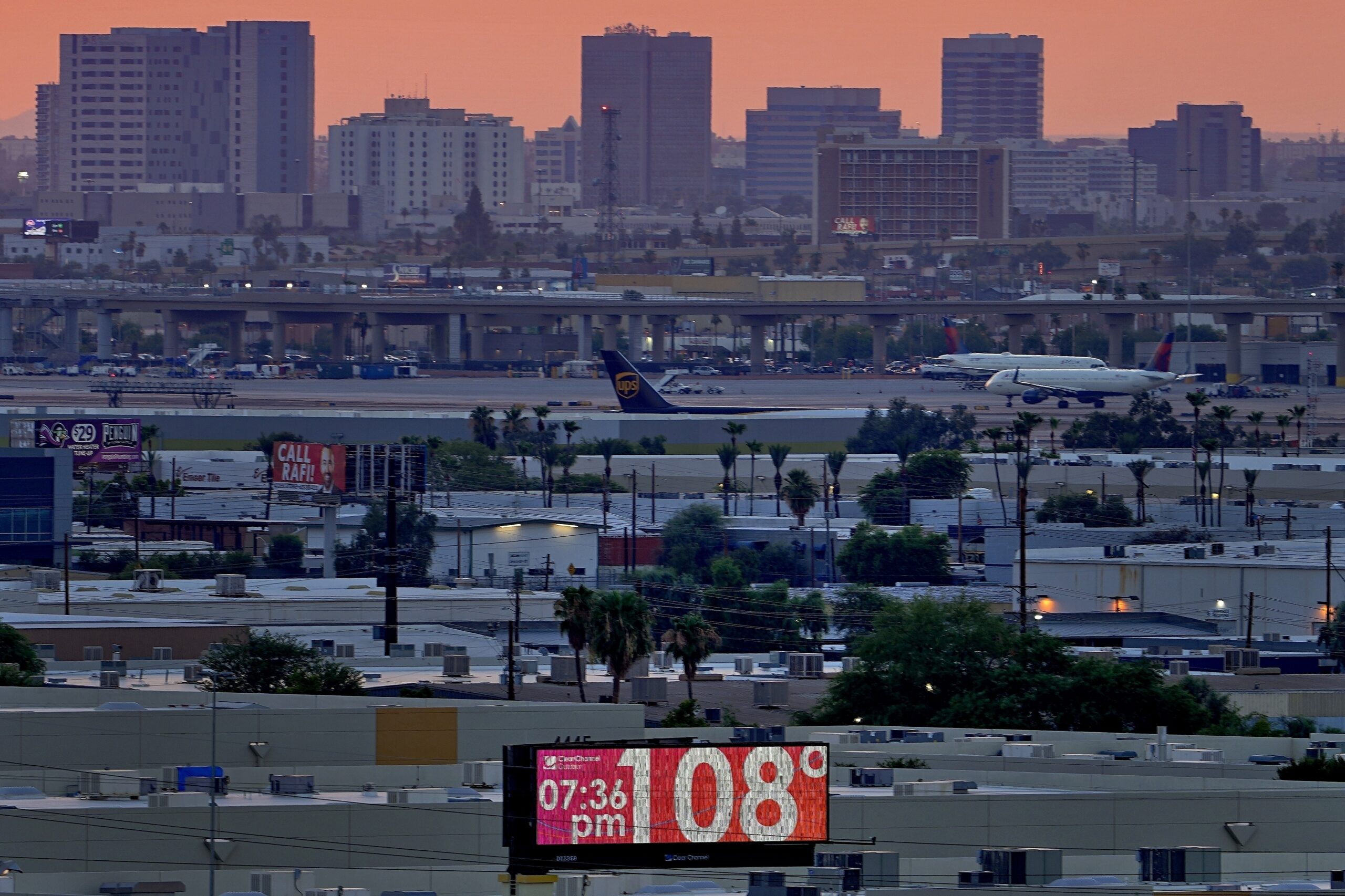
A historic heat wave continues to stifle Phoenix — but the end may finally be in sight for residents of Arizona’s largest city.
The National Weather Service is forecasting a high of 107 degrees Fahrenheit (41.7 degrees Celsius) on Monday and 102 F (38.8 C) on Tuesday.
“I hate to say, ‘Yes, this will be the last,’ but it’s more than likely that will be the case — this will be our last stretch of 110s this summer,” said Chris Kuhlman of the National Weather Service in Phoenix.
An excessive heat warning was expected to expire at 8 p.m. Sunday.
Meteorologists said Phoenix reached 112 F (44.4 C) by early afternoon Sunday and could top out at 114 F (45.5 C) for the second consecutive day.
Either way, it eclipsed the previous record of 111 F (43.8 C) for the date, set in 1990. It also marked the 55th day this year that the official reading at Phoenix Sky Harbor Airport reached at least 110 F (43.3 C).
The city eclipsed the previous record of 53 days — set in 2020 — when it hit 114 F (45 C) Saturday.
The weather service said the 114-degree mark was the latest date in a calendar year that Sky Harbor had ever recorded a temperature that high.
Phoenix experienced the hottest three months since record-keeping began in 1895, including the hottest July and the second-hottest August. The daily average temperature of 97 F (36.1 C) in June, July and August passed the previous record of 96.7 F (35.9 C) set three years ago.
The average daily temperature was 102.7 F (39.3 C) in July, National Weather Service meteorologist Matt Salerno said, and the daily average in August was 98.8 F (37.1 C). In July, Phoenix also set a record with a 31-day streak of highs at or above 110 F (43.3 C). The previous record of 18 straight days was set in 1974.
The sweltering summer of 2023 has seen a historic heat wave stretching from Texas across New Mexico and Arizona and into California’s desert.
Worldwide, last month was the hottest August ever recorded, according to the World Meteorological Organization. It was also the second-hottest month measured, behind only July 2023.
Scientists blame human-caused climate change with an extra push from a natural El Nino, which is a temporary warming of parts of the Pacific Ocean that changes weather around the globe.
(AP)
 Join the official YWN WhatsApp status


