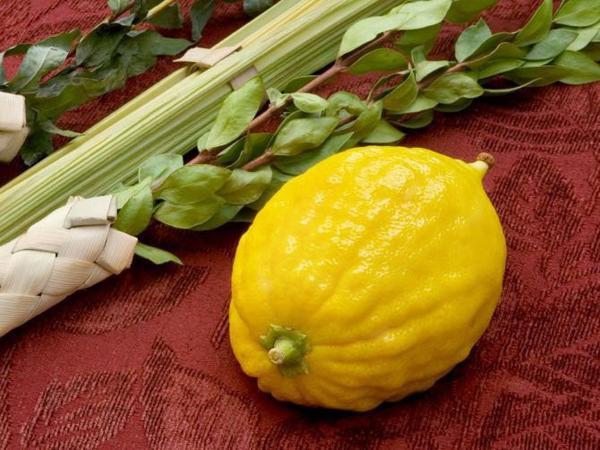
by Rabbi Yair Hoffman
You may want to print this out. What follows is a step-by-step guide as to what to look for regarding the Arba Minim. Please also be aware that there is a difference below between “must” and “should.” “Should” is preferable and ideal, but not absolutely necessary. Also, there is an order to the “shoulds.” They appear in the order that is preferable.
LULAV – 14 Halachos
- The lulav must be four tefachim from where the lowest leaves are connected to the spine until the top of the spine not including the t’yomes According to the Chazon Ish this is 15.35 inches. According to Rav Moshe Feinstein this is 14.16 inches. According to Rav Chaim No’eh this is 12.6 inches.
- The top leaf (t’yomes) must not be open like a fork, it must be both doubled and closed.
- The top leaf must not be split more than half of its length.
- When there are two top leaves neither one may be split more than half of its length.
- The t’yomes must not be cut off.
- The lulav must not be crooked or bent over like a sickle.
- The lulav must not be withered.
- If just the t’yomes is withered – we have a machlokes
- the Mishna Brurah writes it is invalid
- the Chazon Ish permits it.
- The leaves of the lulav must not be so dried out that they cannot be tied together.
- The t’yomes should be completely closed.
- The spine of the lulav should be five tefachim from where the lowest leaves are connected to the spine until the top of the spine not including the t’yomes.
- The lulav should be green and appear fresh
- The lulav should be completely straight.
- Ideally, it is the choice form of fulfilling the Mitzvah if the leaves lie naturally together (MB 645:3).
ESROG – 16 Halachos
- The esrog must be at least the volume of an egg.
- The esrog must not be grafted from other types.
- The esrog must be hadar – beautiful – as defined by chazal.
- There must not be any part of the esrog that is missing.
- The upper chotem (where it starts angling upward) must be free of blemishes – black or white spots
- The upper chotem must be free of scabs that are raised.
- The esrog must not be completely round like a ball.
- The esrog must be edible – it may not be orlah (first three years) or tevel (untithed).
- The esrog should be at least the volume of two eggs.
- The whole esrog should be free of any marks and scabs
- It should have a pitom.
- It should be shaped like a tower.
- It should be yellow.
- It should be bumpy and not smooth lie a lemon
- The stem should be recessed into the fruit.
- The stem and the pitom should be at 180 degrees to each other.
HADDASSIM – 7 Halachos
- They must be 3 tefachim in length. According to the Chazon Ish this is 11.8 inches. According to Rav Moshe it is 10.62 inches. According to Rav Chaim No’eh it is 9.45 inches.
- They must be triple-leaved – meshulash (three leaves growing at same level) for at least 1 and � tefachim.
- They should be meshulash for 3 tefachim.
- All the leaves should be intact.
- All the leaves should be green and appear fresh.
- The leaves should not be larger than a thumb nail.
- The wood part should be covered with leaves, i.e. the top of the leaf should reach and cover the bottom of the leaf above it.
ARAVOS – 9 Halachos
- They must be 3 tefachim in length. According to the Chazon Ish this is 11.8 inches. According to Rav Moshe it is 10.62 inches. According to Rav Chaim No’eh it is 9.45 inches.
- The top of the Aravos must be intact
- Most of the leaves must be present.
- The leaves should be green and appear fresh.
- The leaves should be complete and not slit
- The leaves should be long
- The leaves should have smooth edges
- The wood part should be reddish.
- The aravah, ideally, should come from a tree that grows next to a river (Arvei Nachal)
The author can be reached at [email protected]
 Join the official YWN WhatsApp status