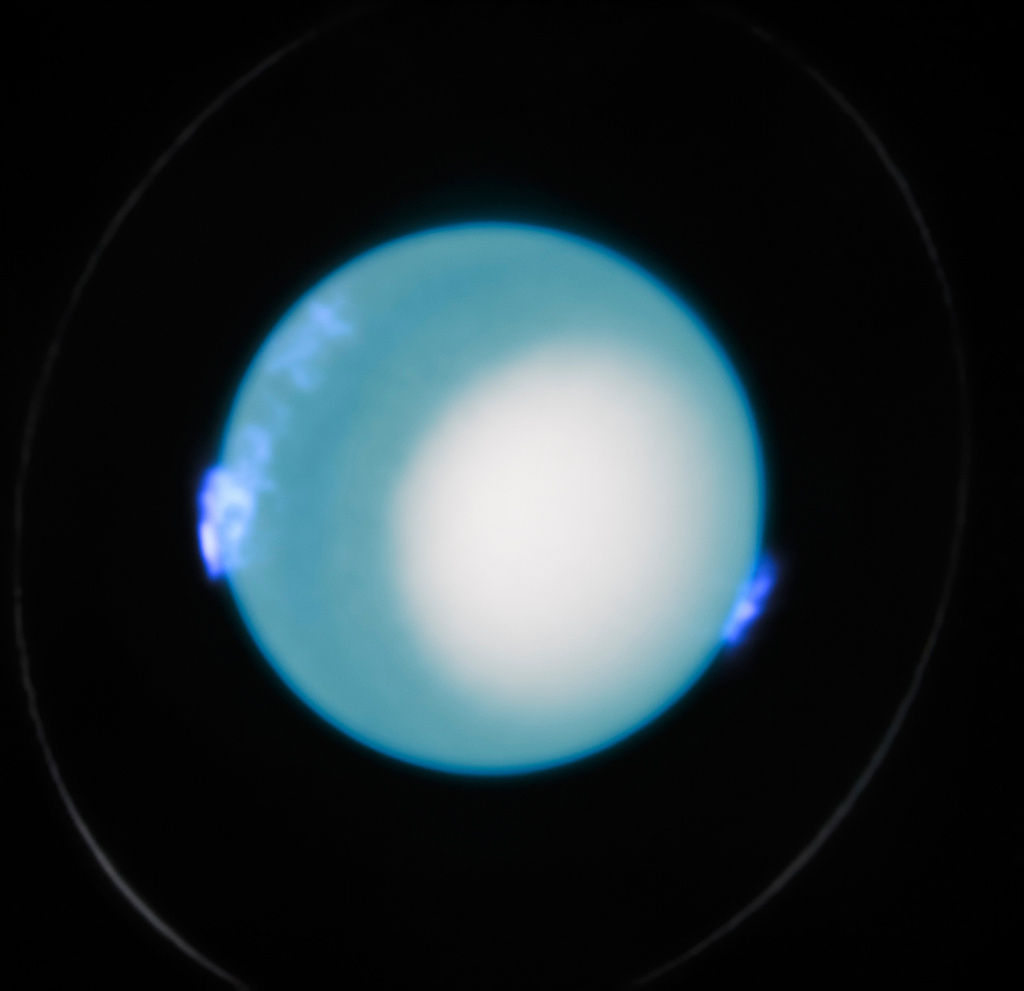
A day at Uranus just got a little longer.
Scientists reported Monday that observations by the Hubble Space Telescope have confirmed it takes Uranus 17 hours, 14 minutes and 52 seconds to complete a full rotation. That’s 28 seconds longer than estimates by NASA’s Voyager 2 spacecraft in the 1980s.
A French-led team studied a decade’s worth of aurora observations at the ice giant to track its magnetic poles. That long-term tracking provided a more precise rotation period for Uranus, the seventh planet from the sun. From that distance, it takes about 84 Earth years for Uranus to orbit the sun.
“The continuous observations from Hubble were crucial,” lead author Laurent Lamy of the Paris Observatory said in a statement.
Lamy and his international team said this new approach can help pinpoint the rotation of any world with auroras and a magnetosphere.
Published in the journal Nature Astronomy, the findings come a few weeks before the 35th anniversary of Hubble’s launch. NASA’s space shuttle Discovery delivered the space telescope to orbit on April 24, 1990.
(AP)
 Join the official YWN WhatsApp status