
European officials said Monday they were comforted by the outcome of discussions on U.S. peace proposals for Ukraine that they had viewed as tilted in Russia’s favor, but they didn’t disclose details of the weekend talks and warned of a long road to peace in Ukraine.
“The negotiations were a step forward, but there are still major issues which remain to be resolved,” Finnish President Alexander Stubb wrote on social platform X about Sunday’s meeting in Switzerland between U.S. and Ukrainian officials.
U.S. President Donald Trump suggested Monday that the process could be moving in the right direction.
“Is it really possible that big progress is being made in Peace Talks between Russia and Ukraine??? Don’t believe it until you see it, but something good just may be happening,” he wrote in a post on the Truth Social platform.
The talks in Geneva covered a 28-point peace plan presented last week by the United States that triggered alarm in Kyiv and European capitals by heavily favoring Moscow’s demands and goals following its invasion of its neighbor nearly four years ago.
German Chancellor Friedrich Merz welcomed the “interim result” of the talks, saying the U.S. proposal “has now been modified in significant parts.”
He cautioned, however: “It was possible to clear up some questions, but we also know that there won’t be peace in Ukraine overnight.”
The plan pressed Ukraine to consent to handing over some of its territory to Moscow and slashing the size of its army, leaving it vulnerable. The proposal also sought Europe’s agreement that Ukraine will never be admitted into the NATO military alliance, though the alliance has previously said Ukraine is on an “irreversible path” to membership.
The surprise emergence of the peace plan coincided with a bleak period for Ukrainian President Volodymyr Zelenskyy, with the war less than three months shy of its fourth anniversary.
It is under severe strain on the front line against Russia’s bigger army, it is short of money, and Zelenskyy is trying to defuse a major corruption scandal that has tainted his government.
Talks offer hope
The Geneva meeting offered some hope for Kyiv. “Diplomacy has been reinvigorated, and that’s good. Very good,” Zelenskyy said late Sunday.
It wasn’t clear whether the talks would continue on Monday.
Russian officials still haven’t seen the revised peace plan text since amendments were made over the weekend, a Kremlin spokesperson said Monday.
Dmitry Peskov added that there was currently no plan in place for U.S. and Russian delegations to meet this week, but that the Russian side remained “open for such contacts.”
Merz, the German leader, said Moscow must now become engaged in the process.
“The next step must be that Russia must come to the table,” he said in Luanda, Angola where he was attending a summit between African and European Union countries. “This is a laborious process. It will move forward at most in smaller steps this week. I do not expect there to be a breakthrough this week.”
The chief diplomats of Germany, Finland, France, the U.K., Italy and Poland consulted Monday with Ukrainian Foreign Minister Andriy Sybiha on further steps toward ending the war, according to the German Foreign Office.
German Foreign Minister Johannes Wadephul said U.S. Secretary of State Marco Rubio, who directed the talks in Switzerland, “made decisive positive contributions to ensuring that this plan can be accepted by both the European and Ukrainian sides.”
“I would like to say that all issues concerning Europe or NATO have been removed from this plan, which is a decisive success that we achieved yesterday,” he told public broadcaster Deutschlandradio.
Rubio said Sunday the talks were “very worthwhile” and constituted the most productive day in “a very long time.”
“I feel very optimistic that we can get something done,” Rubio said.
Turkey is also hoping to build bridges between Russia and Ukraine. Russian President Vladimir Putin was to speak by phone with his Turkish counterpart Recep Tayyip Erdogan later on Monday, Kremlin spokesman Peskov said.
Erdogan’s office said Sunday that the two leaders would discuss a deal from 2022, which allowed Ukraine to safely ship exports of grain via the Black Sea. Moscow refused to extend the deal a year later, saying agreements to ease Russian exports of food and fertilizer hadn’t been honored.
Russian drones kill 4 in Ukraine
Meanwhile, the grim reality of war still cast a pall over Ukraine as Russian forces kept up their deadly and devastating strikes on civilian areas.
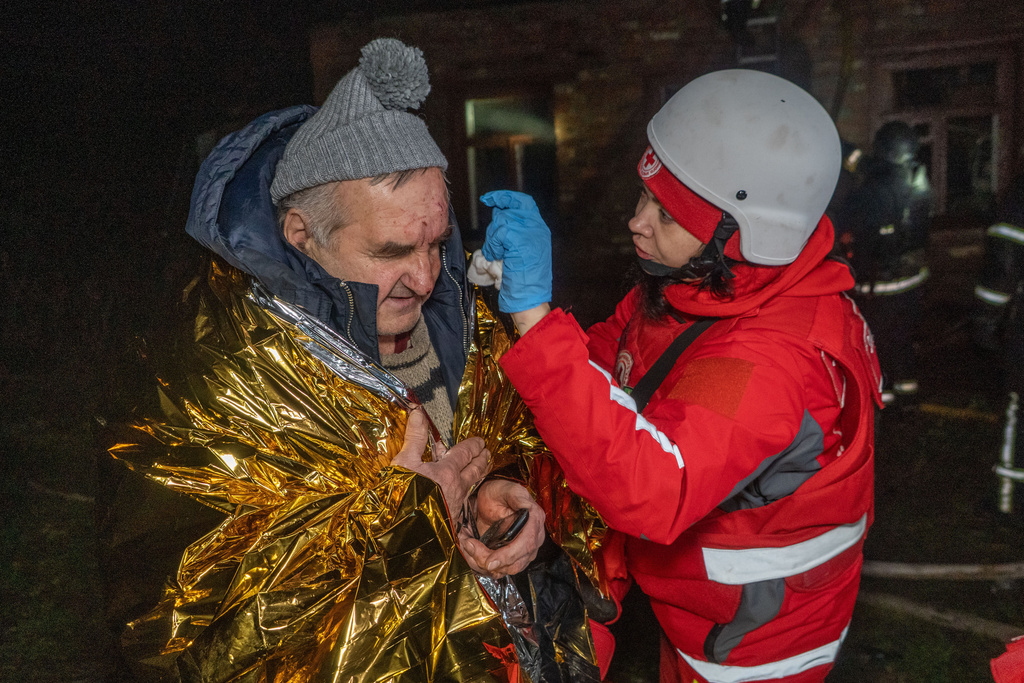
Russian drones hit residential areas of Kharkiv, Ukraine’s second-largest city overnight, killing four people and wounding 13, including two children, authorities said.
Eight residential buildings, an educational facility and power lines were damaged in the attack, according to the head of the regional military administration, Oleh Syniehubov.
Kharkiv Regional Prosecutor’s Office published photos showing homes on fire, rubble scattered across backyards and firefighters and war crimes prosecutors working on site.
Ukraine’s air force says Russia fired 162 strike and decoy drones over the country overnight.
Russia also resumed its nighttime drone attacks on Ukraine’s civilian and port infrastructure close to Romania’s border, the NATO member’s Defense Ministry said Monday.
Romania scrambled two Eurofighter Typhoon jets and two F-16s in response to drones near its border, the ministry said.
(AP)
 Join the official YWN WhatsApp status






One Response
The United States signed an agreement by which Ukraine gave up nuclear weapons in return for the United States guaranteeing their borders. Then when Russia seized Crimea, President Obama did no more than offer “non-lethal” assistance (e.g. meals ready to eat, a.k.a. combat rations). Then when Russia invaded again in 2022, Biden first offered to evacuate the Ukranian government to a neutral country, and then when Ukraine didn’t collapse and our European allies rushed aid, offered limited assistance. Now President Trump offers to give the Russians the victory they failed to achieve on the battlefield, and to cripple Ukraine so the next time Russia in hungry, they can finish them off (and then move on to other digestible neighbors).
The message to Putin and Xi (and Iran and North Korea) is clear. Be stubborn and the United States will betray allies. The message to countries such as (and especially) Israel, but also Taiwan and Eastern Europe, is clear – American guarantees are worthless “pieces of paper”.
If Israel is to survive as a “Jewish” state, they must be able to so without American aid, or they need to find a way to negotiate with the Arabs (and especially with the Palestinians). A modern form of a “dhimmi” might work, especially if the Yishuv had methods of self-defense (i.e. a military), but that would probably be unacceptable to all put the Hareidim (who originally thought the idea of an independent Medinah rulling over goyim would be a failure).