An “abhorrent” violation of Latin American sovereignty. An attack committed by “enslavers.” A “spectacle of death” comparable to Nazi Germany’s 1937 carpet bombing of Guernica, Spain.
There is perhaps no world leader criticizing the Trump administration’s attack on Venezuela as strongly as left-wing President Gustavo Petro of neighboring Colombia.
While other officials tread carefully, Petro has seized on the U.S. capture of Venezuelan President Nicol�s Maduro to escalate his spiraling war of words with President Donald Trump, who has said a U.S. military operation in Colombia “sounds good to me. ”
On Wednesday, Petro called for Colombians to take to the streets “to stand up for their nation’s sovereignty in response to Trump’s insults and military intervention threats.” He convened emergency meetings before the United Nations and the Organization of American States. And the former leftist guerrilla even threatened to take up arms against the U.S. to defend his country.
Petro’s high-stakes gambit has put Colombia, long America’s staunchest regional ally, in Trump’s crosshairs and his government in a bind: how to reap the political rewards of standing up to Washington just months before a presidential election without jeopardizing crucial security assistance or goading Trump into making good on his threat to invade.
That tension was on split-screen display this week as Petro lashed out at Trump while his top officials rushed to assure the U.S. that Colombia remains the pillar of its counternarcotics strategy abroad. For the past 30 years, the U.S. has worked closely with Colombia, the world’s largest producer of cocaine, to arrest drug traffickers, fend off rebel groups and boost economic development.
Colombia retains leverage as the main source of intelligence Washington uses to interdict drugs in the Caribbean, experts say.
“People are trying to tell Trump: ‘Look, you can punish Petro to the extent possible, but you don’t want to punish the country. That undermines the fight against drugs and is going to be harmful for the United States,'” said Michael Shifter, a Latin America expert at the Inter-American Dialogue think tank in Washington.
“But Trump is completely unpredictable,” Shifter said. “He changes his mind, he’s driven by his own impulses.”
Trump and Petro hate each other
Petro has drawn Trump’s ire for months.
He has turned back U.S. military deportation flights, urged American soldiers to disobey Trump during a pro-Palestinian rally in New York, lambasted U.S. attacks on alleged drug vessels as “murder,” and sparred with him over Israel’s military campaign in Gaza and his administration’s crackdown on immigration.
Infuriated, Trump has deployed language that he often used to describe Maduro, calling Petro a “lunatic” and an “international drug leader.” He has revoked Petro’s U.S. visa; slapped sweeping sanctions on him, his relatives and his interior minister on drug-related grounds; vowed to end all U.S. aid to Colombia; and threatened punitive tariffs on Colombian exports.
Thrilled by Maduro’s ouster, Trump pushed the fight even further in recent days. He called Petro a “sick man who likes making cocaine and selling it to the United States” and warned of a possible U.S. military operation on Colombian soil.
Petro plays the fight to his advantage
Petro can’t help relishing the conflict — as long as it remains only verbal. Frustrated with congressional resistance to his contentious reforms, failing to fulfill his promise of “total peace” with armed groups and facing a series of electoral tests, Petro has found in Trump the perfect foil as he fights for his legacy.
“He wants this stage where he is the clearest adversary, rhetorically or politically, to the U.S.,” said Sergio Guzman, a political risk analyst based in Bogot�.
The constitution bars Petro from seeking another term in May’s presidential vote but the country’s first leftist president wants his coalition to retain power over the resurgent right that blames his unpopular government for rising crime. Colombia will also hold legislative elections in March.
So far, Petro’s strategy of playing David to Trump’s Goliath seems to be paying off.
As Trump escalated his threats against Colombia this week, even some of Petro’s opponents rushed to his defense.
“Trump is misinformed and misfocused; his simplistic statements are counterproductive,” said An�bal Gaviria, a right-wing presidential hopeful, praising his country’s strong democratic institutions. “Colombia is not Venezuela, nor Cuba, nor Nicaragua.”
Alarm grows in Colombia over Trump’s threats
A U.S. military operation against Petro who, unlike Maduro, was democratically elected, is unlikely, experts say.
But complicating the calculation for Colombian officials is Trump’s increasingly militaristic comments about Latin America that lump Colombia in with Venezuela as a source of narcotics and immigrants in the U.S.
“Whereas the Colombian institutions still maintain cooperation and have a lot to lose, Petro personally feels like that bridge has already burned,” said Elizabeth Dickinson, a senior analyst at the International Crisis Group.
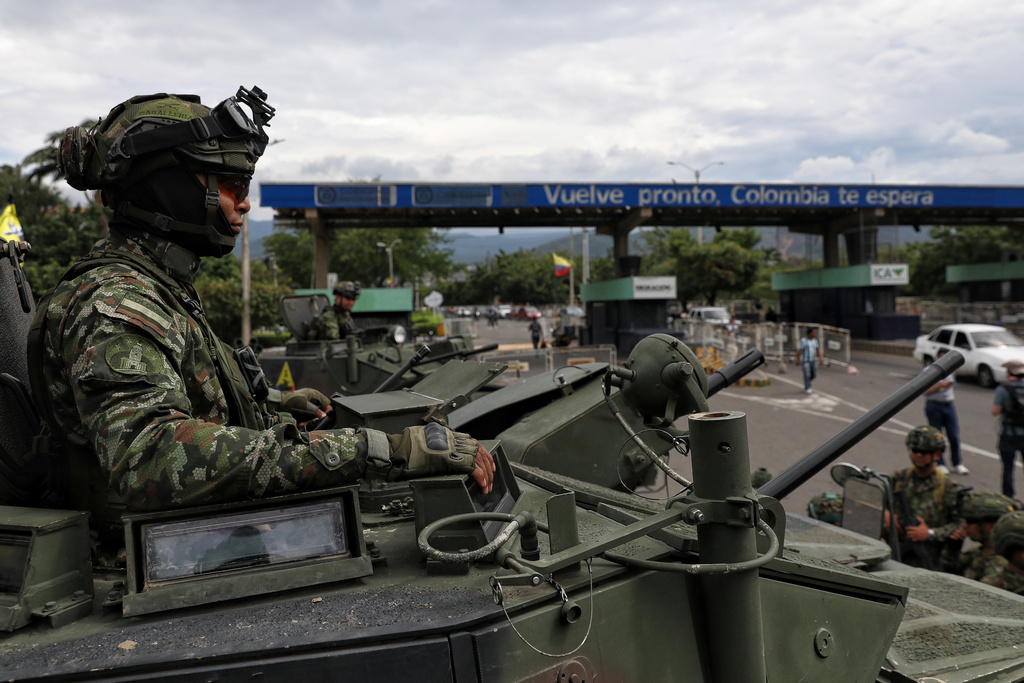
Recent statements from top ministers betray the rising alarm. Fears are also building that Colombia — that shares a 2,200-kilometer (1,360-mile) volatile border with Venezuela and is the biggest host of Venezuelan refugees — could get sucked into a wider regional conflagration if its neighbor descends into chaos.
As Petro fired more salvos on social media, Colombia’s interior and justice ministers scrambled to put out the fire, announcing they had notified U.S. intelligence agencies the government would “continue to coordinate and cooperate in the fight against drug trafficking based on U.S. information and technology.”
In a news conference, Defense Minister Pedro S�nchez sought to reassure the public that the leaders’ latest spat had done nothing to upset security cooperation critical to the Colombian military and police as they fight leftist guerrillas and drug traffickers. Washington has provided Bogot� with roughly $14 billion in the last two decades.
“Today, we have a golden opportunity to invest even more in strengthening international cooperation,” S�nchez said, ticking off the government’s successes in destroying thousands of cocaine labs and intercepting fentanyl shipments.
Colombia is trying to resolve the tensions with Trump diplomatically, Foreign Minister Rosa Villavicencio told reporters on Tuesday. Nonetheless, Colombia is preparing for “the possibility of aggression against our country by the United States.”
“We have a highly trained, very well prepared army,” she said.
Indeed, the army has long received training from the U.S.
(AP)
 Join the official YWN WhatsApp status