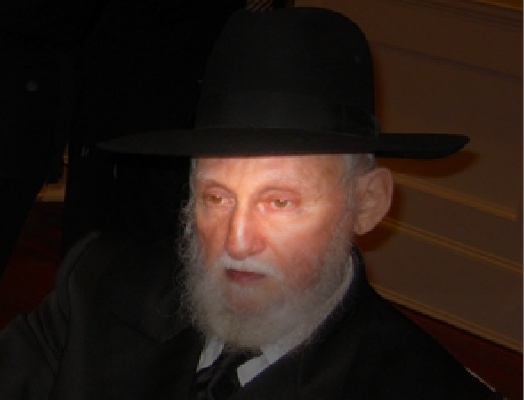
By Rabbi Yair Hoffman for 5TJT.com
It is now the first yartzeit of Moreinu HaRav Shlomo Teitelbaum, and the world is palpably different now. There is less Kedusha in it. Rav Shlomo Teitelbaum zichron tsaddik v’kadosh livracha has passed away, and a paragon – a role model, of what a human being can achieve in both avodas Hashem and kedusha – is now gone.
Rav Shlomo Teitelbaum zt”l possessed a rare combination of genuine and deep-felt ahavas yisroel, meticulous adherence to the mesorah of his father, Rav Yaakov Teitelbaum zt”l and of his Rebbeim, and sheer dedication to the performance of Mitzvos in the most ideal manner possible.
Rav Shlomo’s father, Rav Yaakov Teitelbaum zt”l, was a student of the famed Rav Meir Arik zt”l, along with Rav Meir Shapiro and others. Rav Yaakov Teitelbaum had moved from Eastern Europe to Vienna. He married his wife, Rebbitzen Freida Steinhof in 1938. Almost immediately they had to escape the Nazis y”s, and eventually relocated to England.
On December 8, 1948, the family came to America, on board the Queen Mary. Rav Teitelbaum and his Rebbitzen, arrived with seven children – all age nine and below. In Europe, Rav Yaakov Teitelbaum was a strong Agudist and developed many young Talmidim in Vienna. After his arrival in the United States, he soon established Khal Adas Yereim in Kew Gardens, Queens which shortly became a strong center of committed Torah life in Queens. In 1953, he was appointed to be the Rav of Camp Agudah and influenced thousands of campers for many years. Rav Yaakov zt”l was a true European Gadol, and had a strong and profound influence on his talmidim as well as his family.
Rav Shlomo Teitelbaum was a talmid muvhak of the Philadelphia Yeshiva. He revered his Rebbeim, Rav Elya Svei zt”l and yblcht”v Rav Shmuel Kamenetzky, and consulted with them throughout his life. A few years after he had moved on from Philadelphia to Beis Midrash Gavo’ah in Lakewood, his reputation of remarkable yiras shamayim and hasmada caught the eye of Rav Asher Zimmerman, a renowned Gadol and Posaik. He married Rav Zimmerman’s daughter Nechamah. After a few years in Kollel, tragedy struck. Rav Yaakov Teitelbaum, his beloved father, passed away. It was decided that his son, Rav Shlomo, should take his place.
Rav Shlomo was torn. He loved learning Torah lishma. He was gaining tremendously in Beis Medrash Gavoha of Lakewood. What should he do? His Rebbeim were unanimous in their answer. He must take his father’s place and lead the Kehillah that his father had built.
Rav Shlomo Teitelbaum zt”l davened in the way that most other people learn Gemorah – slowly, meticulously, and making sure to understand and appreciate every word. By the same token, he was able to learn Gemorah at such a dizzying pace that it resembled the manner in which most people davened. He knew numerous mesechtos so well that he was like a fish swimming in water. He could learn and teich maharshas at dizzying speeds – and with great depth.
In matters of tefilah, he loved and enjoyed every new k’naich or darher in the davening – a re-reading or an emphasis that was always inherent in the tefilah but one that was freshly brought out. Example: He loved Rav Chatzkel Levenstein’s re-reading of the words in shmoneh esreh – “mechalkel chaim b’chessed.” Most people understand that the word “b’chessed” is describing how He sustains the world – it acts as a type of adverb, of sorts. Rav Chatzkel read the word as a noun. What is the “food” that He sustains the world with? What is that necessary nutrient – without which none of us would survive? Chessed. Pure, simple, Chessed.
And chessed absolutely permeated every fiber of Rav Teitelbaum’s life. He took care of his mother like no one else did – and set an example for all of us to both admire and emulate. We learned together b’chevrusah, and every day at a certain time we stopped so that he could drive his mother to the swimming pool.
The Rav’s ahavas yisroel extended to everyone. He worked closely and lovingly with children who, r”l, had gone off the derech. Many returned to the proper path thinking, “Rav Teitelbaum truly loves me – how can I not keep Shabbos?” He was not the type who would only befriend those that would change. he loved them – even if they did not budge in their ruchniyus.
Rav Teitelbaum and his wife yblct’v ran a Pesach food order for the entire community – every year – for four decades. Unless one has seen it, it is difficult to imagine all that goes into such an enterprise. From ordering, to arranging for people to pick up their orders. Even when he was suffering physically, he would attend the simchos of others with unparalleled Ahavah.
Reb Shlomo’s smile had a deep warmth to it that was so visibly genuine that everyone recognized it. He possessed a hadras panim that could melt hearts. Correction – that did melt hearts. He loved people. Goyim who came across him – perceived his kedushah. That probably explained why there were gentiles at his levaya that were crying.
The Rav was always looking out for people in terms of shidduchim. He rett shidduchim out of true Ahavas Yisroel.
His shul, Adas Yereim, was a remarkable makom kedusha – filled with learned baal habatim – where one could speak in learning with virtually every member of the shul. He loved them all. He appreciated that Reb Alter Kramer z”l would deliver an amud yomi shiur and when his son Reb Duvie, who had grown up in the shul, took it over – he was elated. These shiurim and others ensured that Kehillah Adas Yereim would thrive as a makom Torah.
His was a shul where Gedolei Torah felt comfortable and at home. Whether it was Rav Shalom Schwadron zt”l, or Rav Simcha Wasserman zt”l – they all took a warm liking to Rav Shlomo. “Zeh mamash kmo Europa kan” Rav Schwadron once said.
If there was any sh’ailah about an item Rav Shlomo would stay away. His chumros in these areas were borne out of true yiras shamayim, ahavas haTorah, and an affinity for matters of kedusha. Yet, never did he look down on others – he loved everyone.
The greatest of his challenges involved not chalilah causing another person pain. His midos were uncanny. He would never get angry at anyone – even if they deserved it. Years before the new aluminum pans had emerged that no longer require tevilah, he was very meticulous in tovelling aluminum pans even if they were only used once. I informed him of a new plastic nine by thirteen pan that could withstand temperatures of above 500 degrees Fahrenheit and took orders for it. He was elated. To make a long story short, I was wrong about the technology. He spent hours erev Shabbos removing the burnt plastic and potato kugel remnants from his oven. He did it with love and not an ounce of kaas.
There is a Ramah that prohibits one from holding a wedding on a Sunday because it was following the ways of gentiles. His shver zatzal was makpid on it and the family had never held a wedding on a Sunday. But one mechutan very much wanted a Sunday wedding. He researched the sugyah thoroughly. The answer? It was a Russian orthodox custom and at the time and location where the Ramah lived in Cracow Poland the majority population held weddings on a Sunday. The gentile population was comprised of three groups. Catholics, Russian Orthodox, and Russian Orthodox that were forced to convert to Catholicism but were told to still keep Russian Orthodox customs. The latter two formed the majority of Cracow’s population. This was not the case in America. Rav Shlomo was elated. He could accede to his mechutan’s desire to hold the wedding on a Sunday and still not violate the Ramah.
Rav Shlomo worked very hard on maintaining the shalom bayis of others. He was strongly opposed to divorce and actually cried whenever he felt that there was not enough effort placed in trying to save a marriage. He often quoted the Gemorah in Sanhedrin 22a – that when a person divorces his first wife – even the Mizbeach itself sheds tears. Rav Shlomo felt the pain of Hashem too, and also cried. Once he pointed out to me a sefer that said that there was no letter “gimel” or “tes” in the parsha of the Korban Tamid. He stayed away from having anything to do with divorces because they were such a source of pain to him.
The Rav and I learned together b’chevrusah for three years and several years after that by phone until he took ill. It was an extraordinary z’chus. Yehi zichro boruch and may he be a meilitz yosher for all of Klal Yisroel.
The author can be reached at [email protected]
 Join the official YWN WhatsApp status