
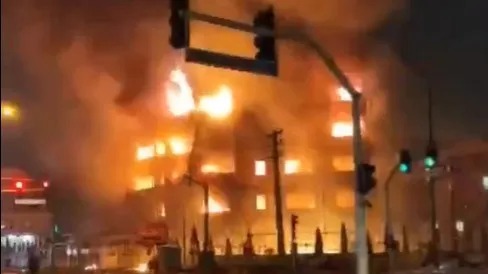
As protests in Iran enter their thirteenth day, mounting reports point to escalating brutality by regime forces in efforts to crush the demonstrations.
Many young people who take to the streets are paying a heavy price, and according to various reports, the number of dead and wounded continues to rise at an alarming rate.
An extensive report in the British newspaper The Guardian depicts a grim reality, with hundreds reported dead and hospitals overflowing with demonstrators wounded by live fire. The report cites a video verified by an Iranian human rights organization showing family members inspecting piles of bodies at Ghadir Hospital in Tehran. The organization said the bodies were those of protesters killed by security forces.
A protester in Tehran told The Guardian–via messages sent through satellite internet–that snipers had been deployed in central parts of the city and that many people were shot in the streets. According to his account, the presence of bodies has become routine, reinforcing a feeling of a merciless struggle by the regime.
At the same time, the Fars news agency, which is affiliated with security elements, aired videos that appeared to show forced confessions by detained demonstrators. Human rights activists warn that such confessions are frequently used to justify executions and constitute severe violations of human rights.
The HRANA organization has reported at least 65 deaths since the protests began, including 50 demonstrators. However, medical testimonies indicate the toll may be far higher. A doctor in Tehran told Time magazine that at least 217 people had been killed in just six hospitals in the capital, most by live ammunition. He said many of the victims were young, and that some were shot outside police stations after security forces opened machine-gun fire on crowds.
Hospitals across the country are operating under emergency conditions. Doctors and medics who contacted the BBC via satellite connection reported extreme overcrowding, the suspension of non-urgent surgeries, and a severe shortage of surgeons. A medic at a hospital in Shiraz said many of the wounded are arriving with gunshot injuries to the head and eyes, and that medical staff are struggling to cope with the scale and intensity of the violence.
The Telegraph reported that the Islamic regime has moved into an unprecedented state of readiness, even higher than during the war with Israel in June. Supreme Leader Ali Khamenei, fearing that Israel could exploit the internal turmoil to strike Iran’s nuclear facilities, has ordered maximum preparedness in the underground “missile cities” scattered across the country.
Rather than relying on the regular army or the police–institutions that have seen defections in the past–Khamenei has placed his trust squarely in the Revolutionary Guards. A senior Iranian source said the Supreme Leader views their loyalty as unwavering. “He will not leave Tehran even if American B-52 bombers fly overhead,” the source said, amid threats by U.S. President Donald Trump to intervene militarily if the killing of protesters continues.
The Revolutionary Guards stated on Saturday morning that guarding the achievements of the 1979 revolution and state security constitute a “red line” and that “missile cities” located underground have been activated to counter external threats.
Despite the harsh crackdown, human rights groups report early signs of dissent among security personnel. According to these accounts, some police officers and security forces have refused orders to use live fire against demonstrators. In response, the Revolutionary Guards have launched what has been described as a “manhunt” for those who refused, with several already arrested and taken in for questioning.
An Israeli minister told Channel 12 News on Motzei Shabbos that for the first time since the protests erupted two weeks ago, security officials are seeing indications that the unrest could threaten the regime’s survival.
He said, “This is still not a critical mass, and the regime is not on the verge of collapse–but the protest graph shows a clear and sustained upward trend, at a pace we haven’t seen in previous weeks.”
Meanwhile, US President Donald Trump issued a similar threat on Firday night to those he made earlier this week, saying the US will intervene if Iran starts “killing people,” while noting he has no intention of sending in ground forces. “Iran is in big trouble. Protesters seem to be taking over cities, something no one thought possible a few weeks ago.”
On Saturday morning, exiled Crown Prince Reza Pahlavi published a message calling for a general strike in the country and preparation for city occupations in Iran.
In a video message posted online, Pahlavi said, “I call on workers and employees in key sectors of the economy, especially in transportation, oil, gas, and energy, to begin a nationwide strike process. I also ask all of you to take to the streets today and tomorrow from 6:00 p.m. with flags, photos, and national symbols, and to occupy public spaces. Our goal is no longer just to take to the streets but to prepare for occupying and defending city centers.”
Pahlavi even called to prepare for prolonged street presence and to stockpile supplies.
Pahlavi added, “To the youth of Iran and to all security and armed forces who have joined us, I say: Slow down and further paralyze the suppression machine so that on the promised day we can shut it down completely. I am also preparing to return to my homeland and be with you, the great nation of Iran, when our national revolution triumphs. I believe that day is very close.”
(YWN’s Jerusalem desk is keeping you updated after tzeis ha’Shabbos in Israel)
 Join the official YWN WhatsApp status





One Response
“Khomeini Fears Israeli Strike” not sure where, or how hot it is wherever Khomeini -shem reshaim yirkav- is right now, but I’m sure that israeli strikes is the least of his concerns