

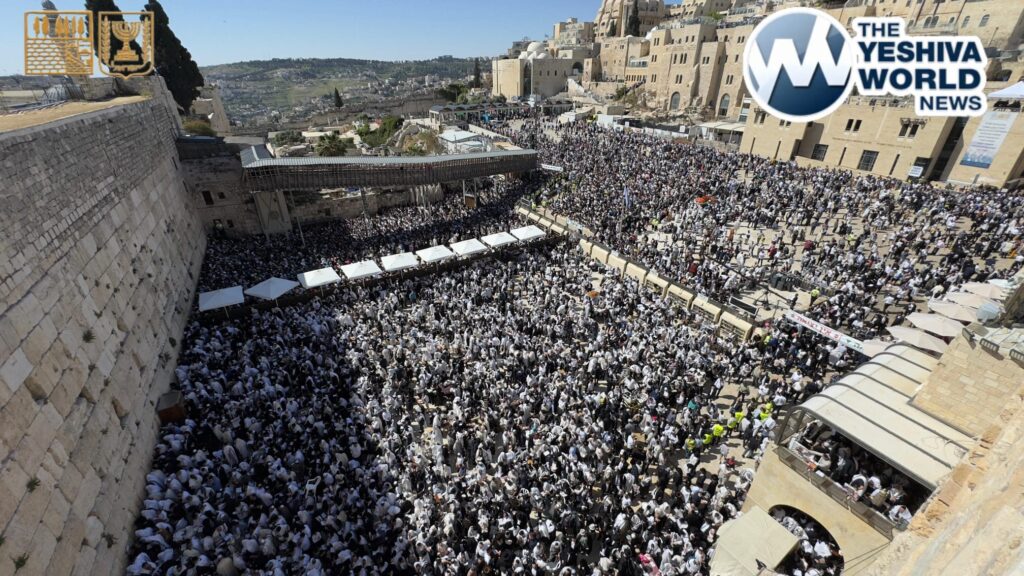
Eighty years after the end of World War II, the global Jewish population has yet to recover to the numbers recorded on the eve of the Holocaust, according to data released by Israel’s Central Bureau of Statistics.
The world’s Jewish population stands at 15.8 million – still short of the 16.6 million counted in 1939, before the Nazi genocide killed approximately one-third of Jews worldwide.
The geographic distribution of world Jewry has shifted dramatically from the pre-war era. In 1939, only about 449,000 Jews – roughly 3% of the global total – lived in what would become the State of Israel. Today, Israel is home to approximately 7.2 million Jews, about 45% of the world’s Jewish population.
The United States is home to roughly 6.3 million Jews, or about 40% of the global total. Together, Israel and the U.S. account for approximately 85% of Jews worldwide.
Beyond those two countries, Jewish communities are significantly smaller. France has approximately 436,000 Jews, Canada 407,000, the United Kingdom 315,000, Argentina 168,000, Germany 126,000, Russia 120,000 and Australia 117,000.
Several diaspora communities have shrunk since the bureau’s last report two years ago. Russia recorded a decline of nearly 10%, from 132,000 to 120,000. France dipped slightly from 440,000 to 436,000, and Argentina from 171,000 to 168,000. Canada was a notable exception, growing from 398,000 to 407,000 despite a documented rise in antisemitic incidents in recent years.
Approximately 111,000 Holocaust survivors and victims of Nazi-era persecution are currently living in Israel. Women make up 63% of that population, men 37%.
The data underscores how rapidly that generation is disappearing. About 37% of survivors were born between 1939 and 1945, placing them between 80 and 85 years old today. Another 35% are between 86 and 89, and roughly 28% are 90 or older.
Nearly half – 49.3% – are widowed. About 38% are married, including approximately 18,700 who are married to another survivor, making up around 9,300 households in Israel where both partners lived through the Holocaust.
Most survivors came to Israel in waves of immigration that tracked the country’s major historical turning points. About 6% arrived before Israel’s establishment in 1948. Roughly 30% came during the major immigration wave of 1948 to 1951, another 30% between 1952 and 1989, and about a third have arrived since the 1990s – primarily from former Soviet Union countries following its collapse.
Nearly all survivors, about 95%, live in urban areas. The largest concentrations are in Haifa, with approximately 7,500, followed by Jerusalem with 7,100 and Tel Aviv-Yafo with 6,000. Significant communities also reside in Ashdod, Netanya, Petah Tikva, Beersheba and Rishon Lezion.
(YWN World Headquarters – NYC)






1 Response
Are the numbers re: populations outside Israel also from Israel’s Cewntral Bureau of Statistics, or from elsewhere?
What percentages of these numbers are really halachically Jews – especially the American numbers?