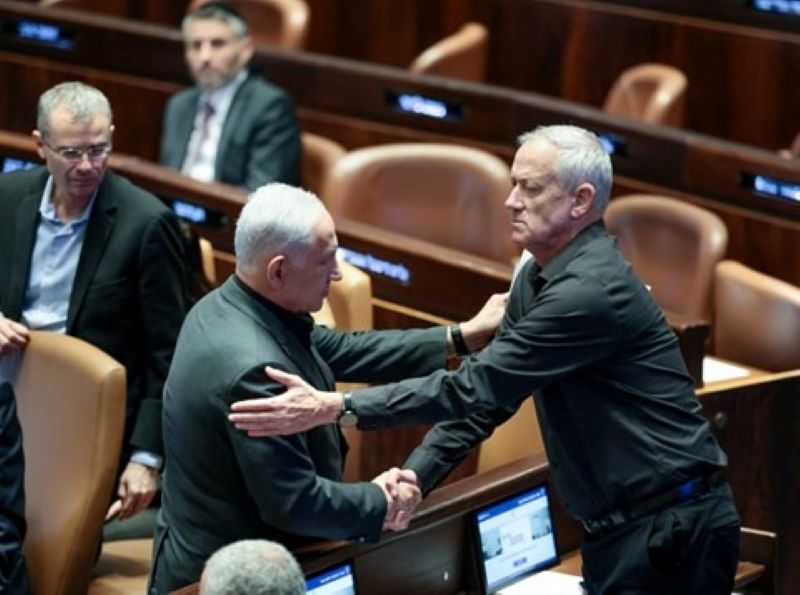
New details about the dramatic hours and days following the October 7 massacre, the negotiations that led to Israel’s emergency unity government, and sharp disagreements within the opposition are being revealed in a new book by National Unity Party chairman Benny Gantz.
In the book, titled “We,” which is set to be published in the coming days, Gantz provides a firsthand account of the atmosphere inside Israel’s military headquarters as the scale of the disaster became clear and explains why he ultimately decided to join Prime Minister Binyamin Netanyahu’s wartime coalition.
“When I arrived for the meeting with Netanyahu that day, I wasn’t focused on him, nor on the political costs,” Gantz writes. “I was focused on the atmosphere in the room and outside it. Officers stood there with slumped shoulders. Military Secretary Maj. Gen. Avi Gil repeatedly entered the meeting carrying notes. Each note brought worse news than the one before.”
According to Gantz, senior members of his party gathered later that evening and quickly concluded that joining the government was the only responsible course of action.
“That evening we convened in my office with senior party officials and advisers,” he writes. “The decision to enter the government stemmed from a simple understanding: it was our duty and the only way to influence what was happening in the country, the war effort, and the fate of the state.”
Gantz says it took four days of negotiations with Likud before an agreement was reached. Among the conditions were the creation of a small war cabinet, a freeze on judicial reform legislation, and a commitment not to dismiss senior civil servants during the crisis.
A significant portion of the chapter focuses on Gantz’s disagreement with opposition leader Yair Lapid, who chose not to join the government.
“Some argued that an outside safety net would be enough,” Gantz writes. “From military headquarters I went to meet Yair Lapid, who believed this was the time to issue an ultimatum regarding the continued presence of Bezalel Smotrich and Itamar Ben Gvir in the coalition.”
Gantz strongly disagreed.
“At that moment, when all our enemies were considering joining the attack and opening a multi-front war, those issues seemed insignificant to me,” he writes. “The correct decision was to join the government, unite the country, and show our enemies that we speak with one voice and act together.”
He further explains that he opposed making the removal of Smotrich and Ben Gvir a condition for entering the government.
“Honestly, I believed that at a moment of existential need for national unity, it was not legitimate to present demands that would divide the nation,” Gantz writes. “Many of our soldiers come from the Religious Zionist community, and many Ben Gvir voters serve the country as well. While I did not believe they belonged in the small decision-making forum, our duty was to embrace all parts of Israeli society because we truly did not know what the coming days would bring.”
Gantz also argues that supporting the government was the only responsible choice during the opening days of the war.
“It was important and correct to give the government full backing,” he writes. “If the pilots are flying and reservists are returning to service, we cannot remain indifferent. That was understood within my faction. It was less understood by Yair Lapid.”
The excerpts offer a rare look inside the political and military decision-making that followed the October 7 massacre and shed new light on the tensions within Israel’s center-left camp during one of the most critical moments in the country’s history.
(YWN World Headquarters – NYC)
 Join the official YWN WhatsApp status