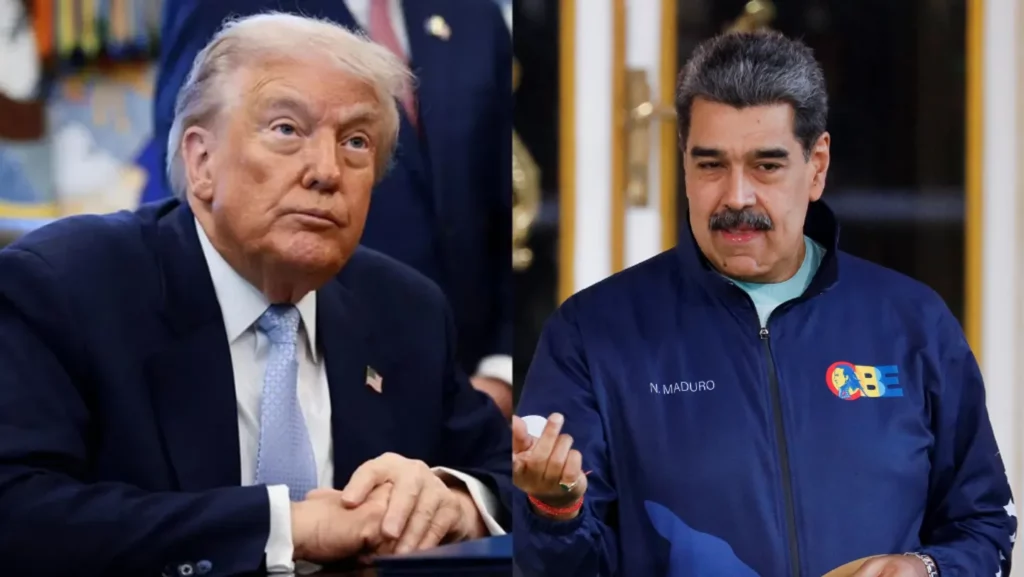
President Donald Trump delivered an ultimatum to Venezuelan leader Nicol�s Maduro in a tense phone call several days ago, telling the embattled strongman that the time had come to step aside � and to leave the country with his family � or face an escalating U.S. campaign designed to isolate and destabilize his regime, according to people familiar with the discussion.
The call, first reported by the Miami Herald and later confirmed by two administration officials, marks the most direct intervention yet in the White House�s months-long effort to force regime change in Caracas. It also underscores Trump�s growing willingness to leverage military assets, economic pressure, and diplomatic isolation simultaneously, even as critics warn the administration is edging toward a confrontation without a clear endgame.
According to sources briefed on the exchange, the call began with Maduro attempting to negotiate a face-saving settlement: global amnesty for himself and his inner circle, and the ability to retain control of Venezuela�s armed forces during any transition � a model resembling Nicaragua�s post-1991 shift.
Trump rejected both demands outright.
Instead, the president issued what one official described as the �clearest red line yet� from Washington: Maduro, his wife, and his son could depart the country safely, but only if they did so immediately.
The offer, combined with the threat of intensified U.S. operations, represented what one senior adviser called the administration�s �last off-ramp� before a broader confrontation.
With negotiations crumbling, the White House has moved to tighten the pressure campaign. Within days, Trump announced that U.S. authorities would consider Venezuelan airspace �closed in its entirety,� a symbolic but consequential statement that triggered rapid real-world effects. Commercial airliners began rerouting around the country, and by Sunday afternoon, no major carriers were flying over Venezuelan territory, according to FlightRadar24 data.
The decision came as the USS Gerald R. Ford, the Navy�s largest carrier, and a Marine Expeditionary Unit capable of amphibious assault positioned themselves off Venezuela�s northern coast, though administration officials insist it is meant to deter narcotrafficking operations, and does not signal imminent ground action.
Trump told reporters Sunday only that he had spoken with Maduro and that the call �didn�t go well or badly,� sidestepping questions about military planning.
Republicans aligned with the president increasingly describe the confrontation not as traditional geopolitical brinkmanship but as part of a broader war against narcotrafficking networks they argue are destabilizing the Western Hemisphere.
�We have a war coming through fentanyl, opioids, cocaine,� Sen. Dave McCormick (R-Pa.) said on Fox News Sunday, noting that drug overdoses killed roughly 100,000 Americans last year � double U.S. casualties in Vietnam.
The administration has carried out at least 21 lethal strikes on small boats in the Caribbean since September. Some of those operations � including an alleged �double tap� strike near Trinidad � have sparked ongoing congressional scrutiny.
Still, the White House maintains that Venezuela remains a central node in regional narcotrafficking, despite a 2019 DEA report showing most fentanyl originates in Mexico using precursors from China.
Caracas has responded by revoking operating rights for several major international carriers, further tightening the country�s isolation and raising fears about its already fragile economy. Maduro�s allies have framed the U.S. pressure campaign as �colonial aggression� aimed at seizing control of the country�s oil reserves.
Inside the administration, officials say they are prepared for that line of attack, and insist Trump is not seeking a ground invasion.
�No, he�s made it clear we�re not putting troops into Venezuela,� Sen. Markwayne Mullin (R-Okla.) said on CNN. �This is about protecting our own shores.�
Still, the administration�s strategy appears to rest on a volatile mix of diplomatic coercion, military deterrence, and economic pressure. Some lawmakers privately warn it could backfire if Maduro refuses to budge.
In Washington, the question dominating foreign-policy circles is whether Trump�s ultimatum was a bluff, a negotiation tactic, or a genuine precursor to expanded operations in and around Venezuela.
What�s clear is that the crisis is accelerating, and the administration has tied its credibility to Maduro�s ouster. Whether Trump�s �leave now or else� gamble succeeds may determine the next phase of U.S.�Venezuela relations, and potentially reshape U.S. posture in the Caribbean for years to come.
(YWN World Headquarters – NYC)
 Join the official YWN WhatsApp status