
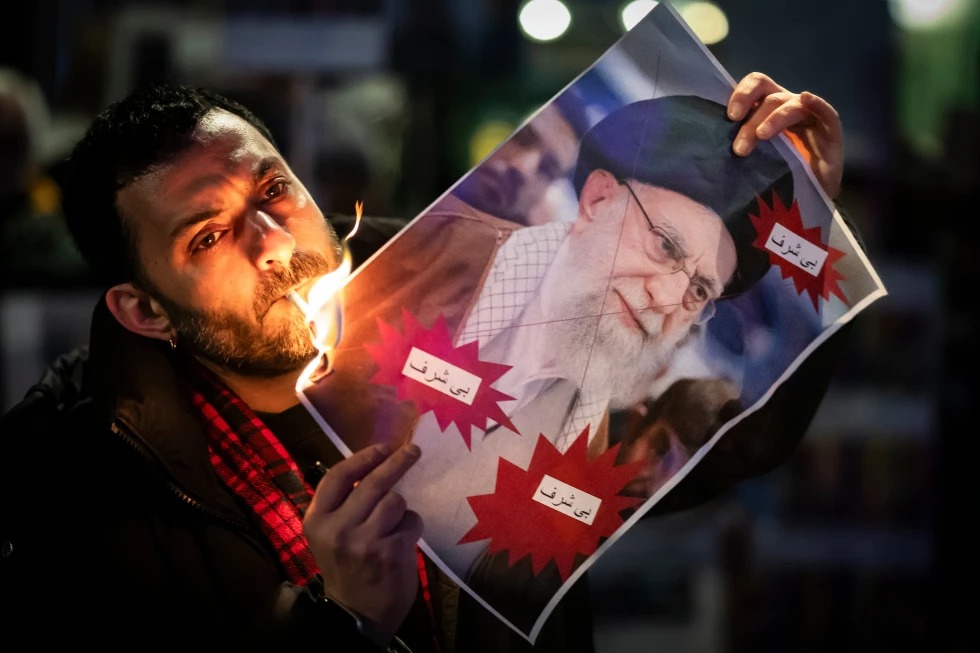
Iran on Saturday moved to project an image of control and continuity after weeks of unrest and escalating fears of a U.S. military strike, releasing rare public images of Supreme Leader Ali Khamenei as senior military and political officials warned Washington and Israel against any attack.
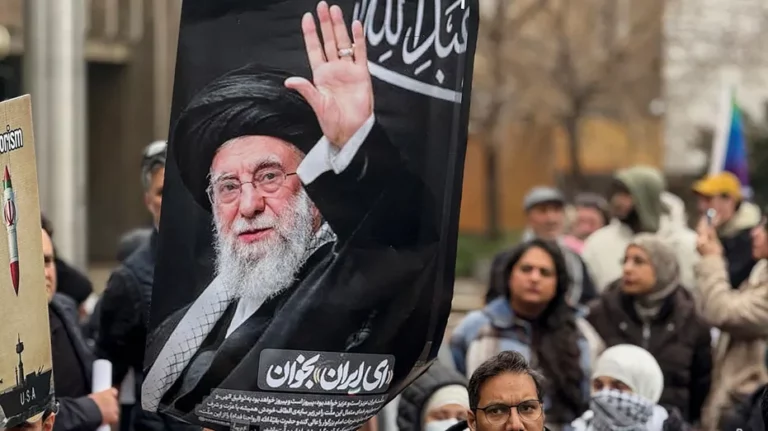
Iranian state media published photographs showing Khamenei attending prayers at the tomb of Ruhollah Khomeini, marking the 47th anniversary of the Islamic Revolution. The appearance marked Khamenei’s first public outing since protests erupted in late December and appeared designed to rebut opposition claims that the supreme leader had been relocated to a fortified underground site amid fears of a looming U.S. strike.
The images came as Iran’s military leadership struck a defiant tone. Army chief Amir Hatami warned the United States and Israel against military action, saying Iran’s forces were on high alert following Washington’s recent deployments in the region.
“If the enemy makes a mistake, without a doubt it will endanger its own security, the security of the region, and the security of the Zionist regime,” Hatami said, according to Iran’s official IRNA news agency. He added that Iran’s armed forces were at “full defensive and military readiness.”
Hatami also dismissed the idea that Iran’s nuclear capabilities could be destroyed, pushing back against recent remarks by President Donald Trump, who said he expected Tehran to seek a deal rather than risk U.S. military action.
“Iran’s nuclear technology cannot be eliminated, even if scientists and sons of this nation are martyred,” Hatami said.
The warnings followed Washington’s decision to send a naval strike group to the Middle East led by the USS Abraham Lincoln, a move that has heightened concerns of a direct confrontation.
Trump has threatened intervention following a deadly crackdown on anti-government protests that swept Iran for two weeks, while Tehran has warned it would retaliate with missile strikes on U.S. bases, naval assets and allies — including Israel — if attacked.
Tensions were further inflamed Friday when U.S. Central Command confirmed that Iran’s Islamic Revolutionary Guard Corps would conduct a two-day live-fire naval exercise in the Strait of Hormuz, a critical chokepoint for global energy supplies. CENTCOM cautioned the IRGC against “any unsafe and unprofessional behavior near U.S. forces.”
The United States designated the IRGC a terrorist organization in 2019, a move the European Union followed earlier this week, drawing sharp condemnation from Tehran and promises of retaliation.
Even as military rhetoric intensified, Iranian officials continued to signal limited openness to diplomacy. Foreign Minister Abbas Araghchi said Tehran was prepared to engage in nuclear talks but insisted that Iran’s missile and defense capabilities “will never be negotiated.”
The U.S. carried out strikes on Iranian nuclear facilities in June when it briefly joined Israel’s 12-day conflict with Iran, during which Israeli strikes killed senior Iranian officers and nuclear scientists and hit military targets across the country.
The show of strength abroad comes as Iranian leaders seek to reassert control at home after widespread protests that began Dec. 28 over rising prices and inflation before morphing into a broader anti-government movement.
Demonstrations peaked on Jan. 8 and 9 and have largely subsided following a sweeping crackdown. Iran’s National Security Council has acknowledged that 3,117 people were killed, while opposition-affiliated outlet Iran International has put the death toll above 36,000.
President Masoud Pezeshkian on Saturday again blamed foreign powers for the unrest, accusing the United States, Israel and European governments of exploiting Iran’s economic woes to foment instability.
“They rode on our problems, provoked, and were seeking — and still seek — to fragment society,” Pezeshkian said in a live state television address. “Everyone knows that the issue was not just a social protest.”
At the same time, Pezeshkian struck a more conciliatory note toward the public, urging officials to address grievances exposed by the demonstrations. “We must work with the people and for the people,” he said, arguing that just governance would deny foreign adversaries any leverage over the country.
Iran also acknowledged for the first time that minors were swept up in the crackdown. The deputy chairman of parliament’s education commission, Farshad Ebrahimpour, said a “number” of students under 18 were detained, as rights groups estimate at least 300 children and adolescents remain in custody.
(YWN World Headquarters – NYC)
 Join the official YWN WhatsApp status




One Response
north korea is testing longer range icbms and building a nuclear-powered submarine, presumably for sale to iran.
if uncle sam doesn�t take care of business �over there�, soon the business will come �over here� instead.