
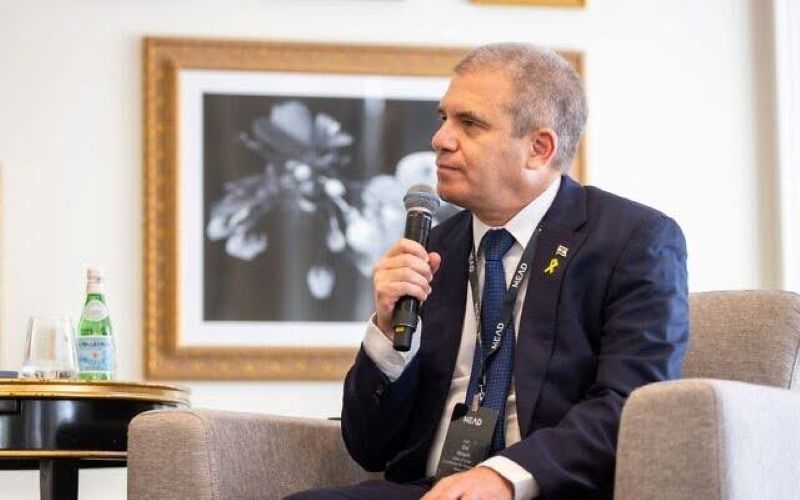
Gal Hirsch, Israel’s coordinator for prisoners and missing persons, who worked for over two years to bring the hostages home, disclosed startling details about Hamas’s long-term strategy and Israel’s desperate rescue attempts.
Hirsch said Hamas leader Yahya Sinwar intended to hold the hostages as bargaining chips for as long as a decade. “Yes–ten years of negotiations,” Hirsch told journalist Amit Segal in Yisrael Hayom. “We categorized the hostages as ‘Ron Arad’–those feared missing and unlikely to be found; ‘Wachsmans’–hostages held at known locations but with slim rescue chances; ‘Regevs and Goldwassers’–deceased; and ‘Shalits’–those who could be returned in a deal.”
When Hirsch took on what he called “the most difficult mission ever assigned in public service,” the number of captives and missing persons was unprecedented–and at the time still unknown.
He explained that he purposely avoided giving an exact count of hostages until the end of November to prevent Hamas from claiming that hostages were merely missing persons. “On the evening of October 8, I realized we were missing 3,200 people,” he recalled. “By the second week, that number dropped to 1,060. Later, it dropped to 400.”
Hirsch described the immense gap between Israel’s intelligence capabilities and the near-impossible odds of successful rescue operations. “There were cases where our unit was literally at the door,” he said, “but we knew we wouldn’t have those crucial few seconds needed to reach the captives alive, so we pulled back.”
He explained the unprecedented situation the army faced: “In modern history, there’s never been a case of an army operating with six divisions while hundreds of hostages were being held in dozens of locations on the battlefield. When the ground war began on October 26, we worked out of an improvised office in a WeWork space, while families poured in crying, ‘What are you doing to them?’ We insisted on maintaining both–hostage operations and the military operation–without giving up on either.”
Hirsch also recounted how Qatar became the official mediator. “I called the cellphone of a senior Qatari official who offered his country’s mediation services. I asked, ‘How do I know you can deliver?’ He said, ‘Tell me what you need.’ I replied, ‘Get the hostages out.’ He traveled south to Gaza to oversee the pilot release. The next day, Judith and Natalie Raanan were freed, followed later by Yocheved Lifshitz and Nurit Cooper via Egypt. That’s how Qatar became the mediator.”
“What killed me was the enormous gap between what I saw in the intelligence files and inside the negotiation rooms,” Hirsch said. “Behind closed doors, Hamas demanded Israel’s total surrender while publicly portraying Israel as the side refusing peace. The peak came during Ramadan–Sinwar was planning ‘Al-Aqsa Flood 2,’ yet we were accused of blocking a ceasefire during the fast and sabotaging a deal.”
This past Thursday morning, the hostage headquarters was officially shut down. Like his colleagues, Hirsch will carry the personal weight of what he saw for the rest of his life.
“Through this work, we saw every video, every atrocity, and heard every testimony,” he said. “I’ve had people die in my arms, I’ve killed and nearly been killed–but I’ve never seen anything so catastrophic, so biblical in its horror.”
(YWN’s Jerusalem desk is keeping you updated after tzeis ha’Shabbos in Israel)
 Join the official YWN WhatsApp status





One Response
and hamas lives to fight another day?