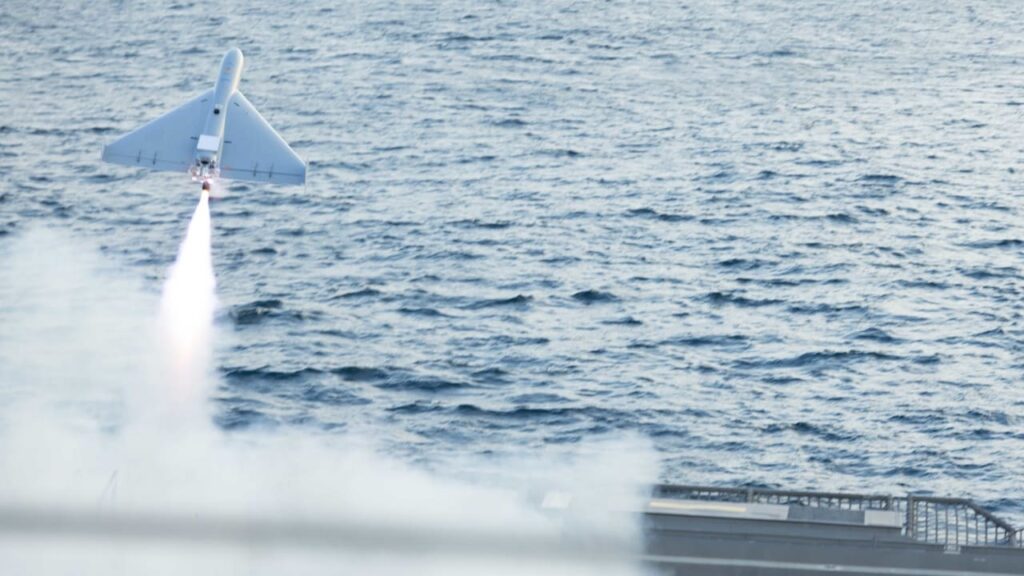
The U.S. Navy has crossed a new threshold in its race to field low-cost strike weapons, successfully launching a one-way attack drone from a ship at sea for the first time.
The test took place Dec. 16 in the Arabian Gulf, when the USS Santa Barbara, a littoral combat ship, launched a Low-cost Unmanned Combat Attack System, or LUCAS, from its flight deck, according to U.S. Naval Forces Central Command. Navy officials say the launch marks a major step toward integrating expendable attack drones into routine naval operations.
“This is about delivering affordable, effective unmanned capabilities to the warfighter,” Vice Adm. Curt Renshaw, the commander of NAVCENT and the U.S. 5th Fleet, said in a statement.
The test comes as the Pentagon accelerates its push to deploy large numbers of cheap, one-way drones — a sharp pivot from its historical reliance on fewer, high-end systems. Just weeks earlier, U.S. Central Command announced the creation of Task Force Scorpion Strike, the military’s first dedicated one-way attack drone unit in the region, following Defense Secretary Pete Hegseth’s directive to fast-track low-cost unmanned systems.
The LUCAS drone itself reflects the shift. Developed by SpektreWorks, the V-shaped platform is modeled on Iran’s Shahed-136, the drone Russia has used by the thousands against Ukraine and that Iranian-backed terrorists have deployed across the Middle East. The U.S. version is designed for rapid production and can be launched from ships, vehicles, or the ground.
For Navy planners, the appeal is operational flexibility. Ship-launched attack drones would allow commanders to respond quickly to threats in choke points like the Strait of Hormuz or Bab el-Mandeb, where Iranian forces and proxies such as the Houthis have repeatedly targeted commercial shipping.
The move also reflects a hard-learned lesson from Ukraine and the Middle East: modern wars are increasingly won by volume as much as by precision.
(YWN World Headquarters – NYC)
 Join the official YWN WhatsApp status