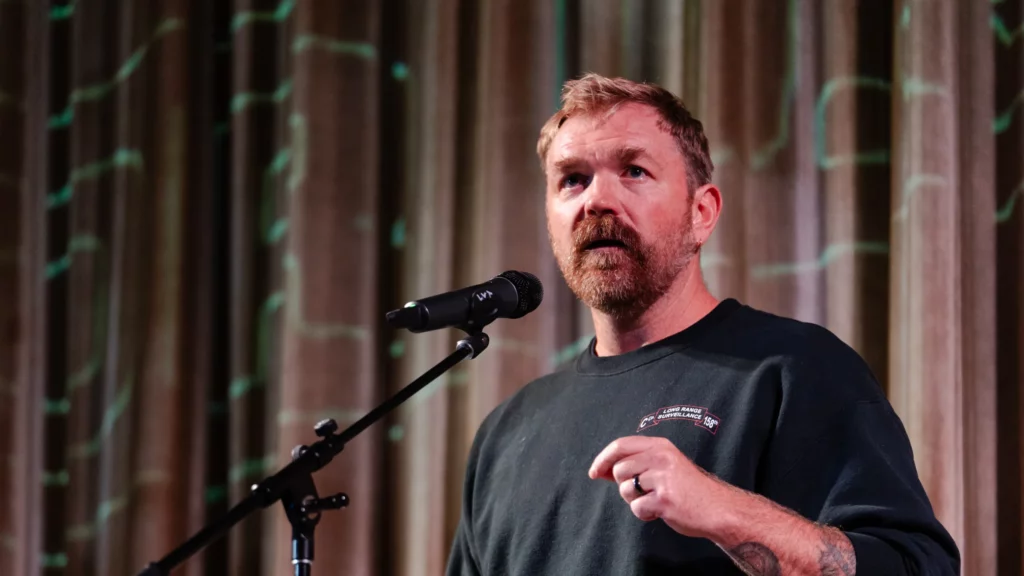
A Democratic candidate for U.S. Senate in Maine has reversed course and is now defending a tattoo that closely resembles a notorious Nazi symbol.
Graham Platner, a Bernie Sanders-backed oyster farmer and former Marine seeking to challenge Republican Sen. Susan Collins, had previously apologized after it was revealed that a large tattoo on his chest resembled the “Totenkopf,” or “death’s head,” symbol used by Adolf Hitler’s SS.
The Totenkopf — a skull-and-crossbones emblem historically associated with Nazi SS units — is widely recognized as a hate symbol, according to the Anti-Defamation League.
When the controversy first erupted last year, Platner insisted he had not realized the symbol’s connection to Nazism and said he planned to have the tattoo removed.
But in a new interview this week with the news site Zeteo, Platner struck a very different tone, dismissing the criticism and claiming the tattoo is nothing more than a generic skull design.
“It’s a skull-and-crossbones,” Platner said, calling the image “an eminently reasonable thing.”
The dismissive defense contradicts his past statements and actions, which undermine his claim that he was unaware of the symbol’s meaning.
Platner has previously said he got the tattoo during a night of drinking with fellow Marines in Croatia in 2007 while on leave from the military. But multiple details that have emerged over the past year cast doubt on his assertion that he did not know the symbol’s Nazi associations.
An acquaintance told Jewish Insider that Platner himself referred to the tattoo as a “Totenkopf” during a 2012 conversation at a Washington, D.C., bar.
“He said, ‘Oh, this is my Totenkopf,'” the source recalled, adding that Platner used the term in what was described as a “cutesy” manner.
Further raising questions, Reddit posts attributed to Platner from 2019 show him participating in discussions about the Totenkopf symbol and its use among military personnel.
Those posts strongly suggest he was familiar with the symbol’s historical meaning years before the controversy surfaced.
The issue has been particularly damaging given Platner’s own background. According to his former political director, Genevieve McDonald, Platner is a military history enthusiast who would have known the significance of such imagery.
“He’s a military history buff,” McDonald wrote in a Facebook post before resigning from the campaign last October. “He knows damn well what it means.”
McDonald stepped down after additional past comments from Platner surfaced online, including offensive remarks posted on Reddit about race and assault on women.
Platner later apologized for those statements, saying they were written during a difficult period when he was struggling with post-traumatic stress disorder after leaving the military.
In response to the tattoo controversy, Platner has since altered the design so it now resembles an animal figure and has said he intends to remove it entirely.
The controversy resurfaced recently amid a public dispute between Platner and Sen. Ted Cruz. After Platner criticized U.S. policy in the Iran conflict while referencing fallen service members, Cruz fired back on social media.
“Were your friends Germans wearing Nazi tattoos like you?” Cruz wrote.
Despite the mounting controversies, Platner’s campaign had initially shown signs of momentum. In the first two months of his Senate bid, he reportedly raised about $5 million, recruited more than 11,000 volunteers, and drew large crowds at town-hall style events across Maine.
Platner is competing in a Democratic primary scheduled for June 9 and could face Collins in what analysts expect to be one of the most closely watched Senate races of the cycle.
He has received praise from, of course, Sen. Bernie Sanders (I-Vt.), who described him as a strong candidate.
“I personally think he is an excellent candidate,” Sanders said earlier this year. “I’m going to support him and look forward to him becoming the next senator from the state of Maine.”
(YWN World Headquarters – NYC)
 Join the official YWN WhatsApp status