
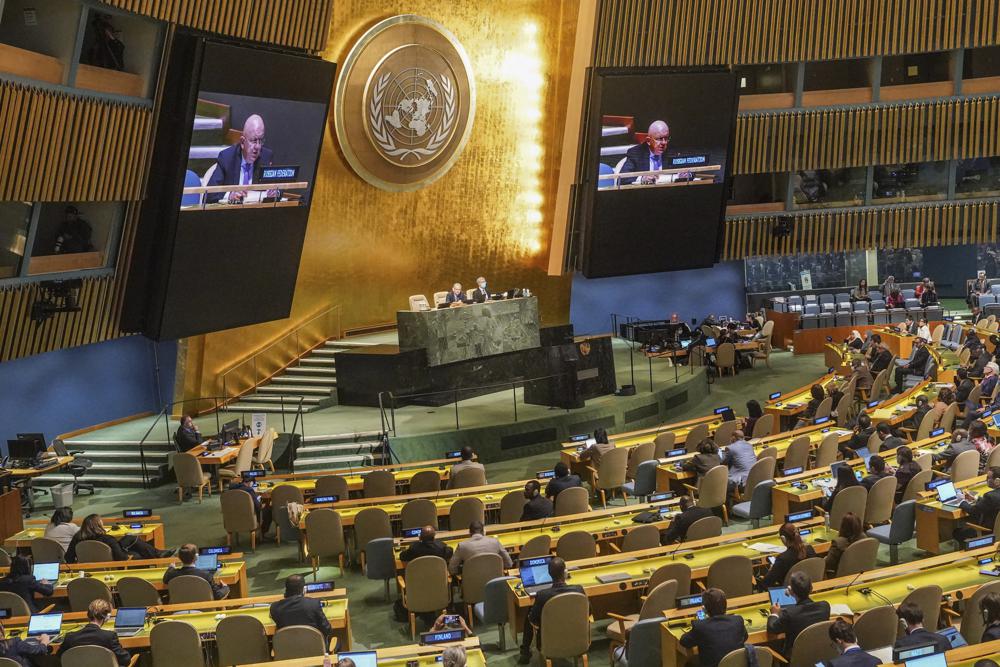
The U.N. General Assembly voted overwhelmingly Wednesday to condemn Russia’s “attempted illegal annexation” of four Ukrainian regions and demand its immediate reversal, a sign of strong global opposition to the seven-month war and Moscow’s attempt to grab its neighbor’s territory.
The vote in the 193-member world body was 143-5 with 35 abstentions. It was the strongest support from the General Assembly for Ukraine and against Russia of the four resolutions it has approved since Russian troops invaded Ukraine Feb. 24.
Ukraine’s U.N. ambassador, Sergiy Kyslytsya, called the vote “amazing” and “a historic moment.” U.S. Ambassador Linda Thomas-Greenfield said supporters were “holding our breaths” and called it “a monumental day.” European Union Ambassador Olof Skoog called it “a great success” that sends “a resounding message to Russia that they are and remain isolated.”
The Western-sponsored resolution was a response to Russia’s announced annexation last month of Ukraine’s Donetsk, Luhansk, Kherson and Zaporizhzhia regions. Moscow acted following Kremlin-orchestrated “referendums” that the Ukrainian government and the West have dismissed as sham votes conducted on occupied land amid warfare and displacement.
During two days of speeches at the assembly’s resumed emergency special session on Ukraine speaker after speaker accused Russia of violating key principles of the United Nations Charter — respect for the sovereignty and territorial integrity of all U.N. member nations.
There was intense lobbying by supporters of the EU-facilitated resolution ahead of Wednesday’s vote.
U.S. envoy Thomas-Greenfield told the assembly before the vote that when the United Nations was established on the ashes of World War II it was built on an idea — “that never again would one country be allowed to take another’s territory by force.”
Afterward, she told reporters the vote means “that in the eyes of the world and the United Nations, Ukraine’s borders remain the same.”
“The resolution also sends an enormously important signal to Moscow and to everyone: It does not matter if you as a nation are big or small, rich or poor, old or new. If you are a U.N. member state, your borders are your own and are protected by international law,” Thomas-Greenfield said. “They cannot be redrawn by anyone else by force.”
A key issue for the resolution’s Western backers was how many countries would support it, and the result went beyond their most optimistic expectations.
The General Assembly voted 141-5 with 35 abstentions March 2 to demand an immediate Russian cease-fire, withdrawal of all its troops and protection for all civilians. On March 24, it voted 140-5 with 38 abstentions on a resolution blaming Russia for Ukraine’s humanitarian crisis and urging an immediate cease-fire and protection for millions of civilians and the homes, schools and hospitals critical to their survival.
But the assembly voted by a far smaller margin April 7 to suspend Russia from the U.N.’s Geneva-based Human Rights Council over allegations Russian soldiers in Ukraine engaged in rights violations that the United States and Ukraine have called war crimes. That vote was 93-24 with 58 abstentions.
A 2014 resolution affirming Ukraine’s territorial integrity and declaring the referendum that led to Russia’s annexation of the Crimean Peninsula illegal was adopted by a vote of 100-11 with 58 abstentions.
Among the surprise supporters of Wednesday’s resolution were the “yes” votes from Saudi Arabia, the United Arab Emirates and other members of the Gulf Cooperation Council as well as Brazil.
Russia’s U.N. ambassador, Vassily Nebenzia, had appealed to countries to vote against the resolution, calling it “a politicized and openly provocative document” and denouncing its sponsors as “unscrupulous Western blackmailers.” He expressed regret the vote was not by secret ballot, as Russia sought but the assembly rejected.
Nebenzia reiterated Russia’s claims the referendums were valid, saying “the populations of these regions do not want to return to Ukraine.”
The four countries that joined Russia in voting against the resolution were North Korea, Belarus, Syria and Nicaragua.
Ukraine’s Kyslytsya expressed profound regret that the four countries made “the wrong choice against the U.N. Charter” and urged them to reconsider their commitment to the U.N.’s principles.
Among the 35 countries that abstained, 19 were from Africa, including South Africa. China and India, the world’s two most populous countries, also abstained along with Pakistan and Cuba.
The more powerful Security Council, whose resolutions are legally binding, has been stymied on taking action on Ukraine because of Russia’s veto power, which it used Sept. 29 to block condemnation of Russia’s attempts to annex Ukrainian territory.
By contrast, the General Assembly, where there are no vetoes, has now approved four resolutions criticizing Russia over Ukraine. Its votes reflect world opinion but are not legally binding.
The resolution adopted Wednesday declares that Moscow’s actions violate Ukraine’s sovereignty and territorial integrity, are “inconsistent” with the principles of the U.N. Charter, and “have no validity under international law and do not form the basis for any alternation of the status of these regions of Ukraine.”
It demands that Russia “immediately, completely and unconditionally withdraw all of its military forces from the territory of Ukraine within its internationally recognized borders.”
And it supports “the de-escalation of the current situation and a peaceful resolution of the conflict through political dialogue, negotiation, mediation and other peaceful means” that respect Ukraine’s sovereignty, territorial integrity and internationally recognized borders.
Many countries among the more than 70 speakers urged a negotiated end to the war. The EU’s Skoog called the appeal for a peaceful solution “very important,” but stressed it must be based on Ukraine’s territorial integrity.
During Wednesday’s debate there was strong support for the resolution.
Australian Ambassador Mitch Fifield called Russia’s attempted annexation “illegal and a dangerous escalation” and urged all countries to oppose acts of aggression.
Ambassador Fergal Mythen of Ireland said voters in the “sham” referendums in the four regions “faced intimidation by the Russian military and Russia’s illegitimately appointed authorities.”
Cambodian Ambassador Sovann Ke didn’t indicate how he would vote but said that “the forcible annexation of regions from a sovereign country is a flagrant violation of the U.N. Charter and international laws, which is not acceptable” and urged that internationally respected borders “be fully respected.” In the voting, Cambodia supported the resolution.
South Korea’s ambassador, Hwang Joonkook, gave unequivocal support “to the sovereignty, political independence and the territorial integrity of Ukraine.” He said his country’s “own painful experiences” after the 1950-53 Korean War “can testify that any attempt to divide a nation in any form or method is merely the beginning of lasting very serious troubles, rather than a solution.”
On the other side of that divide, North Korean Ambassador Kim Song supported the “self-determination” of the people in the four regions annexed by Russia as a right protected in the U.N. Charter and said the results must be respected.
He accused the United States and Western countries of “brutally” violating the sovereignty and territorial integrity of former Yugoslavia, Afghanistan, Iraq and Libya under “the pretext” of promoting international peace and security without ever having its actions called into question by the Security Council. He argued that U.S. interference in the internal affairs of countries is continuing in the 21st century.
Syrian Ambassador Bassam Sabbagh accused the General Assembly of “being manipulated flagrantly by some Western countries for their own geopolitical interests” and urged countries to oppose efforts “to isolate Russia and to employ double standards.”
(AP)
 Join the official YWN WhatsApp status


