

In light of growing public uncertainty over the kashrus status of common beers, the CRC (Williamsburg) has released a new clarification addressing which beverages remain free of concern. The announcement comes amid an influx of questions regarding the possibility of non-kosher additives appearing even in well-known brands.
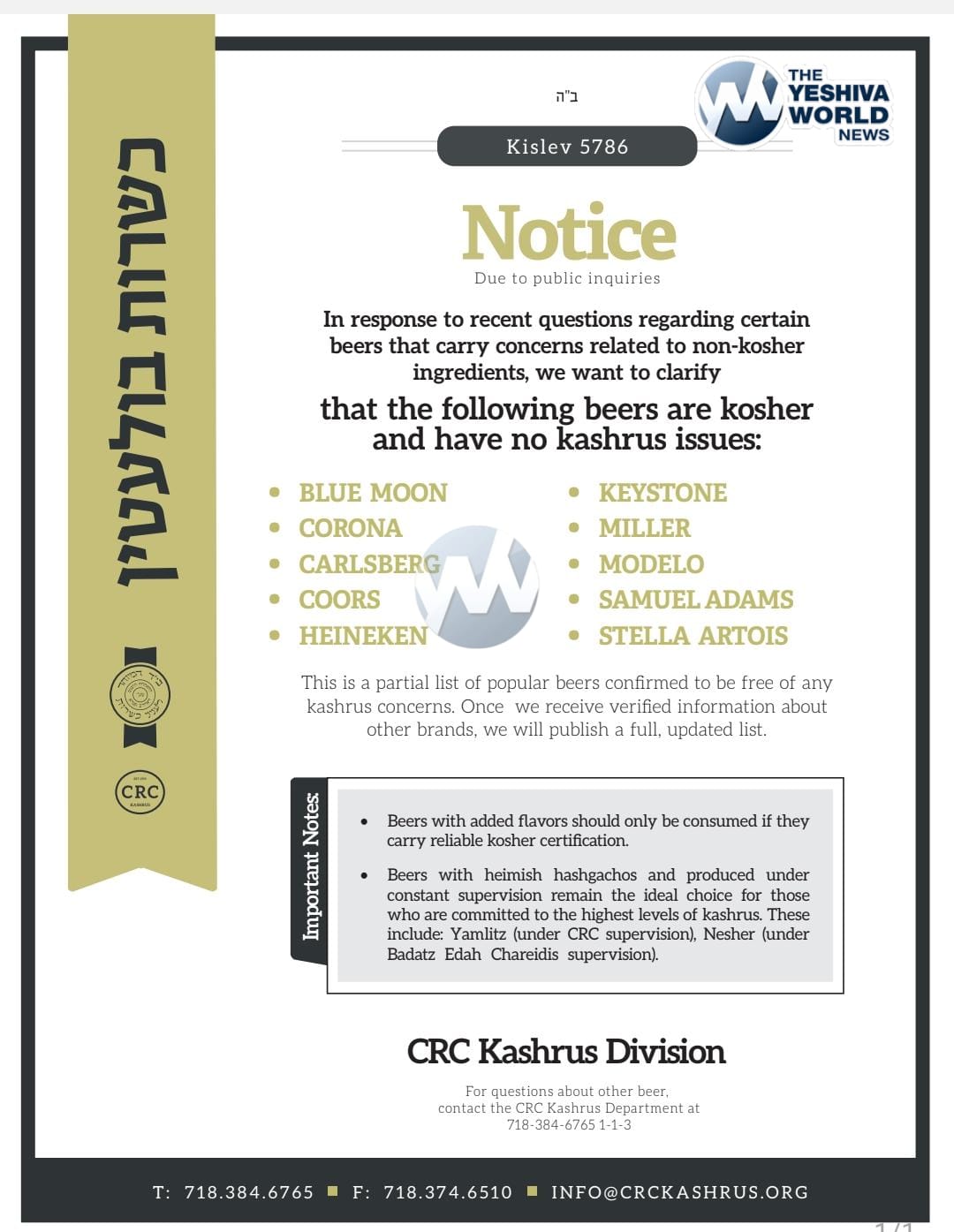
According to the CRC, many widely purchased beers remain entirely kosher and present no kashrus issues whatsoever. Among the brands listed as acceptable are Blue Moon, Corona, Carlsberg, Coors, Heineken, Keystone, Miller, Modelo, Samuel Adams, and Stella Artois. The CRC notes that this is only a partial list and that additional brands will be evaluated and publicized once verified information is obtained.
The CRC explains that standard, unflavored beers continue to be permissible, as the traditional brewing process of water, hops, barley, and yeast remains intact for many major manufacturers. At the same time, the CRC emphasizes that beers containing added flavors should be consumed only when bearing reliable kosher certification. For those seeking higher kashrus standards, the CRC points to beers produced under constant supervision, such as Yamiltz under its own certification and Nesher under the Badatz Eidah Chareidis.
The CRC’s policy stands in sharp contrast to the direction being taken by the Orthodox Union (OU), which recently announced a major policy overhaul set to take effect on January 1. In a letter to mashgichim and food-service operators, the OU stated that the beer industry has changed dramatically, to the point that the old assumption–that unflavored beer requires no certification–can no longer be relied upon. The explosion of craft breweries, the widespread use of unexpected additives, barrel-aging techniques involving wine or spirits, and the sharing of equipment with flavored or potentially non-kosher products have, in the OU’s view, introduced too much uncertainty into the beer market. Even beers that appear to be “plain” may include post-fermentation additives that do not appear on labels.
As a result, the OU will now require that only beers with proper kosher certification be permitted in OU-supervised establishments. Craft beers will need visible certification or written confirmation, while national brands already operating under kosher oversight will remain acceptable. The OU is distributing a list of nearly one thousand certified breweries to mashgichim around the country.
While the CRC affirms that many mainstream beers remain perfectly acceptable without certification, the OU is moving to a stricter model that treats beer with far greater scrutiny than in past decades. The two agencies, operating from different assessments of the industry landscape, have reached divergent conclusions on how to best safeguard the kashrus standards of the tzibbur.
(YWN World Headquarters – NYC)
 Join the official YWN WhatsApp status








13 Responses
You’re not correct and misunderstood the CRC. All the CRC listed beers have a somewhat of hashgacha, that’s why it’s fine.
This is terrible misinformation. The OU is allowing most of the best selling national beer companies. The CRC is not saying anything different than the OU new policy (which by the way, was never meant to be publicized and was a policy change for establishments only).
MHKA- Make Heiniken Kosher Again !!!
Thank you-
Nesher makes beer? I’ve only seen a sweet Nesher malt drink.
Is this the historic first-time-ever that the OU is more machmir than the chassidishe hechsher?!
Fake news. The OU policy is only for events and restaurants under its hashgachah, not for individual consumers. There is no disagreement here whatsoever.
Forget the the CRC List. It is their statement that strongly contradicts the OU, Star-K’s, and cRc’s upcoming policy change. The statement also grossly misrepresents the new Food Service policy.
Craft beers have been on the radar of the technoligically-advanced and industry-wise national hashgachos for some time (perhaps 10 or more years). American breweries are not bound by centuries-old recipes and traditions as are the European breweries.
It has LONG been the policy of the major kashrus organizations to not endorse flavored beers from ANY country.
The ou policy was about certified events and establishments. Does the crc allow beers without a hechsher in establishments under their supervision? And they should clarify that only the standard ones from these brands or those with a hechsher are ok from this list. As there are many flavors from these brands, some dairy etc.and saying the brand name is ok can cause someone to rely on them mistakenly
If I may, you are a little behind the news. Part of the beer tumult was a misunderstanding. Rabbi Shalom Fishbane of the Chicago CRC explained on a podcast that the letter, which has been publicized, was an inter-Kashrus organization memo, and NOT a letter for the public. Also, they have visited many breweries, and there is now a list on the Chicago site. Hundreds of beers are listed there. They have three categories of beers. There are beers with hashgacha, like Coors and Blue Moon; there are beers that don’t have supervision but are recommended, and breweries that have real treifus. There are kraft beers that pork is put in, while others have salami. The date Jan.1 was a random date because it has come time to be more careful. We should appreciate the hard work that these agencies have done and pay attention to the facts
Maybe I missed something, but it seems theres not such a disagreement.
The CRC says that Certain Beers have no issues (the article itself describes them as ‘widely purchased’) while the OU seem to be concerned about Craft Beers, or basically, smaller startups and lesser known companies.
Both seem to be plausible at the same time!
Do any of these beers without hashgacha lead to side effects causing those who drink them to lose their sense of time, and not recognize that a half-hour after chatzos is no longer the appropriate time for shachris, but rather, is the accepted time for mincha?
Zelmen, you are incorrect. Plain beers that are made in major breweries that operate under strict policies, remain kosher.
Apparently whoever wrote this article misunderstood both policies.
This seems to be perfectly in line with the OU policy, as they included the following: �Many national-brand beers that already operate under kosher oversight will remain acceptable, even if no symbol appears on the label.�