
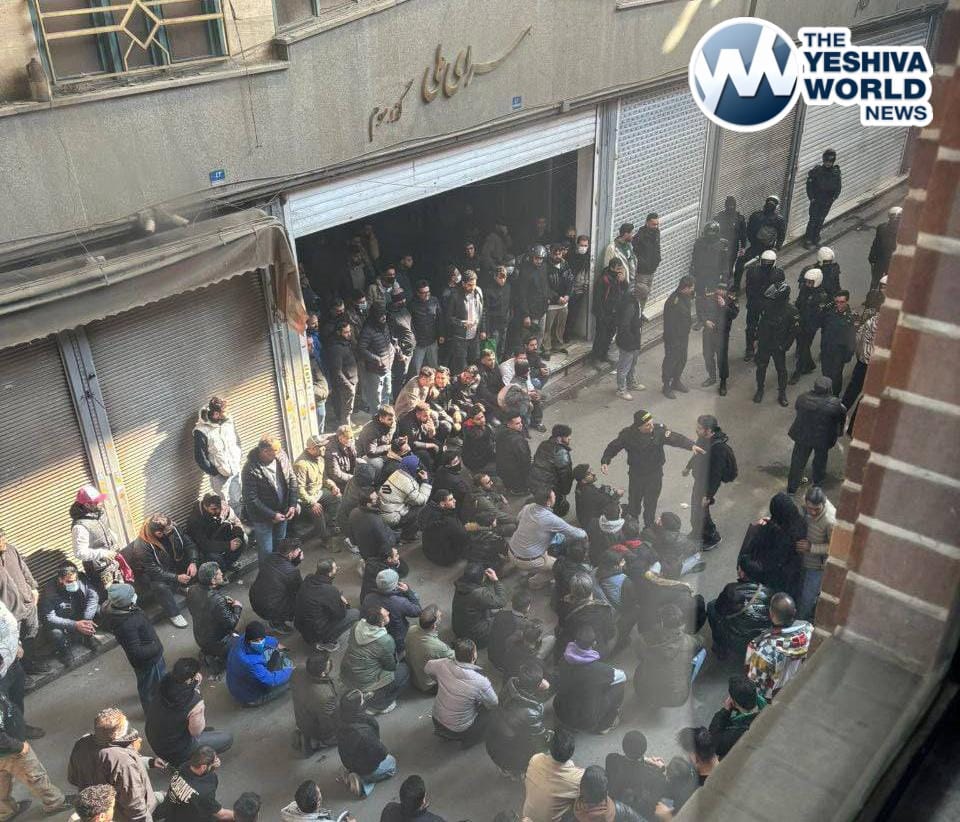
One of the Islamic Republic’s most powerful economic and political symbols erupted into open confrontation on Tuesday, as protesters clashed with security forces inside the Tehran Grand Bazaar, prompting authorities to fire tear gas and shutter large swaths of the centuries-old marketplace.
Witnesses said demonstrators staged a sit-in inside the bazaar — long regarded as the regime’s economic backbone and a historic engine of revolution — before riot police moved in to forcibly disperse the crowd. By afternoon, the normally bustling market was largely closed, an unmistakable sign of escalating unrest as Iran’s currency plunged to a record low.
The clash marks a dangerous new phase in weeks of nationwide demonstrations fueled by economic collapse, inflation, and deepening public anger. Activists outside Iran say at least 35 people have been killed in protest-related violence so far, with more than 1,200 detained as security forces struggle to contain unrest spreading across major cities.
Economic pressures are intensifying by the day. Iran’s Central Bank of Iran has sharply reduced the subsidized dollar exchange rates offered to importers and producers — a move expected to trigger immediate price hikes on basic goods. Merchants warn that consumers, already battered by years of international sanctions, are nearing a breaking point as savings evaporate and purchasing power collapses.
In a rare public admission of weakness, President Masoud Pezeshkian acknowledged that the crisis is slipping beyond the state’s control. Speaking in a televised address, Pezeshkian ordered an investigation into one protest incident but conceded that the government is overwhelmed.
“We should not expect the government to handle all of this alone,” Pezeshkian said. “The government simply does not have that capacity.”
The statement — unusually blunt by Iranian leadership standards — underscores the severity of the moment. The Grand Bazaar has historically functioned as a bellwether for regime stability; when merchants close their shops, it has often preceded major political upheaval, including the 1979 revolution.
For now, Tehran is attempting to project authority through force, but Tuesday’s scenes suggest the unrest is hardening rather than fading. With the rial in free fall, prices poised to spike, and the president openly warning of institutional limits, Iran’s leadership faces a convergence of economic and political pressures that security crackdowns alone may no longer be able to contain.
(YWN World Headquarters – NYC)
 Join the official YWN WhatsApp status




3 Responses
When you supply most of the world’s terrorism but your own people can’t afford groceries it’s time to put the Rockets aside for a minute and get everyone some bread. Or invite your own downfall quickly
Revolution is way overdue….! Can’t wait for the nessia groups to kever Mordechei V’Esther on Taanes Esther…!
replacing the old khomeinist faces with new khomeinist faces won�t change anything. the regime won�t fall unless someone pushes it.