
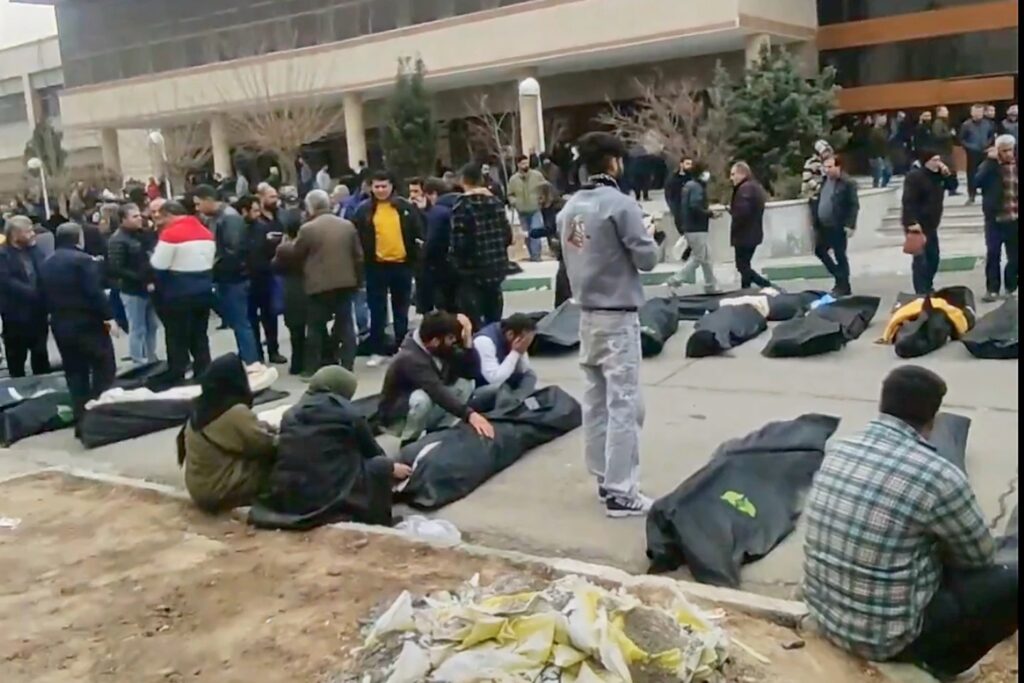
At least 12,000 people were killed in Iran amid nationwide protests as the regime imposed an unprecedented nationwide blackout that appears aimed not only at maintaining security control but also at concealing the scale of the violence, Iran International reported on Tuesday.
Internet shutdowns, crippled communications, the silencing of media outlets, and intimidation of journalists and witnesses all point to a single objective: preventing a vast and historic crime from being seen, the opposition outlet stated.
The outlet wrote, “In recent days, after receiving scattered but shocking and deeply troubling reports, Iran International has focused on verifying information to build a clearer picture of the scale of repression and the killings during the latest protests. In a country where authorities deliberately restrict access to information, such an assessment is difficult and time-consuming—particularly because rushing to publish incomplete casualty figures risks errors in documenting events and could distort the true scale of this tragedy.”
The report continued by saying that by Sunday, the volume of evidence and the convergence of independent accounts reached a point that allowed for a credible assessment. Over the past two days, Iran International’s editorial board conducted a rigorous, multi-stage review in line with professional journalistic standards. The material examined included information from a source close to the Supreme National Security Council, two sources within the presidential office, accounts from multiple sources inside the Islamic Revolutionary Guard Corps in Mashhad, Kermanshah, and Isfahan, testimonies from eyewitnesses and families of those killed, field reports, data connected to medical centers, and information provided by doctors and nurses in several cities.
Based on this review, Iran International concluded that the events constitute the largest mass killing in Iran’s contemporary history, with the killing of at least 12,000, primarily over two consecutive nights, Thursday and Friday, January 8 and 9.
“In terms of geographic scope, intensity of violence, and the number of deaths in a short time span, this killing is unprecedented in Iran’s history,” the outlet wrote.
According to the information reviewed, the victims were mainly shot by forces of the Islamic Revolutionary Guard Corps and the Basij. The violence was organized and systematic, not the result of sporadic or unplanned clashes. Many of those killed were young people under the age of 30.
Information obtained from sources within the Supreme National Security Council and the presidential office indicates that the operation was carried out on the direct order of Ali Khamenei, with the knowledge and approval of the heads of all three branches of government. A live-fire directive was issued by the Supreme National Security Council itself.
Based on available data and cross-checked information from reliable sources, including within the Supreme National Security Council and the presidential office, the initial estimate by Iran’s own security institutions is that at least 12,000 people were killed nationwide. Under the current communications blockade and without direct access to information, confirming a final figure will require further detailed documentation. Experience in recent years shows that Iranian security bodies have consistently withheld information and avoided recording or publishing accurate casualty numbers.
Iran International has stated that it will continue refining this estimate with the help of the public by collecting documentation, cross-checking accounts, and verifying information on an ongoing basis, with the goal of ensuring that no victim is erased and no family is left unheard.
Inside Iran, media outlets have been effectively silenced. Hundreds of national and local newspapers, an unprecedented development in the history of the country’s press, have ceased operations since Thursday. Aside from the state broadcaster, only a handful of news websites remain active, all operating under censorship and direct security oversight.
The outlet has called on Iranians inside and outside the country to submit any relevant documentation, including videos, photographs, audio recordings, eyewitness testimony, medical information, and details regarding the locations and timing of the killings. It emphasized that the safety of sources and the confidentiality of information are an absolute priority.
After completing verification, Iran International plans to publish its findings in full and provide them to relevant international bodies and institutions. The Islamic Republic, it said, cannot conceal this crime by cutting the Iranian people off from the world. The truth will be documented, the names of those killed will be preserved, and the massacre will not be buried in silence. Those who were killed belong not only to their grieving families, but to the broader national struggle of the Iranian people.
(YWN Israel Desk—Jerusalem)
 Join the official YWN WhatsApp status


4 Responses
And all the pro palis are silent; No Jews, No news
And the GutterRat is mum cuz it’s not Israel.
But soon he will call a UN General Assembly emergency meeting and condemn Israel
And not one of them was on with the Israel mossad, that pays thousands agents millions and billions, they was told to back out right on time
It’s genocide of Iranians. Where’s the UN chief