
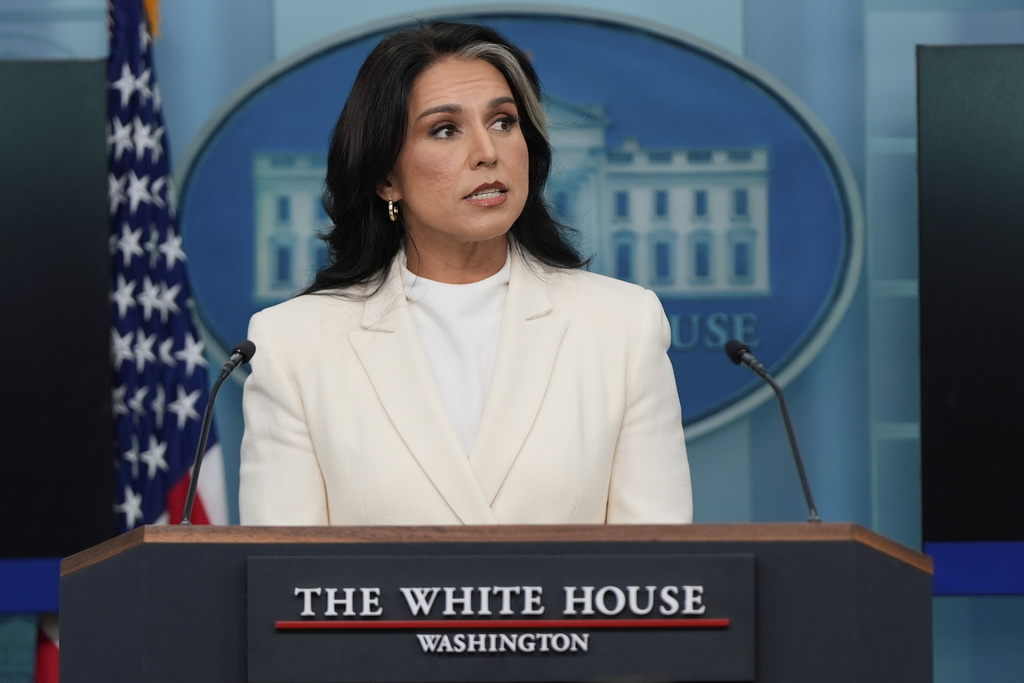
A mysterious intercepted phone call, a locked-down intelligence report, and months of behind-the-scenes maneuvering have ignited a political storm inside the U.S. intelligence community, placing Director of National Intelligence Tulsi Gabbard at the center of a widening controversy.
According to the attorney for a federal whistleblower, the National Security Agency last spring flagged an unusual conversation between two members of foreign intelligence that referenced a person close to Donald Trump. The highly classified intercept was considered sensitive enough to be elevated to the highest levels of government.
Instead of allowing the NSA to circulate the report through standard intelligence channels, Gabbard allegedly took a paper copy directly to White House chief of staff Susie Wiles, according to whistleblower lawyer Andrew Bakaj.
Within a day, Bakaj said, Gabbard instructed the NSA not to publish the intelligence assessment and ordered officials to route future information exclusively through her office. The move, he claims, effectively halted the report’s normal distribution.
“These details were never meant to be shelved,” Bakaj said, describing the intelligence as a matter of “urgent concern” with potential national security implications.
Alarmed by the handling of the report, a whistleblower contacted the intelligence community’s inspector general in April and filed a formal complaint in May, alleging that Gabbard had blocked classified material from reaching Congress.
However, for nearly eight months, the intelligence report was kept sealed, even as the whistleblower pushed for disclosure to congressional oversight committees. Acting Inspector General Tamara A. Johnson ultimately dismissed the complaint after a brief review, saying her office could not determine whether the allegations were credible.
The whistleblower was told that any approach to Congress would require prior guidance from Gabbard’s office.
Initial reporting suggested the call was between someone close to Trump and a foreign intelligence contact. Bakaj later corrected that account, clarifying that the NSA intercepted a call between two foreign intelligence operatives that involved references to someone close to the Trump White House.
“The NSA does not monitor individuals without a reason,” he said.
Officials familiar with the matter say the person referenced is not believed to be a government employee.
The Office of the Director of National Intelligence has rejected the allegations outright.
In a statement, an ODNI spokesperson said Gabbard’s actions were “fully within her legal and statutory authority,” calling the reporting politically motivated and misleading.
The office also cited factors such as the classified nature of the material, a government shutdown, and internal reporting failures as reasons for the delay.
Two prior inspector general reviews, the statement added, found the allegations to be baseless.
Despite those assurances, lawmakers from both parties have raised concerns.
Members of the elite “Gang of Eight” leadership group recently received a heavily redacted version of the complaint. Reactions were sharply divided.
Republican Sen. Tom Cotton defended Gabbard, saying she followed the law in handling sensitive material.
“The law is clear,” said Sen. Mark Warner, the senior Democrat on the Senate Intelligence Committee. “This whistleblower complaint was issued in May. We didn’t receive it until February.”
Warner accused officials of attempting to “bury the complaint.”
Further controversy erupted after Gabbard assigned a senior adviser, Dennis Kirk, to work inside the inspector general’s office shortly after the complaint was filed. Critics say the move may have compromised the watchdog’s independence.
Rep. Stephen F. Lynch, the top Democrat on the House Oversight Committee, warned in a letter that Kirk’s appointment raised “troubling questions” about political interference.
Kirk previously served in the Trump administration and helped author Project 2025, a conservative blueprint for restructuring government agencies.
Much of the whistleblower complaint released to lawmakers remains blacked out. Bakaj said Gabbard’s office cited executive privilege, signaling that the matter may involve presidential actions.
“By invoking executive privilege, they’re telling us this goes straight to the Oval Office,” he said.
Bakaj has since requested guidance on how to provide Congress with the full report. After receiving no response by a recent deadline, he plans to brief intelligence committees in the coming days.
Meanwhile, members of Congress have begun requesting the underlying intelligence directly from the NSA, bypassing the ODNI.
What exactly was discussed in the intercepted phone call — and why it triggered such an extraordinary chain of events — remains unknown.
With key documents still classified, lawmakers divided, and accusations of political interference mounting, the episode has become a test of transparency and trust inside America’s intelligence system.
As Bakaj put it, “This disclosure impacts our national security and the American people. And until the full truth comes out, it will remain a shadow hanging over Washington.”
(YWN World Headquarters – NYC)
 Join the official YWN WhatsApp status






One Response
This whole story is an outright fabrication.
Originally the story was that a foreign intelligence person was talking to someone close to Trump. Even that was not necessarily newsworthy — it could have been someone from a friendly country, such as the UK or Israel, and why should such a person not talk to someone close to Trump?
But then it transpired that that was an outright LIE, and in fact it was two foreign intelligence people discussing someone close to Trump. SO FREAKING WHAT???? How is it in any way newsworthy that foreign intelligence people would talk about someone in the American government? Isn’t that their job? Of course they discuss American officials and unofficials all the time!
As for the claim that Gabbard somehow covered this up or sat on it for 8 months, that’s a lie too. It was being handled by Biden appointee Tamara Johnson, and Gabbard never even heard about it until two weeks ago, at which time she acted promptly on it.